Vacuum Rake Dryer for Paste Materials: Track the Changing Consistency
By QUANPIN
For a paste dryer purchase, the difficult intermediate stage matters as much as the easy starting material.
A vacuum rake dryer for paste materials should be tested across the full consistency change from wet paste to the specified dried product. A sample that mixes readily at the start may become adhesive, lumpy or difficult to discharge later. The most useful trial records material behavior as well as temperature, pressure and moisture.
Review the related QUANPIN drying equipment alongside this guide. Equipment selection should follow the actual material, product targets and installation conditions.
Define the incoming paste
Record solids, liquid composition, temperature and the preparation history. Describe whether the paste holds its shape, spreads or separates during storage. Where viscosity or another rheological measurement is used, include its method and conditions. These details help the supplier evaluate feed handling without assuming that every paste behaves like a liquid.
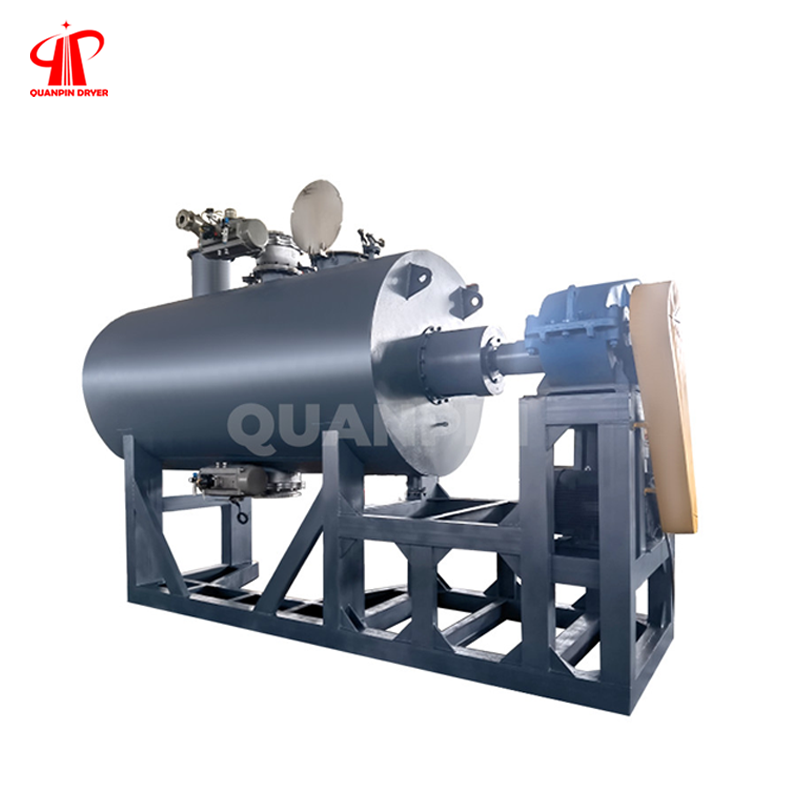
A vacuum rake drying machine brief needs to describe the changing material consistency.
Observe intermediate behavior
Identify stages when the paste adheres to surfaces, forms lumps or changes its response to agitation. Record the time and operating conditions associated with those observations. Do not interpret the initial mixing behavior as proof of complete-cycle suitability. Drying changes both liquid content and the structure of the material.
For a rake type vacuum dryer, record intermediate handling behavior rather than only initial feed properties.
Review heat transfer and vapor removal
Ask how the proposed arrangement supplies heat and removes vapor under the intended conditions. Record temperature and pressure measurement locations. Vapor-system performance and available cooling conditions belong in the proposal boundary. A vacuum pump specification alone does not describe the complete drying system or its ability to handle the material.
A vacuum harrow dryer should be assessed together with the proposed heat supply and vapor-removal arrangement.
Define representative endpoint sampling
Agree on the moisture or residual-liquid method and how samples will represent the discharged batch. Record differences between lumps and finer material if those occur. Keep the sample preparation consistent. A dry surface observation cannot establish that the interior of a product agglomerate has reached the same endpoint.
An agitated vacuum dryer trial requires representative endpoint samples and documented analytical methods.
Inspect discharge and cleaning
Document the normal discharge procedure, retained material and the access needed for cleaning. Assess whether the accepted product can move into the next operation without an unplanned manual step. These observations make the trial useful for a purchasing decision rather than simply showing that some material can be dried.
A vacuum contact dryer proposal should identify discharge and cleaning interfaces.
Prepare a Trial Record That Supports the Decision
| Trial record | What to document |
|---|---|
| Feed | Actual formulation, preparation and batch variation |
| Loading | Defined mass or feed rate and the tested arrangement |
| Operating conditions | Measurement locations, stable periods and planned changes |
| Product | Sample location, analytical method and acceptance result |
| Recovery | Accepted product, retained material and off-specification output |
| System boundary | Included handling, utilities and cleaning operations |
An industrial vacuum dryer is selected around the defined material duty rather than a generic application label.
What Buyers Should Request Before Ordering
Ask the supplier to demonstrate the full consistency change and normal discharge with representative paste. Request observations of sticking, retained material, vapor-system duty and cleaning access.
Frequently Asked Questions
Can a paste be represented by a diluted liquid trial?
Only for a limited preliminary purpose. Dilution changes consistency and drying duty, so complete-cycle suitability requires representative material.
Should drying stop when the material looks powdery?
Appearance can guide observations but is not an analytical endpoint. Use the agreed moisture or residual-liquid test and representative sampling.
Request a Material-Specific Equipment Proposal from QUANPIN
Ready to compare equipment for your material? Send the feed description, required output, product specification and available utilities through our contact page. You can also browse the drying equipment range and visit QUANPIN to learn about the available process routes. Final equipment configuration follows a review of your actual requirements.
Email sales@quanpinmachine.com or call +86 19850785582.