Vacuum Mixing and Drying for Granules: Verify Blend Uniformity and Particle Integrity
By QUANPIN
A combined mixing and drying purchase should deliver both an accepted blend and accepted granules. Verify each duty before committing to a configuration.
Vacuum mixing and drying for granules should be evaluated as two related duties with separate acceptance criteria. A uniform blend does not establish that the material is dry, and a satisfactory moisture result does not establish that each part of the batch has the same composition. The review must also account for changes in granule size.
Review the related QUANPIN drying equipment alongside this guide. Equipment selection should follow the actual material, product targets and installation conditions.
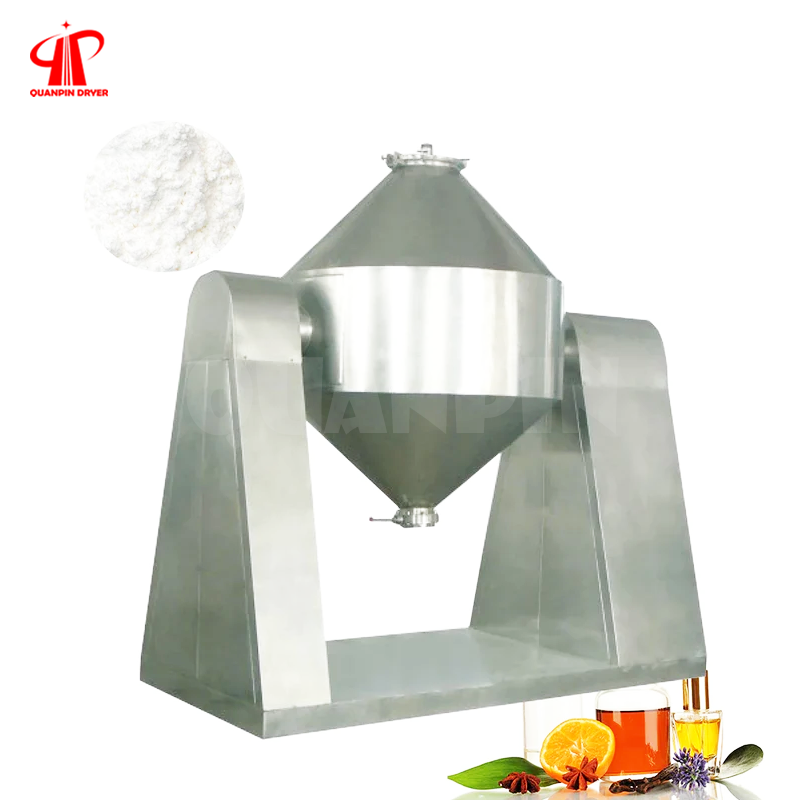
Separate the mixing and drying objectives
Define blend uniformity, remaining moisture and particle integrity independently. Identify the analytical method for each result. If different ingredients respond differently to drying or movement, include that concern in the trial plan. A single average sample can conceal local differences that matter to the final product.
For a double cone vacuum dryer, document the wet material and its movement during the complete batch.
Describe every component of the batch
Record ingredient proportions, wet-state condition, size distribution and the liquid present. Note whether some components adhere, segregate or soften during the process. The supplier should review the actual blend rather than separate easy-to-handle ingredients. Changes during drying may affect movement differently from the initial loading condition.
A rotary vacuum dryer trial needs separate checks of drying endpoint and particle integrity.
Use a sampling plan that tests uniformity
Specify sampling locations or discharge intervals that represent the batch. Keep samples separate before calculating or reporting a combined result. Compare the results with an agreed uniformity criterion. Mixing assessment depends on both sampling and analysis, so a visual inspection alone cannot establish compositional uniformity.
Do not assume that the name vacuum tumble dryer establishes a universally suitable batch load.
Measure the effect on granule size
Check for fines, broken particles or agglomerates using consistent preparation and measurement methods. Record handling steps between drying and analysis. Where downstream filling or dissolution matters, include those tests. Any apparent improvement in dryness should be reviewed alongside a change in the granules’ intended performance.
Assess rotary vacuum drying equipment using representative analytical results and the observed discharge behavior.
Document the complete batch cycle
Record loading, mixing, drying, any cooling requirement and discharge as separate activities. Explain which stages occur under vacuum and which do not. Include retained product and cleaning observations. Comparing only active drying time can overlook an important difference in daily accepted output.
A double conical vacuum dryer proposal should identify the complete cycle and retained-product boundary.
Prepare a Trial Record That Supports the Decision
| Trial record | What to document |
|---|---|
| Feed | Actual formulation, preparation and batch variation |
| Loading | Defined mass or feed rate and the tested arrangement |
| Operating conditions | Measurement locations, stable periods and planned changes |
| Product | Sample location, analytical method and acceptance result |
| Recovery | Accepted product, retained material and off-specification output |
| System boundary | Included handling, utilities and cleaning operations |
An industrial vacuum dryer specification must describe the actual material and tested conditions.
What Buyers Should Request Before Ordering
Request separate acceptance criteria for blend uniformity, remaining liquid and size change. Ask for the sampling plan and the complete loading-to-discharge cycle in the proposal.
Frequently Asked Questions
Can one composite sample prove blend uniformity?
It can describe an average composition, but it cannot reveal differences between sampled parts of the batch. Keep representative samples separate for the uniformity assessment.
Does combined mixing and drying eliminate product segregation?
No universal claim is justified. Assess the actual ingredients, movement and discharge sequence with an appropriate sampling plan.
Request a Material-Specific Equipment Proposal from QUANPIN
Ready to compare equipment for your material? Send the feed description, required output, product specification and available utilities through our contact page. You can also browse the drying equipment range and visit QUANPIN to learn about the available process routes. Final equipment configuration follows a review of your actual requirements.
Email sales@quanpinmachine.com or call +86 19850785582.