Rotary Atomizer vs Pressure Nozzle: Specifying a Spray Dryer Comparison
A rotary atomizer vs pressure nozzle spray dryer comparison should evaluate an entire feed-to-powder system. The atomizer creates droplets, but chamber airflow, feed preparation and powder collection also affect the result. Begin with the same feed properties and powder acceptance limits for both proposals so that differences in scope do not become misleading performance claims.
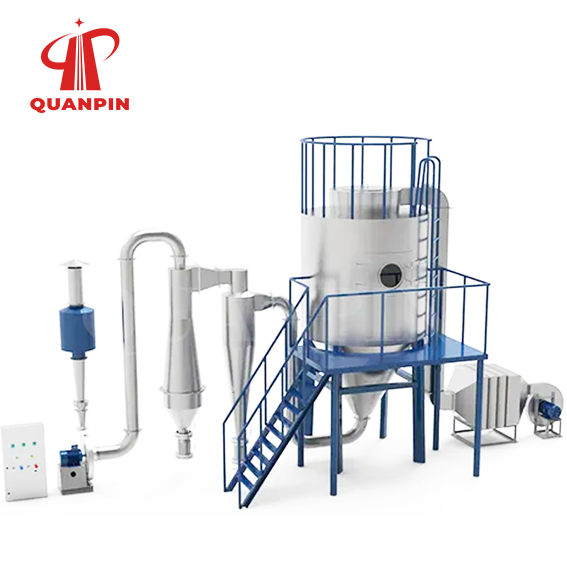
Understand the two atomization routes
A centrifugal spray dryer uses a rotating atomizer to disperse liquid. A pressure spray dryer uses a pumped feed and pressure nozzle. Spraying Systems explains nozzle-based atomization in its spray drying application guidance. Such general technical guidance is useful for defining questions; it does not establish QUANPIN operating limits.
Avoid selecting from a rule such as one method always making a finer powder. Ask the supplier to explain how the proposed atomization arrangement, chamber and feed conditions are intended to meet your particle-size distribution. Require evidence from a representative trial rather than a generic sample from a different material.
Describe the feed the atomizer will receive
Supply solids concentration, viscosity at the intended feed temperature, suspended particle characteristics and whether the mixture settles during holding. Describe upstream filtration and any allowable changes in formulation. If viscosity changes during a production shift, ask how that variation will be represented in the evaluation.
For centrifugal spray dryer design, request the proposed feed delivery and atomizer access arrangements. For the nozzle route, review pumping scope, filtration access and nozzle replacement procedures. Ask which components are expected to wear with your feed and how the supplier will identify that wear. Do not assume that a material described as a slurry is automatically suitable for either route.
Compare powder and operating evidence together
Specify tests for moisture, particle size, bulk density and any relevant product quality attribute. Agree where samples are taken and how recovered powder, wall deposits and fines are counted. A comparison of collected powder quality without a yield boundary can miss material retained elsewhere in the system.
Include start-up, shutdown and cleaning observations in the trial report. Ask how operators access the atomizer or nozzle, isolate the equipment and restore production after maintenance. These details help purchasing teams assess the practical burden of a configuration alongside the powder results.
Request proposals with matched boundaries
Use the equipment catalogue and QUANPIN website to identify candidate systems. Share a spray drying comparison brief containing representative feed data, target powder properties and included auxiliaries. Request a documented trial comparison before choosing the atomization method.