Double Cone Vacuum Dryer for Crystals: Check Attrition and Discharge
By QUANPIN
A low-moisture crystal batch has limited value if drying creates too many fines or leaves product trapped in the vessel.
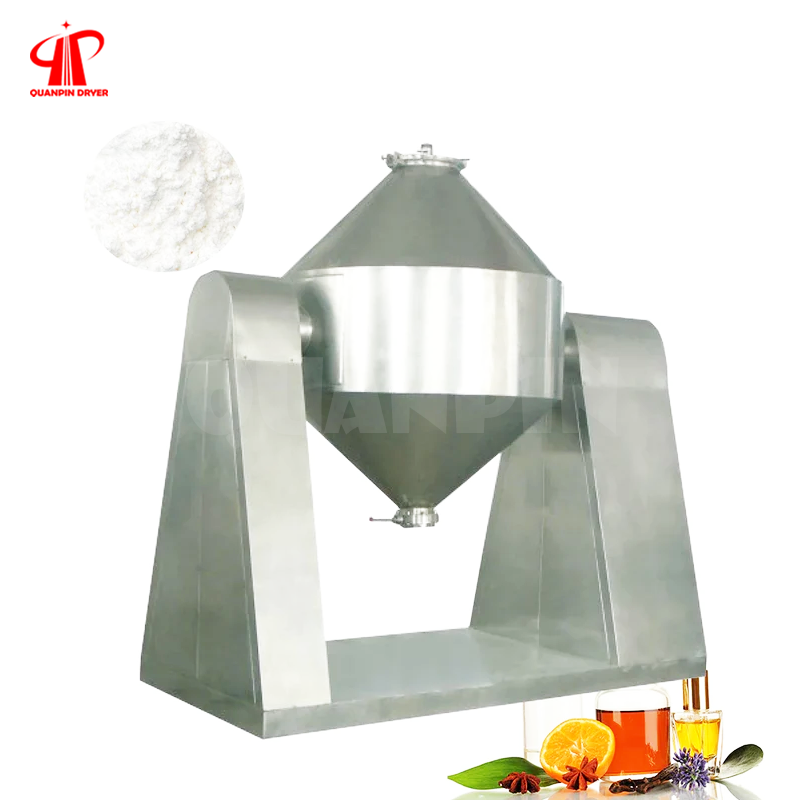
A double cone vacuum dryer for crystals combines reduced-pressure drying with movement of a rotating vessel. That movement must be compatible with the crystal product. Buyers should evaluate drying endpoint, particle integrity and discharge together, because a batch can meet moisture requirements while no longer meeting the required crystal-size specification.
Review the related QUANPIN drying equipment alongside this guide. Equipment selection should follow the actual material, product targets and installation conditions.
Describe the wet crystal condition
Record the liquid present, initial moisture, crystal-size distribution and any tendency to stick or agglomerate. State whether the material is free-flowing or enters as a wet mass. Provide representative wet product rather than only a dry reference sample. Its initial handling behavior influences loading, movement and the drying assessment.
For a double cone vacuum dryer, document the wet material and its movement during the complete batch.
Specify what crystal integrity means
Choose a particle-size method and identify the acceptable changes in fines or coarse material. Where morphology matters, add an appropriate examination procedure. A general statement that tumbling is gentle is not sufficient acceptance evidence. Compare the wet-feed reference and dried product while accounting for differences introduced by sample preparation.
A rotary vacuum dryer trial needs separate checks of drying endpoint and particle integrity.
Review batch loading and movement
Ask the supplier to explain the tested load and operating conditions for the actual material. Document any interruptions or changes during a trial. Avoid treating vessel volume as equivalent to usable batch capacity. Heat transfer, movement and discharge must remain suitable throughout the changing consistency of the product.
Do not assume that the name vacuum tumble dryer establishes a universally suitable batch load.
Connect vacuum readings to the drying endpoint
Document sensor locations, process temperatures and the test used to confirm remaining liquid. A pressure reading alone cannot prove that solvent has been removed to the product specification. Sample representative parts of the discharged batch and preserve the operating record. The endpoint should be an accepted analytical result under a defined method.
Assess rotary vacuum drying equipment using representative analytical results and the observed discharge behavior.
Observe complete discharge and retained product
Record whether crystals bridge, adhere or remain in the vessel after normal discharge. Include recovery and cleaning access in the comparison. A dry sample drawn during the trial cannot demonstrate full-batch discharge performance. The acceptance report should distinguish accepted product from retained or damaged material.
A double conical vacuum dryer proposal should identify the complete cycle and retained-product boundary.
Prepare a Trial Record That Supports the Decision
| Trial record | What to document |
|---|---|
| Feed | Actual formulation, preparation and batch variation |
| Loading | Defined mass or feed rate and the tested arrangement |
| Operating conditions | Measurement locations, stable periods and planned changes |
| Product | Sample location, analytical method and acceptance result |
| Recovery | Accepted product, retained material and off-specification output |
| System boundary | Included handling, utilities and cleaning operations |
An industrial vacuum dryer specification must describe the actual material and tested conditions.
What Buyers Should Request Before Ordering
Ask for particle-integrity measurements and a full discharge observation during a representative trial. Request an explanation of usable batch loading, retained material and the complete cycle.
Frequently Asked Questions
Is a double cone dryer suitable for every fragile crystal?
No. Suitability depends on the material and required integrity. Representative trials should assess size changes and handling alongside the drying result.
Does deeper vacuum always improve drying?
Not automatically. Heat transfer, vapor removal and the product’s behavior also matter. Use a material-specific operating window rather than a universal pressure target.
Request a Material-Specific Equipment Proposal from QUANPIN
Ready to compare equipment for your material? Send the feed description, required output, product specification and available utilities through our contact page. You can also browse the drying equipment range and visit QUANPIN to learn about the available process routes. Final equipment configuration follows a review of your actual requirements.
Email sales@quanpinmachine.com or call +86 19850785582.