Vacuum Tray Dryer Temperature and Pressure: What Buyers Should Specify
Selecting a vacuum tray dryer requires more than choosing a temperature and a vacuum number. Buyers need to define the product’s allowable conditions, where measurements will be taken and how the batch endpoint will be demonstrated. A setting copied from a different material or laboratory arrangement is not a production specification.
Separate product temperature from the heating setting
Heat must reach the material while moisture leaves it. The heating utility or shelf setting does not by itself establish the temperature throughout a loaded batch. Tray contact, material thickness, changing moisture content and the selected heating arrangement affect the process.
Specify the product-quality limits that matter to your application and explain how they will be measured. Ask the supplier to identify sensor positions, available measurements and the limits of each reading. A chamber reading should not be presented as proof that every tray has reached the same product condition.
Describe pressure using an unambiguous basis
When discussing vacuum tray dryer temperature and pressure, state whether a pressure value is absolute or relative to local atmospheric pressure, and include its unit. Otherwise two quotations can appear to offer the same vacuum while describing different quantities.
Reduced pressure can lower the boiling temperature of a liquid, but it does not establish a drying time on its own. Heat supply, vapor transport and the material’s behavior also matter. BUCHI’s thermodynamic discussion explains the pressure–boiling relationship; its freeze-drying cycle settings are not operating instructions for an industrial tray dryer.
Define the tray load that the proposal must support
For a vacuum tray drying machine, supply the planned wet load per tray, layer thickness, tray dimensions and expected variation between batches. Explain whether the feed spreads evenly, forms a skin, shrinks or remains cohesive. These details should inform trials and the proposed loading arrangement.
Record tray positions during a trial and sample more than one location. Decide with the process team how to assess batch uniformity and which analytical method will establish final moisture. Do not accept a single favorable sample as the full acceptance plan.
Review the vapor path and the whole cycle
Vacuum tray drying requires the released vapor to leave the chamber through the specified system. Ask how the vacuum source, connecting pipework and any condenser will be coordinated with the expected vapor load. Identify the liquid being removed rather than assuming that all vapor behaves like water.
Include charging, unloading, cleaning, inspection and any cooling step in the batch schedule. A stationary-tray arrangement involves handling tasks that can affect daily output even when the drying step meets its target. Clarify what is included in the supplier’s estimated cycle.
Agree on a practical acceptance plan
Before requesting a quotation, prepare one shared specification covering feed condition, batch loading, product limits, endpoint tests, utilities and installation constraints. Ask which inputs are verified and which remain provisional.
Compare a rotating-vessel alternative only when tumbling is acceptable for the material. A different handling arrangement may change loading, discharge and cleaning requirements. Use representative feed and the same final-product criteria for the comparison.
Related equipment and project review
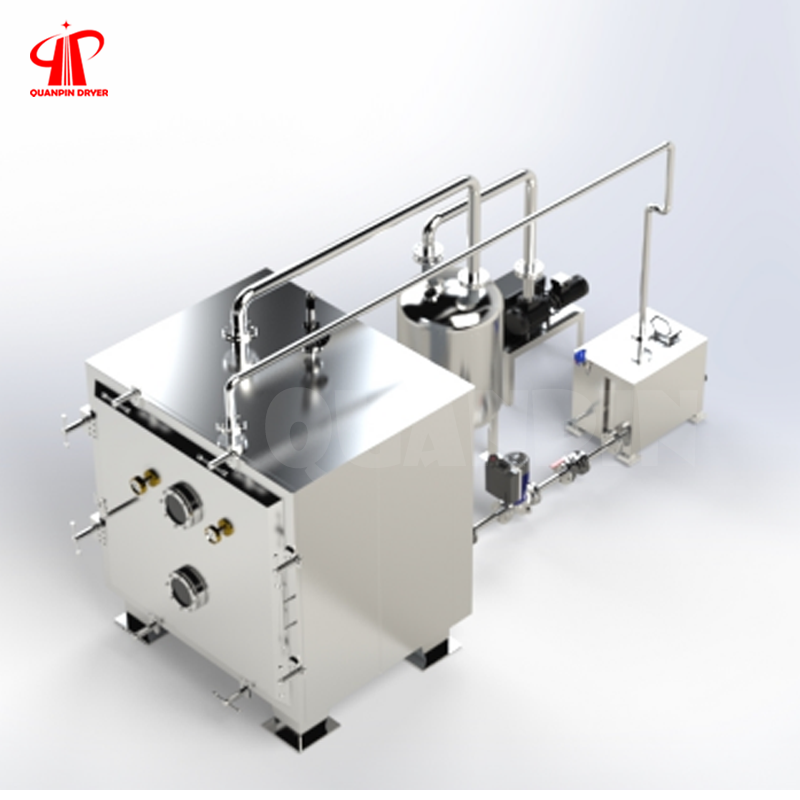
Review QUANPIN’s vacuum tray dryer and the alternative equipment arrangement. Explore the drying equipment range, learn about QUANPIN, or send your process requirements for an application review.
Technical background: BUCHI: thermodynamic background on pressure and boiling temperature. This reference explains a general principle and does not verify QUANPIN-specific performance.