Double Cone Vacuum Dryer: A Buyer’s Checklist for Batch Loading and Discharge
A double cone rotary vacuum dryer should be selected around the complete batch cycle, including charging, tumbling, vapor removal and discharge. A vessel that appears large enough can still be a poor match if the wet material sticks to the wall, changes its flow behavior or cannot leave the outlet in the required form. Buyers should define material handling requirements before comparing nominal vessel sizes.
How the material moves through the batch
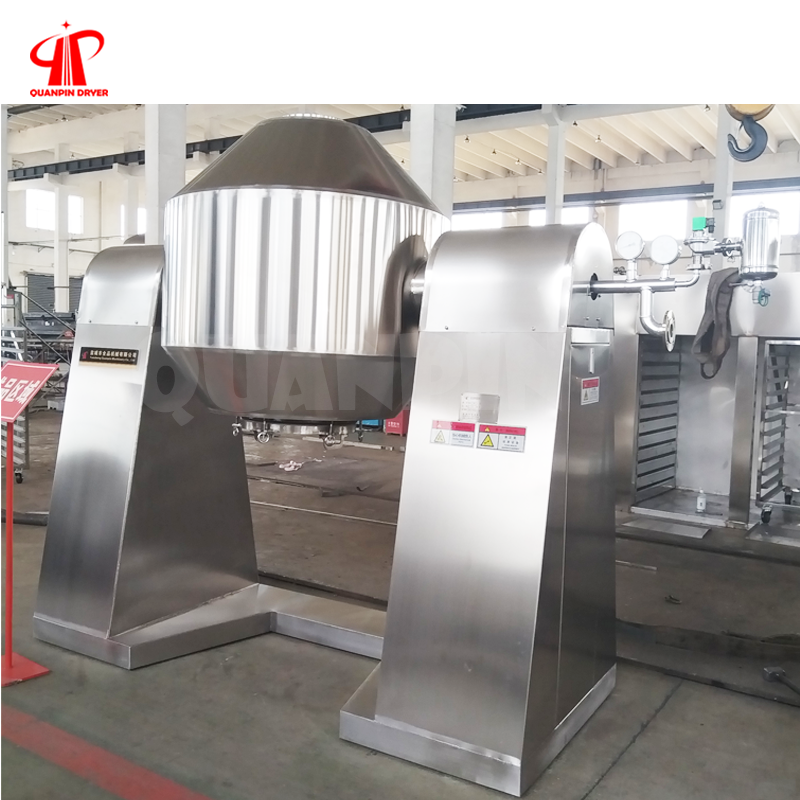
In a double cone vacuum dryer, the vessel rotates while heat enters through the jacket and the vacuum arrangement removes released vapor. The material is redistributed by tumbling rather than by a separate internal rake agitator. QUANPIN’s product description identifies this arrangement for suitable powders and granular materials; suitability must be established for the actual feed.
Describe the incoming material as it will be charged, rather than only listing its chemical name. Include bulk density, particle-size variation, liquid content and whether lumps are present. Record any transition from wet cohesive material to free-flowing powder. A sample of already-dried product cannot demonstrate how the wet batch will move.
Specify usable loading rather than vessel volume alone
Ask the supplier to explain the recommended working load for your material and how it relates to the proposed vessel geometry. Total vessel volume is not the same as usable batch volume. The proposal should identify its assumptions about density, free space for movement and the state of the material during drying.
Calculate the required production schedule from the entire cycle. Charging, heating, drying, cooling where required, unloading, cleaning and inspection all occupy time. Comparing quotes only by the stated drying period can hide a handling constraint that affects daily output.
Make discharge a purchasing requirement
Define the product form needed by the next operation: loose powder, granules or another agreed condition. Describe the receiving container, available access and any need to limit exposure during transfer. Ask how residual material at the outlet and on contact surfaces will be inspected.
For a double cone dryer, discuss the loading and discharge connections, seals, access points and space needed for the vessel to rotate. Confirm that the installation arrangement accommodates both operation and maintenance. Do not assume that a compact equipment footprint includes all handling and service space.
Compare stationary trays when tumbling is undesirable
A vacuum tray dryer keeps material on stationary trays instead of redistributing it through vessel rotation. This may warrant evaluation when mechanical movement is undesirable or a defined layer is needed. Tray loading and unloading create their own labor and process constraints, so neither arrangement is automatically preferable.
Request a representative material trial with agreed acceptance criteria. Assess final moisture, product condition, discharge behavior and cleaning effort. Use the same feed specification and endpoint when comparing alternative equipment.
Information to include in an inquiry
Provide batch mass, bulk density, initial and final moisture, allowable product temperature, liquid identity, available heating utilities and required operating schedule. Include drawings or descriptions of the charging and receiving arrangement. Request the supplier’s technical assumptions alongside the quotation, so unresolved inputs remain visible.
Related equipment and project review
Review QUANPIN’s double cone rotary vacuum dryer and the alternative equipment arrangement. Explore the drying equipment range, learn about QUANPIN, or send your process requirements for an application review.