
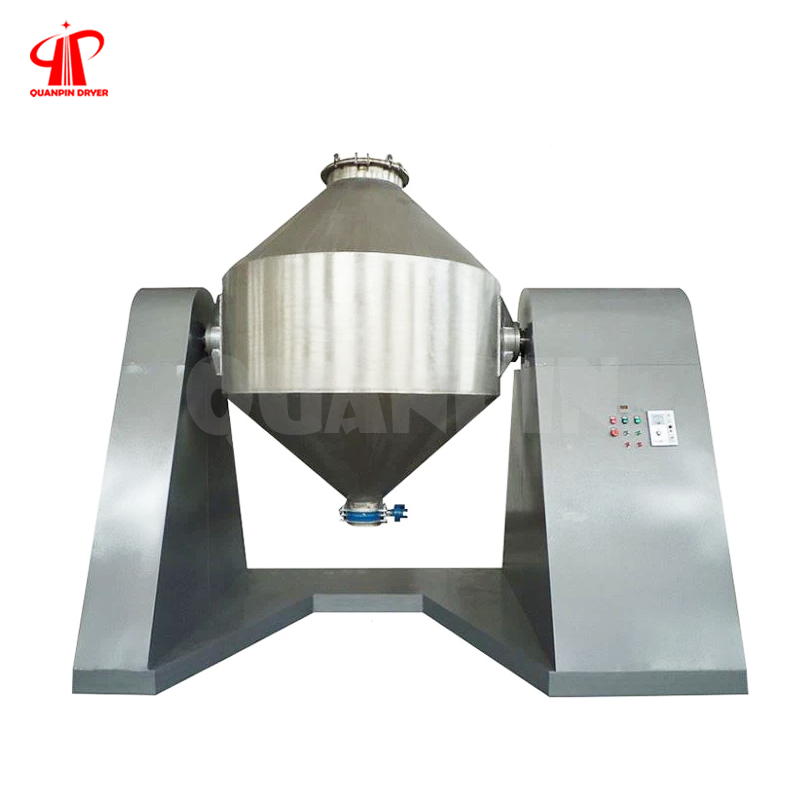
SZG Double Cone Rotary Vacuum Dryer for Food Ingredients: Sodium Citrate Crystals
SZG Double Cone Rotary Vacuum Dryer is evaluated for sodium citrate crystals in food ingredients. The defined feed is washed food-grade citrate crystals. Review the material-specific operating requirements below alongside the original equipment specifications.
Sodium Citrate Crystals: Application and Process Requirements
For sodium citrate crystals, retain the hydrate identity specified for the supplied grade. Start with washed food-grade citrate crystals, and identify the volatile phase and incoming variability before choosing a cycle.
The jacketed double-cone vessel tumbles suitable solids under reduced pressure.
Feed, Quality and Downstream Interface
| Review item | Sodium Citrate Crystals |
|---|---|
| Defined feed | washed food-grade citrate crystals |
| Material-specific focus | retain the hydrate identity specified for the supplied grade |
| Product quality checks | moisture, hydrate identity, particle size and purity |
| Downstream handling | hygienic ingredient packaging |
Loading and Material Movement
Include moisture, hydrate identity, particle size and purity in the trial record. Define the sampling locations and analytical methods before the test; a result from a different grade, loading pattern or residual liquor cannot establish the operating endpoint for this feed.
Drying Endpoint and Acceptance
Compare combined-batch and discharge-fraction samples, recording fines and retained solids.
Material-Specific Configuration
double cone rotary vacuum dryer selection for this feed should be assessed alongside the double cone vacuum dryer process description. Evaluate industrial vacuum dryer and low-temperature vacuum drying with representative sodium citrate crystals. This food vacuum drying application requires a material-specific sampling and acceptance plan.
After the batch meets the agreed specification, arrange hygienic ingredient packaging. Examine the effect of discharge, temporary holding and packaging exposure on the measured product condition. Establish the usable batch and cycle for this material; the original model parameters below remain the equipment reference, not a throughput promise for every formulation.
View the SZG Double Cone Rotary Vacuum Dryer range and original equipment specifications
Technical References for This Application
Integrate the drying step with the site’s hygiene and hazard-control plan. Codex food-hygiene framework.
Specify hygienic product handling, cleaning and packaging for the intended market. FDA food-manufacturing practices.
Distinguish residual moisture from water activity in the finished food. FDA water-activity reference.
Use the actual powder test data when defining dust collection and handling. HSE combustible-dust handling guidance.
Define the heat-transfer duty and utilities rather than assuming a universal drying cycle. U.S. DOE process-heat reference.
Equipment Reference Parameters
These are the SZG Double Cone Rotary Vacuum Dryer model specifications. The operating duty for sodium citrate crystals must be established from the feed and the finished-product requirements above.
| Item | Unit | SZG100 | SZG200 | SZG350 | SZG500 | SZG750 | SZG1000 | SZG2000 | SZG3000 | SZG4000 | SZG5000 | SZG6000 | SZG8000 | SZG10000 |
|---|---|---|---|---|---|---|---|---|---|---|---|---|---|---|
| Total Volume | L | 100 | 200 | 350 | 500 | 750 | 1000 | 2000 | 3000 | 4000 | 5000 | 6000 | 8000 | 10000 |
| Working Volume | L | 50 | 100 | 175 | 250 | 375 | 500 | 1000 | 1500 | 2000 | 2500 | 3000 | 4000 | 5000 |
| Heating Area | m² | 1.16 | 1.5 | 2 | 2.63 | 3.5 | 4.61 | 7.5 | 10.2 | 12.1 | 14.1 | 15.9 | 17.6 | 19.1 |
| Rotational Speed | rpm | 6 | 6 | 6 | 6 | 6 | 6 | 5 | 4 | 4 | 4 | 4 | 4 | 4 |
| Power | kW | 0.75 | 1.1 | 1.5 | 2 | 3 | 3 | 4 | 5.5 | 7.5 | 7.5 | 11 | 15 | 15 |
| Rotational Height | mm | 1810 | 1910 | 2090 | 2500 | 2665 | 2915 | 3055 | 3530 | 3800 | 4180 | 4300 | 4600 | 4900 |
| Machine Weight | kg | 825 | 1050 | 1350 | 1800 | 2070 | 2250 | 3000 | 4500 | 5350 | 6000 | 7600 | 9800 | 12000 |
| Vessel Design Pressure | MPa | −0.09 to −0.096 | −0.09 to −0.096 | −0.09 to −0.096 | −0.09 to −0.096 | −0.09 to −0.096 | −0.09 to −0.096 | −0.09 to −0.096 | −0.09 to −0.096 | −0.09 to −0.096 | −0.09 to −0.096 | −0.09 to −0.096 | −0.09 to −0.096 | −0.09 to −0.096 |
| Jacket Design Pressure | MPa | 0.3 | 0.3 | 0.3 | 0.3 | 0.3 | 0.3 | 0.3 | 0.3 | 0.3 | 0.3 | 0.3 | 0.3 | 0.3 |
| Parameter | Project information |
| Material | Composition, bulk density and handling characteristics |
| Batch size | Required loading quantity and operating schedule |
| Moisture | Initial and target final moisture |
| Temperature | Product temperature limit and available heat source |
| Vacuum | Required process conditions and vapor load |
| Construction | Contact material, seal and cleaning requirements |
| Model | 100 | 350 | 500 | 750 | 1000 | 1500 | 2000 | 3500 | 4500 | 5000 | 8000 |
| Volume inside of tank (L) | 100 | 350 | 500 | 750 | 1000 | 1500 | 2000 | 3500 | 4500 | 5000 | 8000 |
| Practical loading volume (L) | ≤50 | ≤175 | ≤250 | ≤375 | ≤500 | ≤750 | ≤1000 | ≤1750 | ≤2250 | ≤2500 | ≤4000 |
| Rotary speed (r.p.m.) | 3~13 | 6 | 5 | 4 | 4 | 4 | 3.5 | ||||
| Power of motor (kw) | 0.75 | 1.1 | 1.5 | 2.2 | 3 | 4 | 5.5 | 7.5 | 11 | 15 | 37 |
| Occupied area LxW (mm) | 2160×800 | 2260×800 | 2350×800 | 2560×1000 | 2860×1300 | 3060×1300 | 3260×1400 | 3760×1800 | 3960×2000 | 4400×2500 | 4400×2500 |
| Rotating height (mm) | 1750 | 2100 | 2250 | 2490 | 2800 | 2940 | 2990 | 3490 | 4100 | 4200 | 4900 |
| Design pressure inside of tank (MPa) | -0.1~0.15 | ||||||||||
| Design pressure of jacket (MPa) | ≤0.3 | ||||||||||
| Working temperature (°C) | In the tank≤85, Jacket≤140 | ||||||||||
| Model and power of vacuum pump | SK-0.4 1.5KW | SK-0.4 1.5KW | SK-0.8 2.2KW | SK-1.5 4KW | SK-1.5 4KW | SK-3 5.5KW | SK-6 11KW | SK-6 11KW | SK-9 15KW | SK-12 18.5KW | SK-15 22KW |
| Weight (kg) | 800 | 1100 | 1200 | 1500 | 2800 | 3300 | 3600 | 6400 | 7500 | 8600 | 10000 |
Discuss Sodium Citrate Crystals Drying
Send QUANPIN the incoming sodium citrate crystals specification, sample information and the required final product condition for an equipment review.
Start Optimizing Your
Drying Process Today.
Our engineers are ready to assess your material and recommend a reliable, cost-effective drying solution.