Spray Dryer Particle Size Control: Separate Atomization from Powder Measurement
By QUANPIN
If customers reject powder because it fills, disperses or flows poorly, a particle-size number alone is not a sufficient purchasing target.
Spray dryer particle size control requires more than changing an atomizer setting. The feed must form droplets, those droplets must dry, and the recovery system must collect the resulting powder. A meaningful specification identifies which powder fraction will be tested and how its distribution relates to the product’s intended use.
Review the related QUANPIN drying equipment alongside this guide. Equipment selection should follow the actual material, product targets and installation conditions.
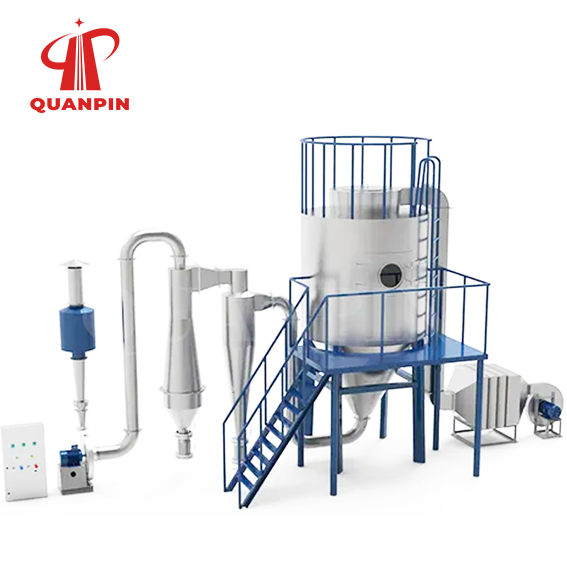
Define a distribution rather than one number
Request an agreed particle-size method and the preparation conditions used before measurement. State whether agglomerates should remain intact or be dispersed for testing. Two measurements using different dispersion procedures may describe different aspects of the same powder. The acceptable distribution should reflect handling or application requirements rather than an unexplained average diameter.
The spray drying route should be assessed with the actual formulation and the customer’s product tests.
Characterize the feed supplied to the atomizer
Record viscosity, solids and temperature, together with the preparation and holding procedure. Check settling or changes in consistency during the run. Droplet formation depends on the material entering the atomizer, so unstable feed can undermine a supposedly fixed operating setting. Keep a feed sample alongside the collected powder for the trial record.
An industrial spray dryer proposal needs a clearly stated feed and evaporation basis.
Review atomization within the whole system
Nozzle configuration or rotary atomizer operation should be considered with chamber geometry and drying conditions. Smaller droplets do not automatically produce a better product. Finer powder may change recovery demands and bulk behavior, while larger droplets may require different drying exposure. Establish the tradeoff with product measurements rather than a generic preference for fineness.
A rotary atomizer spray dryer should be reviewed alongside the feed condition and the complete recovery arrangement.
Sample all relevant collected fractions
Identify chamber discharge, cyclone collection and filter fines separately when evaluating the distribution. A sample from only one location may omit a significant fraction of the material. If streams are recombined, test the actual combined product. Link each result to its collection location so that the reported particle size can be reproduced.
Compare spray drying equipment using samples from the defined finished-product boundary.
Tie size to the customer’s performance test
Evaluate whether the measured change improves dissolution, flow, filling or the customer’s downstream operation. Include moisture and recovery in the comparison. A narrow size distribution is not useful if it causes unacceptable deposition or poor finished-product function. Select an operating window that satisfies the complete specification.
A spray drying system should document how changes are monitored, tested and recorded.
Prepare a Trial Record That Supports the Decision
| Trial record | What to document |
|---|---|
| Feed | Actual formulation, preparation and batch variation |
| Loading | Defined mass or feed rate and the tested arrangement |
| Operating conditions | Measurement locations, stable periods and planned changes |
| Product | Sample location, analytical method and acceptance result |
| Recovery | Accepted product, retained material and off-specification output |
| System boundary | Included handling, utilities and cleaning operations |
The spray drying plant project should include handling and cleaning requirements as well as the drying chamber.
What Buyers Should Request Before Ordering
Request powder samples from the agreed finished-product stream and the complete distribution method. Ask how atomization, fines recovery and the operating window will be reviewed together.
Frequently Asked Questions
Are droplet size and powder particle size identical?
No. Drying changes the liquid droplet as solids concentrate and particles form. The finished powder must be measured directly.
Can a single mean size describe powder suitability?
Usually it cannot describe the full distribution or its coarse and fine fractions. Use a defined distribution and the product’s relevant functional tests.
Request a Material-Specific Equipment Proposal from QUANPIN
Ready to compare equipment for your material? Send the feed description, required output, product specification and available utilities through our contact page. You can also browse the drying equipment range and visit QUANPIN to learn about the available process routes. Final equipment configuration follows a review of your actual requirements.
Email sales@quanpinmachine.com or call +86 19850785582.