
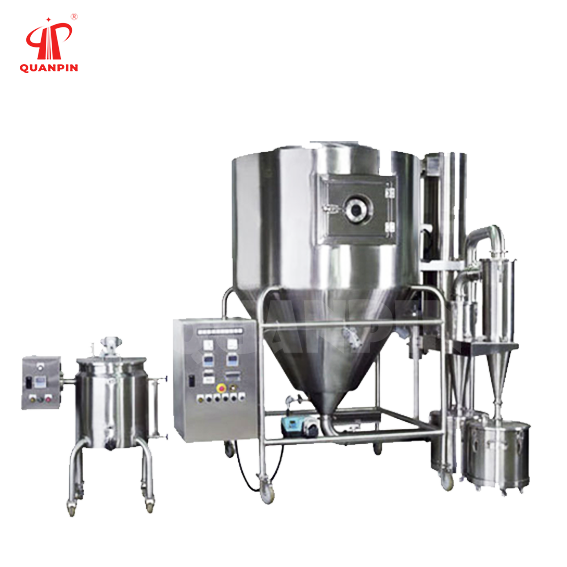
LPG Centrifugal Spray Dryer for Chemical and Mineral Processing: Alumina Ceramic Granules
LPG Centrifugal Spray Dryer is evaluated for alumina ceramic granules in chemical and mineral processing. The defined feed is aqueous alumina slurry with a specified binder formulation. Match this duty to the material checks below and the unchanged original equipment parameters.
Alumina Ceramic Granules: Application and Process Requirements
For alumina ceramic granules, control slurry dispersion and granule strength for ceramic pressing. Begin with aqueous alumina slurry with a specified binder formulation and confirm how the incoming grade varies before defining the drying cycle.
Feed, Product Quality and Downstream Handling
| Review item | Alumina Ceramic Granules |
|---|---|
| Defined feed | aqueous alumina slurry with a specified binder formulation |
| Material-specific focus | control slurry dispersion and granule strength for ceramic pressing |
| Product checks | granule size, residual moisture, apparent density and binder distribution |
| Downstream handling | protected granule transfer to ceramic pressing and subsequent firing |
Material Movement and Drying Control
Include granule size, residual moisture, apparent density and binder distribution in the trial record. Fix the sampling locations and analytical methods before comparing trials; feed preparation and cooling can affect the measured result.
Drying Endpoint and Product Acceptance
After acceptance, arrange protected granule transfer to ceramic pressing and subsequent firing. Review discharge, temporary holding and packaging exposure as part of the moisture-control plan.
Application-Specific Equipment Selection
LPG Centrifugal Spray Dryer selection for alumina ceramic granules starts with Centrifugal Spray Dryer requirements and the defined feed. Assess High Speed Centrifugal Spray Dryer and Spray Drying together with Spray drying equipment; the chemical powder drying duty must be demonstrated using representative material and the required finished-product specification.
View the LPG Centrifugal Spray Dryer range and original equipment specifications
Technical References for This Application
Obtain the SDS for the actual grade and residual process liquor. HSE safety-data-sheet guidance.
Assess charging, sampling, cleaning and discharge for the selected material. HSE exposure-assessment guidance.
Review the dust characteristics of the collected dry material. HSE combustible-dust guidance.
Review operation and maintenance around the specified equipment configuration. HSE work-equipment guidance.
Review the thermal duty and utilities for the actual feed. U.S. DOE process-heat reference.
Equipment Reference Parameters
These are the LPG Centrifugal Spray Dryer model specifications. The operating duty for alumina ceramic granules must be established from the feed and the finished-product requirements above.
| Specification | Selection basis |
| Product-contact material | Selected for the feed chemistry and cleaning procedure |
| Feed rate | Determined by feed solids, evaporation load and required output |
| Drying duty | Application-specific water removal and outlet moisture target |
| Atomization | Centrifugal, pressure-nozzle or two-fluid configuration |
| Heating and controls | Matched to available utilities and process requirements |
| Documentation | Confirmed with the project specification |
| Model | LPG-5 | LPG-25 | LPG-50 | LPG-100 | LPG-150 | LPG-200–10000 |
|---|---|---|---|---|---|---|
| Inlet-Air Temperature (°C) | 140–350, automatic control | 140–350, automatic control | 140–350, automatic control | 140–350, automatic control | 140–350, automatic control | 140–350, automatic control |
| Outlet-Air Temperature (°C) | Approx. 80–90 | Approx. 80–90 | Approx. 80–90 | Approx. 80–90 | Approx. 80–90 | Approx. 80–90 |
| Maximum Water Evaporation (kg/h) | 5 | 25 | 50 | 100 | 150 | 200–10000 |
| Centrifugal Atomizer Drive | Compressed-air drive | Mechanical drive | Mechanical drive | Mechanical drive | Mechanical drive | Mechanical drive |
| Atomizer Speed (rpm) | 25000 | 18000 | 18000 | 18000 | 15000 | 8000–15000 |
| Atomizer Disc Diameter (mm) | 50 | 100 | 120 | 140 | 150 | 180–340 |
| Heat Source | Electricity | Electricity + steam | Electricity + steam, fuel oil or coal gas | Electricity + steam, fuel oil or coal gas | Electricity + steam, fuel oil or coal gas | Determined by the user |
| Maximum Electric-Heater Power (kW) | 9 | 36 | 63 | 81 | 99 | — |
| Overall Dimensions (L×W×H) (m) | 1.8×0.93×2.2 | 3×2.7×4.26 | 3.7×3.2×5.1 | 4.6×4.2×6 | 5.5×4.5×7 | Determined according to the project |
| Powder Recovery (%) | ≥95 | ≥95 | ≥95 | ≥95 | ≥95 | ≥95 |
| Atomization method | Key considerations | Typical selection questions |
| Pressure nozzle | Pump and nozzle conditions | Is the feed stable and suitable for the nozzle? |
| Centrifugal | Atomizer operation and chamber layout | What powder characteristics and capacity are needed? |
| Two-fluid nozzle | Atomizing gas and feed delivery | What are the trial scale and gas requirements? |
Equipment Views
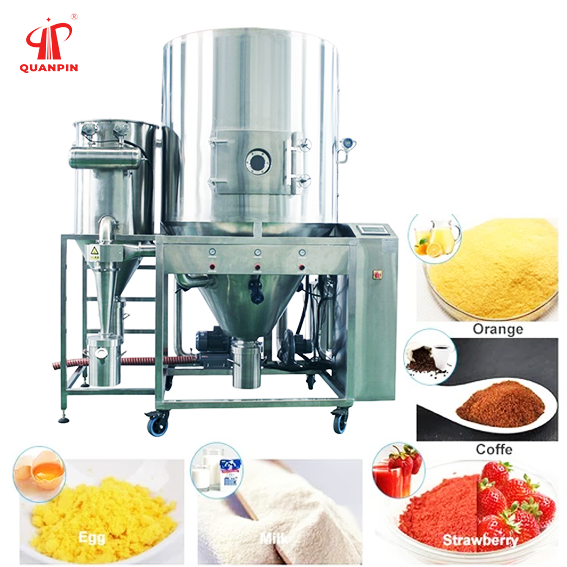
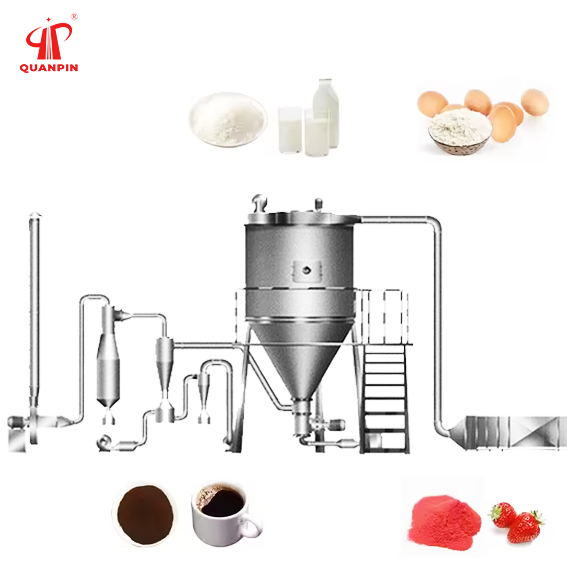
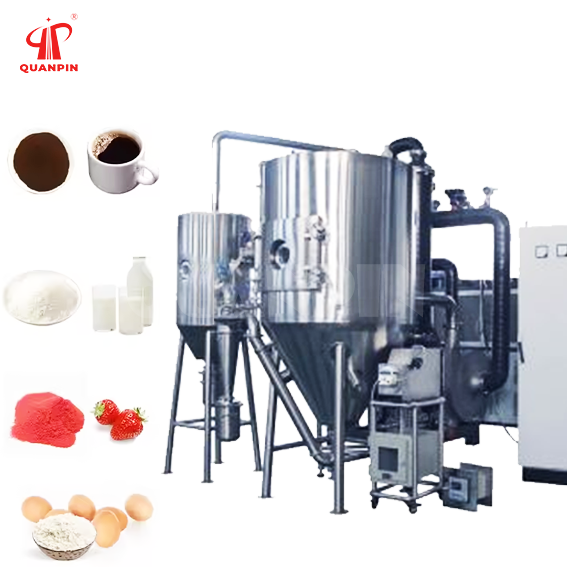
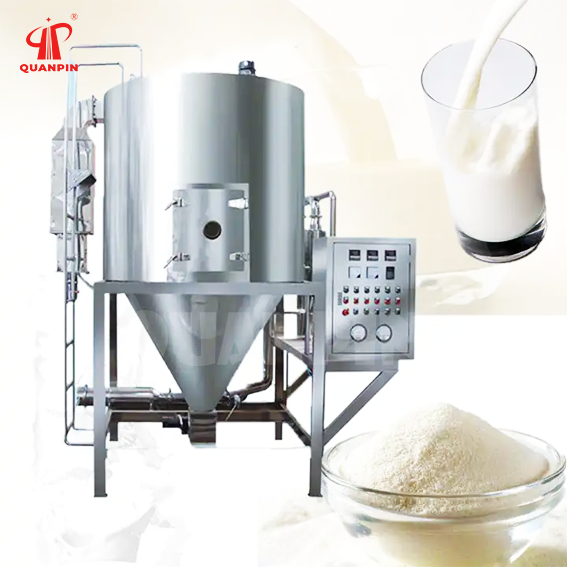
Discuss Alumina Ceramic Granules Drying
Send QUANPIN the incoming alumina ceramic granules specification, sample information and the required final product condition for an equipment review.
Start Optimizing Your
Drying Process Today.
Share your material and production requirements with our engineering team.