Centrifugal Spray Dryer Quotation: Feed Data and Powder Targets Buyers Need
A centrifugal spray dryer price is meaningful only when the quotation is based on a defined feed and finished-powder specification. The same requested powder output can involve different liquid-removal duties when feed solids change. Buyers should provide a consistent data sheet to every supplier before comparing equipment prices.
Describe the liquid at the dryer inlet
Identify whether the feed is a solution, emulsion or suspension, and provide measured solids content, density, viscosity and relevant temperature conditions. For suspensions, describe particle behavior and any settling or agglomeration observed. Explain how the feed is prepared and delivered to the drying system.
QUANPIN describes centrifugal spray drying as rotating atomization for suitable liquid feeds. Suitability depends on the feed and powder targets. Ask the supplier which properties require a material trial instead of assuming that every pumpable liquid behaves the same way.
Keep feed rate and powder output distinct
List the wet feed rate, required dry-solids output and finished-product moisture separately. Provide a normal operating range and any expected variation. This allows the supplier to state a liquid-removal duty and explain the assumptions used in sizing.
Do not calculate a production guarantee from a model name or a chamber size. The proposal should connect the stated duty with the actual feed specification, available utilities and agreed product endpoint. Any estimated value should remain clearly identified until validated.
Define powder quality before choosing atomization
For centrifugal spray dryer design, specify the powder attributes that affect its use: final moisture, particle-size requirements, bulk behavior and any quality tests appropriate to the product. Identify temperature-sensitive components and explain downstream packaging or handling.
GEA’s conventional spray-dryer description lists rotary atomizer and nozzle options, supporting the need to compare atomization arrangements. A pressure nozzle spray dryer is an alternative to evaluate against the same feed and powder requirements; it is not automatically an interchangeable replacement.
Check collection, cleaning and supply boundaries
Ask how the proposed collection arrangement relates to the powder specification and what losses or retained material must be measured during acceptance. Define the recovery boundary and explain whether fines can be reused. Do not confuse visible powder production with a verified collection yield.
State the cleaning method, product changeover requirements and access needs. Request a supply-scope list covering feed preparation interfaces, atomization, drying air, collection, controls and the connections expected from the buyer. Missing auxiliary equipment can materially change a quote comparison.
Make trials and quotation assumptions traceable
Provide representative material and agree on the trial observations in advance. Record actual feed properties, operating conditions, collected powder and the analytical results relevant to the target product. Ask how the trial arrangement differs from the proposed production system.
A useful quotation distinguishes confirmed requirements from estimates, identifies outstanding tests and sets an acceptance basis. Send QUANPIN the feed sheet, production target, quality criteria, utilities and layout constraints to begin a technical review.
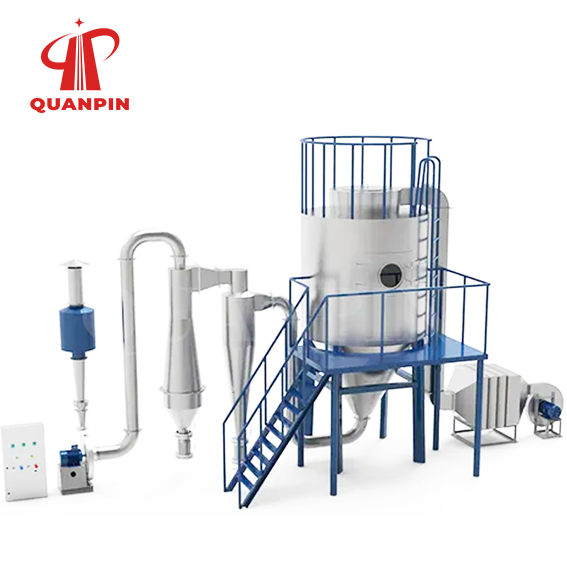
Related equipment and project review
Review QUANPIN’s centrifugal spray dryer and the alternative equipment arrangement. Explore the drying equipment range, learn about QUANPIN, or send your process requirements for an application review.
Technical background: GEA: conventional spray-dryer atomization options. This reference explains a general principle and does not verify QUANPIN-specific performance.