Rotating Flash Dryer: Separate Pigment Moisture Basis from Evaporation-Duty Estimates
By QUANPIN
A pigment drying enquiry needs an unambiguous moisture basis. Distinguish water as a fraction of total wet material from water expressed relative to dry solids before discussing evaporation duty. A spin flash dryer trial must connect feed dispersion with the required pigment application.
This guide concerns the XSG rotating flash-dryer application review and the feed information needed for a meaningful material balance. See the matching chemical industry applications.
What Does the Reported Pigment Moisture Percentage Mean?
State the moisture definition, units and measured feed basis. Preserve the analytical method and identify which volatile material the result represents.
An isolated percentage is insufficient for an evaporation estimate when its denominator or material basis is unclear.
Equipment Principle and Material Requirements
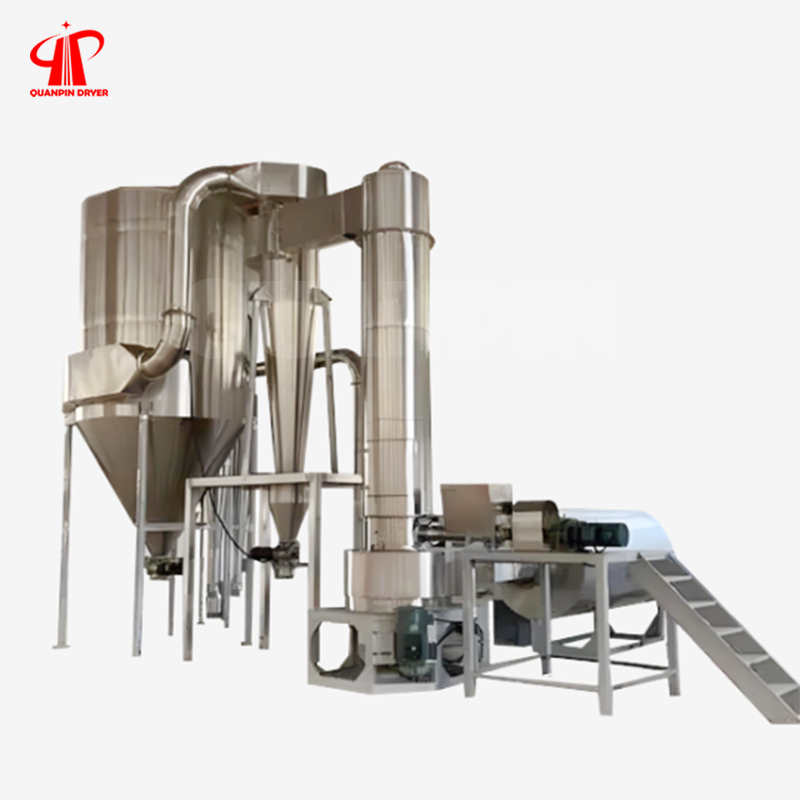
The rotating flash dryer combines material dispersion with hot-air drying in its specified processing arrangement.
The wet pigment duty includes feed form, preparation and required final product, rather than moisture percentage alone.
Five Steps for the Application Study
Identify pigment feed form
Identify the actual pigment feed and whether its form matches the proposed delivery and dispersion arrangement.
Define incoming moisture
State the incoming moisture definition and the basis of the measured feed quantity.
State the product basis
Define the target product moisture using the same clearly identified material basis.
Review the material balance
Review the solids and volatile balance with the complete feed and recovery boundary.
Separate estimate from demonstration
Use the clarified duty for supplier review without treating a preliminary balance as demonstrated equipment capacity.
Four Process Boundaries to Record
The feed boundary identifies material entering the agreed drying system.
The moisture boundary defines the measured volatile content and its denominator.
The recovery boundary distinguishes accepted product, other collected material and unaccounted losses.
The thermal boundary includes additional design information beyond a water-removal estimate.
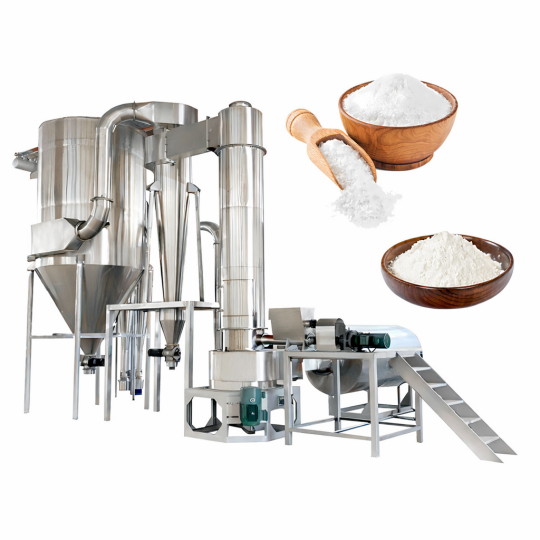
Rotating Flash Dryer Components and Interfaces
Wet cake feeder
Confirm the feed-delivery and breakup arrangement from the actual equipment specification. Compare spin flash dryer price quotations on the same feed preparation, recovery and installation boundary.
Rotating dispersion system
Identify the drying and dispersion assembly included in the proposed configuration. Do not treat this wet-cake trial as evidence for every slurry drying duty; feed form and delivery must match.
Drying chamber
Describe the powder separation and collection components within the supply scope.
Gas heating and transport
Review the means of obtaining representative feed and product samples.
Powder recovery
Record the analytical methods used to determine moisture or other relevant volatile content.
Discharge and application sampling
Keep preliminary balance assumptions connected to the equipment enquiry and subsequent trial results.
Comparison Choices and Process Interfaces
Define the Reference Basis
Begin with a stated feed quantity and an explicit moisture basis. The powder drying result must include the intended coating, ink or polymer preparation method.
Identify the solids basis that connects the incoming material with the desired product.
Keep measurement uncertainty and unaccounted losses visible in the preliminary calculation.
Keep the Comparison Interpretable
When comparing another duty, resolve the moisture definition before comparing percentages or throughput.
Do not treat a wet-basis and dry-basis percentage as numerically interchangeable.
If the material contains other volatiles, review what the analytical method measures rather than assuming all loss is water.
Assess the Receiving Process
Assess the actual pigment product against the required quality attributes after drying. For chemical powder drying, a low moisture result and a satisfactory application result are separate acceptance questions.
Keep evaporation-duty estimates separate from demonstrated collection yield and emissions performance.
Use a product-specific trial and engineering review to resolve the remaining process questions.
Industry Application and Acceptance
Chemical pigment applications require material identity, hazard information and product acceptance criteria appropriate to the actual pigment. Review the actual material hazard information before defining the pigment duty. See HSE safety data sheets.
Moisture targets should be considered alongside properties relevant to the customer’s intended formulation or use. Keep chemical classification, labels and material safety information appropriate to the actual pigment. See HSE chemical classification resources.
Powder-quality acceptance does not establish workplace extraction performance or environmental compliance. Identify potentially applicable site requirements independently from powder-quality acceptance. See EPA chemical-production emissions resources.
Applicable site requirements need their own review within the installation’s jurisdiction and process scope.
Benefits and Practical Limits
A defined moisture basis reduces ambiguity when different teams discuss the same feed. Compare Industrial drying equipment using the same prepared feed and finished-product test.
It does not establish heat demand, safe operating conditions or equipment throughput without the remaining engineering inputs.
Six Details That Affect the Result
Write the moisture definition beside the value rather than relying on an unstated convention.
Identify whether the feed quantity is total wet material or dry solids.
Record the analytical method and the actual sample identity.
Distinguish a target product condition from a measured trial result.
Reconcile collected fractions when evaluating a demonstrated drying run.
Retain preliminary assumptions so later revisions do not appear as unexplained capacity changes. Workplace extraction needs its own design and assessment. See HSE local exhaust ventilation resources.
Safety and Operating Requirements
Review the pigment safety data and relevant dust or volatile hazards before defining a trial.
Operating temperature, extraction and protective measures require assessment of the actual material and installed system. Assess relevant combustible-dust hazards using the actual pigment and process. See HSE dangerous substances and combustible dust guidance.
Prepare Your Equipment Enquiry
Provide QUANPIN with the pigment feed form, quantity basis, moisture definitions and desired product attributes. Ask a Spin Flash Dryer Manufacturer to document the demonstrated material range, not just nominal throughput.
Include available analytical records and identify the recovery and site-service boundaries required for the enquiry. A spin flash dryer supplier enquiry should include the pigment recipe test, collection boundary and real utility constraints.
Frequently Asked Questions
How do wet-basis and dry-basis moisture differ?
Wet-basis moisture uses total wet material as its denominator; dry-basis moisture uses dry solids.
Can an undefined percentage support a balance?
A moisture percentage without its basis should be clarified before it is used in a balance.
Does estimated evaporation establish machine throughput?
An evaporation estimate is not a demonstrated throughput rating for the selected machine.
Does loss on drying always mean water?
Loss-on-drying information should be interpreted through its method and material context rather than automatically called water content.
Does powder acceptance establish emissions compliance?
An acceptable powder sample does not independently establish emissions or dust-extraction compliance.
What basis should a supplier enquiry state?
A useful supplier enquiry states the material and calculation basis before requesting a capacity or price comparison.
Discuss Your Rotating Flash Dryer Application with QUANPIN
Discuss your application with Rotating Flash Dryer specialists at QUANPIN. Use the enquiry below or our contact page.
Email sales@quanpinmachine.com or stacie@quanpinmachine.com. Call +86 19850785582, or contact us on WhatsApp: +86 15921493205.