
Mixing Equipment / DSH
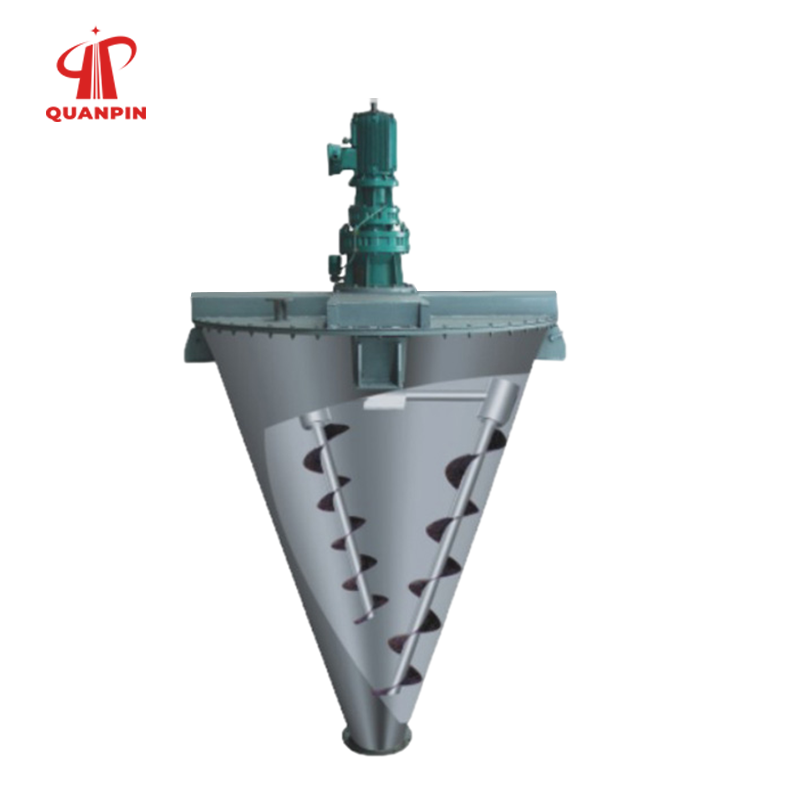
DSH Series Double-Screw Conical Mixer for Food and Pharmaceutical Powder Blending
Model: DSH
A double-screw conical mixer combines screw conveying with movement around a conical vessel to circulate a powder batch. Assess this powder mixer as part of the complete mixing equipment scope, with representative dry blending and granule blending trials to check uniformity and handling after discharge.
Working Principle
The screws turn on their own axes while moving around the vessel. Material is lifted along the screws and redistributed through the surrounding batch, creating circulation across different regions of the cone.
Key Features
- Screws combine axial rotation with movement around the vessel.
- Upward screw conveying supports circulation in the cone.
- Drive, screw and discharge configuration are reviewed together.
Suitable Materials
- Powder mixtures that are compatible with screw-driven circulation. Evaluate cohesive components, large density differences and any sensitivity to mechanical action through a representative material trial.
- Confirm the actual material properties, moisture or solvent content, temperature sensitivity and target product condition before selecting the configuration.
Applications
Consider conical screw mixing for powder formulations requiring circulation through a conical vessel. Review low-dose ingredients, density differences and the cleaning requirements for product changes.
Discuss your application with QUANPIN through our industries page or the inquiry form below.
Technical Parameters
On smaller screens, swipe the table sideways to view all models and values.
| Item | Unit | DSH0.3 | DSH0.5 | DSH1 | DSH2 | DSH4 | DSH6 | DSH10 |
|---|---|---|---|---|---|---|---|---|
| Total Volume | m³ | 0.3 | 0.5 | 1 | 2 | 4 | 6 | 10 |
| Loading Coefficient | — | 0.4–0.6 | 0.4–0.6 | 0.4–0.6 | 0.4–0.6 | 0.4–0.6 | 0.4–0.6 | 0.4–0.6 |
| Mixed-Particle Size | μm | 40–3000 | 40–3000 | 40–3000 | 40–3000 | 40–3000 | 40–3000 | 40–3000 |
| Operating Conditions | — | Ambient temperature and pressure; dust-tight | Ambient temperature and pressure; dust-tight | Ambient temperature and pressure; dust-tight | Ambient temperature and pressure; dust-tight | Ambient temperature and pressure; dust-tight | Ambient temperature and pressure; dust-tight | Ambient temperature and pressure; dust-tight |
| Batch Capacity at ρ = 1 g/cm³ | kg | 180 | 300 | 600 | 1200 | 2400 | 3600 | 6000 |
| Power | kW | 2.2 | 2.2 | 5.5 | 5.5 | 11 | 20.7 | 30.7 |
| Mixing Time | min | 4–10 (determined by testing for special materials) | 4–10 (determined by testing for special materials) | 4–10 (determined by testing for special materials) | 4–10 (determined by testing for special materials) | 4–10 (determined by testing for special materials) | 4–10 (determined by testing for special materials) | 4–10 (determined by testing for special materials) |
| Total Weight | kg | 500 | 1000 | 1200 | 1500 | 2800 | 3500 | 4500 |
Confirm the selected model, material properties and required options with QUANPIN before ordering. Final installation dimensions and equipment scope are defined in the approved technical documents.
Frequently Asked Questions
What is the DSH mixer designed to do?
A double-screw conical mixer combines screw conveying with movement around a conical vessel to circulate a powder batch.
What information is needed for model selection?
Provide batch volume, bulk density, component ratios and flow behaviour. Confirm screw and drive configuration, discharge requirements, cleaning access and any specified sealing or protection needs. Establish uniformity using an agreed sampling method.
How should mixing performance be evaluated?
Agree the formulation, batch size, sampling procedure and acceptable variation before a trial. Evaluate the discharged blend as well as the material in the vessel, because subsequent handling can affect segregation.
Selection and Configuration
For a configuration review, send the material name, bulk density, particle-size distribution, moisture level, batch mass and required blending endpoint. Working volume, drive rating, contact materials, sealing and discharge details are confirmed for the selected configuration; no numerical model rating is implied by this overview.
Discuss Your Mixing Requirements
Tell us about your material, batch size, cleaning requirements and production layout.
Application Review: Food and Pharmaceutical Powder Blending
Define the ingredients, particle-size distribution, working fill and sampling method for the proposed blend. Check uniformity after discharge as well as within the vessel.
For pharmaceutical process evaluation, consult FDA process validation guidance.
For pharmaceutical cleaning requirements, consult the FDA equipment and cleaning questions.
For food ingredients, review the Codex food hygiene and HACCP framework when defining hygienic handling.
Review the actual powder characteristics using the HSE safe handling of combustible dusts.
Include moving-part access in the installation review using HSE work equipment and guarding guidance.
Discuss Your
Mixing Process Today.
Share your formulation, batch size and blending target with our engineers to discuss a suitable mixing configuration.