
Mixing Equipment / HLD
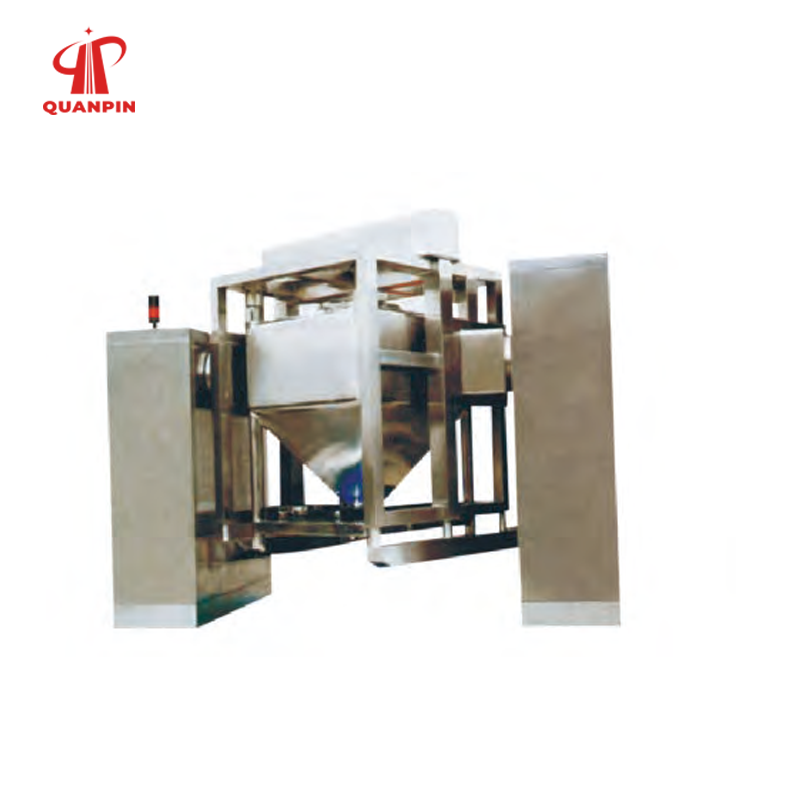
HLD Series Hopper Mixer for Food and Pharmaceutical Powder Blending
Model: HLD
A hopper mixer blends a batch in its own vessel and supports a workflow built around removable mixing containers. Assess this powder mixer as part of the complete mixing equipment scope, with representative dry blending and granule blending trials to check uniformity and handling after discharge.
Product Overview
A hopper mixer blends a batch in its own vessel and supports a workflow built around removable mixing containers.
Working Principle
The loaded hopper is clamped within a rotating frame. As the assembly turns, the material rolls, divides and recombines under gravity. After blending, the hopper can be released for the agreed transfer or discharge arrangement.
Key Features
- The batch is blended within a clamped hopper.
- Rotation produces gravity-driven rolling and redistribution.
- Removable-container handling can connect the agreed process steps.
Suitable Materials
- Dry powders and granules suited to container tumbling, particularly where batch handling needs to be considered together with mixing.
- Confirm the actual material properties, moisture or solvent content, temperature sensitivity and target product condition before selecting the configuration.
Applications
Consider hopper blending for batch formulation and final blending of suitable pharmaceutical solids, food ingredients or chemical powders. Container handling between loading, blending and discharge should be reviewed as one process.
Discuss your application with QUANPIN through our industries page or the inquiry form below.
Technical Parameters
On smaller screens, swipe the table sideways to view all models and values.
| Item | Dimension | HLD800 | HLD1000 | HLD1200 | HLD1500 | HLD2000 |
|---|---|---|---|---|---|---|
| Hopper Volume (L) | — | 800 | 1000 | 1200 | 1500 | 2000 |
| Maximum Filling Coefficient | — | ≤80% | ≤80% | ≤80% | ≤80% | ≤80% |
| Maximum Filling Weight (kg) | — | 400 | 500 | 620 | 750 | 1000 |
| Motor Power (kW) | — | 7 | 7 | 7 | 9.7 | 9.7 |
| Main-Shaft Speed (rpm) | — | 1–12 | 1–12 | 1–12 | 1–12 | 1–12 |
| Total Weight (kg) | — | 2500 | 2800 | 3000 | 3500 | 4000 |
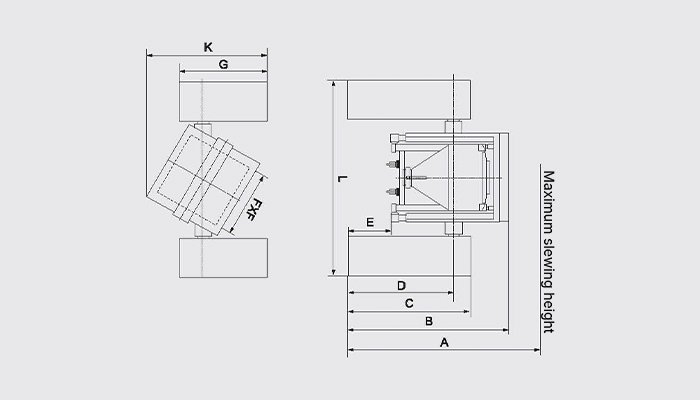
| Overall Dimensions (mm) | A | 2800 | 2850 | 2950 | 3175 | 3530 |
| Overall Dimensions (mm) | B | 2100 | 2200 | 2300 | 2500 | 2960 |
| Overall Dimensions (mm) | C | 1650 | 1750 | 1800 | 1960 | 2140 |
| Overall Dimensions (mm) | D | 1400 | 1450 | 1500 | 1640 | 1840 |
| Overall Dimensions (mm) | E | 400 | 400 | 400 | 500 | 600 |
| Overall Dimensions (mm) | F | 1000 | 1100 | 1200 | 1250 | 1400 |
| Overall Dimensions (mm) | G | 1400 | 1400 | 1400 | 1450 | 1500 |
| Overall Dimensions (mm) | L | 3050 | 3300 | 3400 | 3550 | 3680 |
| Overall Dimensions (mm) | K | 2000 | 2150 | 2150 | 2200 | 2320 |
Confirm the selected model, material properties and required options with QUANPIN before ordering. Final installation dimensions and equipment scope are defined in the approved technical documents.
Frequently Asked Questions
What is the HLD mixer designed to do?
What information is needed for model selection?
Match hopper volume and working fill to batch mass and bulk density. Confirm container interchangeability, loading access, discharge height and cleaning arrangements; evaluate segregation during transfer as well as blend uniformity.
How should mixing performance be evaluated?
Agree the formulation, batch size, sampling procedure and acceptable variation before a trial. Evaluate the discharged blend as well as the material in the vessel, because subsequent handling can affect segregation.
Selection and Configuration
For a configuration review, send the material name, bulk density, particle-size distribution, moisture level, batch mass and required blending endpoint. Working volume, drive rating, contact materials, sealing and discharge details are confirmed for the selected configuration; no numerical model rating is implied by this overview.
Discuss Your Mixing Requirements
Tell us about your material, batch size, cleaning requirements and production layout.
Application Review: Food and Pharmaceutical Powder Blending
Define the ingredients, particle-size distribution, working fill and sampling method for the proposed blend. Check uniformity after discharge as well as within the vessel.
For pharmaceutical process evaluation, consult FDA process validation guidance.
For pharmaceutical cleaning requirements, consult the FDA equipment and cleaning questions.
For food ingredients, review the Codex food hygiene and HACCP framework when defining hygienic handling.
Review the actual powder characteristics using the HSE safe handling of combustible dusts.
Include moving-part access in the installation review using HSE work equipment and guarding guidance.
Discuss Your
Mixing Process Today.
Share your formulation, batch size and blending target with our engineers to discuss a suitable mixing configuration.