Pressure Spray Dryer for Detergent Powder: Review Slurry and Bulk Handling
By QUANPIN
A detergent dryer should be compared at the point where powder enters your next operation, rather than only at the drying chamber.
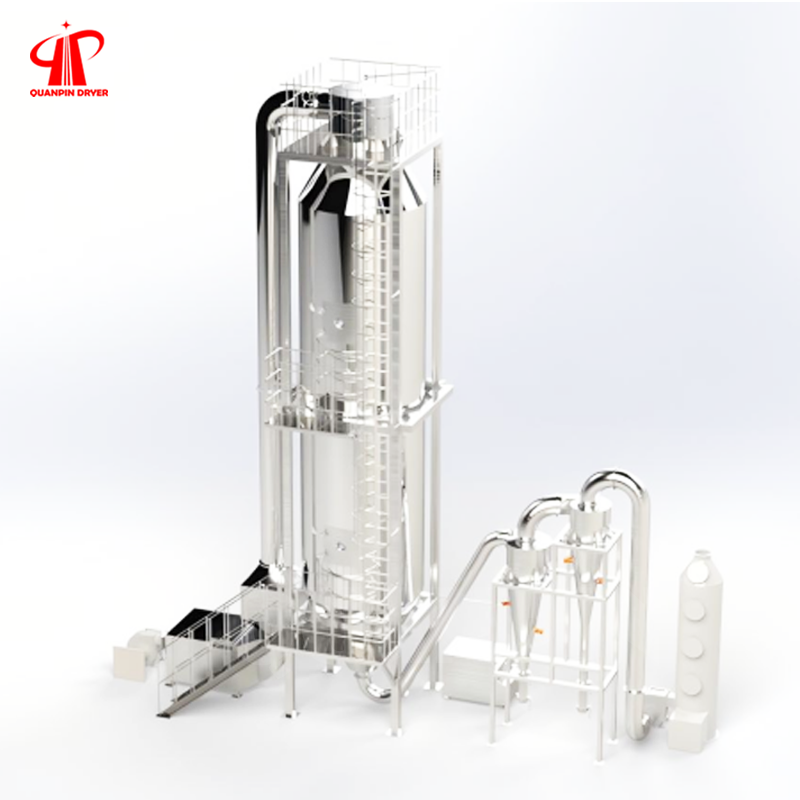
A pressure spray dryer for detergent powder should be selected around the slurry formulation and the intended powder-handling route. Drying, particle formation and collection interact, so a quotation needs more than an output tonnage. A representative trial can reveal whether the formulation produces usable powder under practical operating conditions.
Review the related QUANPIN drying equipment alongside this guide. Equipment selection should follow the actual material, product targets and installation conditions.
Describe the complete slurry
Identify ingredients, solids, viscosity, feed temperature and the mixing procedure. Check for settling, entrained gas or changes during holding. Include components that may influence compatibility or thermal behavior. The process team should supply actual formulation information through the appropriate confidential route rather than asking the supplier to size equipment from a generic detergent label.
A pressure spray drying machine brief should identify the actual feed rather than use the equipment name as a process specification.
Define density and size on a clear basis
Specify the finished powder’s required bulk behavior and the method used to measure density. Add particle-size and moisture criteria relevant to storage, blending and filling. If post-drying additions are part of the process, identify where the accepted product is sampled. Dryer powder and the final blended detergent are different assessment boundaries.
For a pressure nozzle spray dryer, include the tested formulation and nozzle condition in the operating record.
Examine nozzle duty and feed stability
Review pressure requirements, wear-prone components and the feed pump’s operating range with the supplier. Record nozzle condition before and after a trial. A fluctuating feed or changing slurry can alter the spray even when the nominal pressure remains unchanged. Assess the complete atomization arrangement rather than treating nozzle pressure as a finished-product specification.
Review pressure atomization spray dryer in relation to both feed behavior and the required finished product.
Evaluate the recovery and transfer system
Account for collected powder, fines and deposits. Check bridging or buildup at discharge and transfer points. State whether fines return to the process and how that affects the product assessment. A dryer that produces acceptable powder in a small container may still require changes to transfer and storage equipment.
The nozzle atomization system belongs inside the complete trial boundary, including feed delivery and recovery.
Include cleaning and material hazards
Review product-contact compatibility, cleaning access and the material-specific hazard assessment. Record the interfaces between the dryer, dust collection and downstream handling. Do not assume that general ventilation demonstrates adequate dust control or explosion protection. The final proposal should state responsibilities and the complete system boundary.
Compare spray drying equipment using accepted product and documented sampling rather than nominal throughput alone.
Prepare a Trial Record That Supports the Decision
| Trial record | What to document |
|---|---|
| Feed | Actual formulation, preparation and batch variation |
| Loading | Defined mass or feed rate and the tested arrangement |
| Operating conditions | Measurement locations, stable periods and planned changes |
| Product | Sample location, analytical method and acceptance result |
| Recovery | Accepted product, retained material and off-specification output |
| System boundary | Included handling, utilities and cleaning operations |
A spray drying system quotation should identify the included equipment, utilities and downstream interfaces.
What Buyers Should Request Before Ordering
Request an assessment of slurry delivery, nozzle duty, accepted bulk properties and the transfer arrangement. Make post-drying additions and fines handling explicit in the quotation boundary.
Frequently Asked Questions
Does a dryer guarantee a particular detergent bulk density?
A guarantee needs an agreed formulation, method and tested process window. Bulk density should be verified on representative collected powder and, where relevant, on the final blend.
Can a trial omit downstream powder handling?
It can support preliminary drying work, but handling remains part of equipment suitability. Document any untested transfer or storage assumptions.
Request a Material-Specific Equipment Proposal from QUANPIN
Ready to compare equipment for your material? Send the feed description, required output, product specification and available utilities through our contact page. You can also browse the drying equipment range and visit QUANPIN to learn about the available process routes. Final equipment configuration follows a review of your actual requirements.
Email sales@quanpinmachine.com or call +86 19850785582.