Centrifugal Spray Dryer for Herbal Extracts: Link Feed Concentration to Product Tests
By QUANPIN
For herbal extracts, the useful buying question is whether the proposed route produces your specified ingredient consistently and can handle it practically.
A centrifugal spray dryer for herbal extracts must be assessed using the actual extract and its required finished-powder properties. Extracts can vary with raw materials, extraction conditions and concentration. The purchasing brief should document this variation and identify which analytical results will determine whether the dried product is acceptable.
Review the related QUANPIN drying equipment alongside this guide. Equipment selection should follow the actual material, product targets and installation conditions.
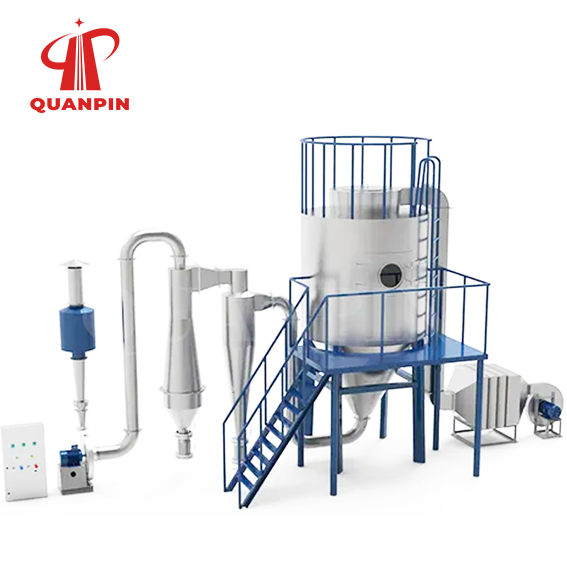
Record extraction and concentration history
Identify the solvent system, concentrate composition and any carrier or formulation addition. State solids, viscosity and feed temperature at the dryer inlet. Note changes during holding and whether precipitation occurs. A representative sample is more informative than a nominal botanical name because the processing route influences the material reaching the atomizer.
The spray drying route should be assessed with the actual formulation and the customer’s product tests.
Define product quality independently of appearance
Choose analytical markers and functional properties that matter to the purchaser, using appropriate established methods. Include moisture and handling requirements. Do not interpret a pleasant color or aroma as proof that all relevant constituents remain unchanged. The article does not establish therapeutic efficacy; equipment trials concern the defined ingredient specification.
An industrial spray dryer proposal needs a clearly stated feed and evaporation basis.
Resolve pumpability and atomization
Check whether the concentrate remains consistent at the intended feed conditions. If dilution or other formulation changes are proposed, document their effects on evaporation duty and finished powder. A convenient laboratory feed is not automatically representative of production. Review the feasible preparation route before using a trial to size equipment.
A rotary atomizer spray dryer should be reviewed alongside the feed condition and the complete recovery arrangement.
Account for sticky behavior and recovery
Observe wall deposits, collection behavior and powder handling during a representative run. Identify material that remains inside the equipment separately from collected product. Check whether the finished powder changes after exposure or packing preparation. These observations help determine a useful operating campaign rather than only a short successful collection.
Compare spray drying equipment using samples from the defined finished-product boundary.
Agree on a reproducible acceptance report
Record feed preparation, operating conditions, sample locations and analytical results. Retain feed and powder samples with clear identification. Include the tested formulation limits and unresolved questions in the report. Compare proposals on accepted powder output and cleaning requirements, not just the highest stated feed rate.
A spray drying system should document how changes are monitored, tested and recorded.
Prepare a Trial Record That Supports the Decision
| Trial record | What to document |
|---|---|
| Feed | Actual formulation, preparation and batch variation |
| Loading | Defined mass or feed rate and the tested arrangement |
| Operating conditions | Measurement locations, stable periods and planned changes |
| Product | Sample location, analytical method and acceptance result |
| Recovery | Accepted product, retained material and off-specification output |
| System boundary | Included handling, utilities and cleaning operations |
The spray drying plant project should include handling and cleaning requirements as well as the drying chamber.
What Buyers Should Request Before Ordering
Request a formulation-specific trial and the analytical checks your quality team requires. Ask the supplier to document deposition, accepted recovery and the preparation needed before packing.
Frequently Asked Questions
Can one trial qualify every batch of an herbal extract?
No. A trial represents its tested material and conditions. Expected variation in raw material and concentrate preparation should be considered before finalizing the operating window.
Does spray drying prove retention of active constituents?
No. Relevant constituents require appropriate analytical testing. Their retention should not be inferred solely from inlet temperature or visual powder quality.
Request a Material-Specific Equipment Proposal from QUANPIN
Ready to compare equipment for your material? Send the feed description, required output, product specification and available utilities through our contact page. You can also browse the drying equipment range and visit QUANPIN to learn about the available process routes. Final equipment configuration follows a review of your actual requirements.
Email sales@quanpinmachine.com or call +86 19850785582.