Pressure Spray Dryer for Ceramic Powder: Specify Granule Quality Before a Trial
By QUANPIN
Buy the granule quality your forming process needs, rather than comparing dryers by feed rate alone.
A pressure spray dryer for ceramic powder should be evaluated as a granule-forming process, not simply a machine that removes water. The slurry must form a stable spray, while the dried granules must meet the requirements of storage, conveying and subsequent forming. A useful trial therefore connects slurry preparation to measurable granule behavior.
Review the related QUANPIN drying equipment alongside this guide. Equipment selection should follow the actual material, product targets and installation conditions.
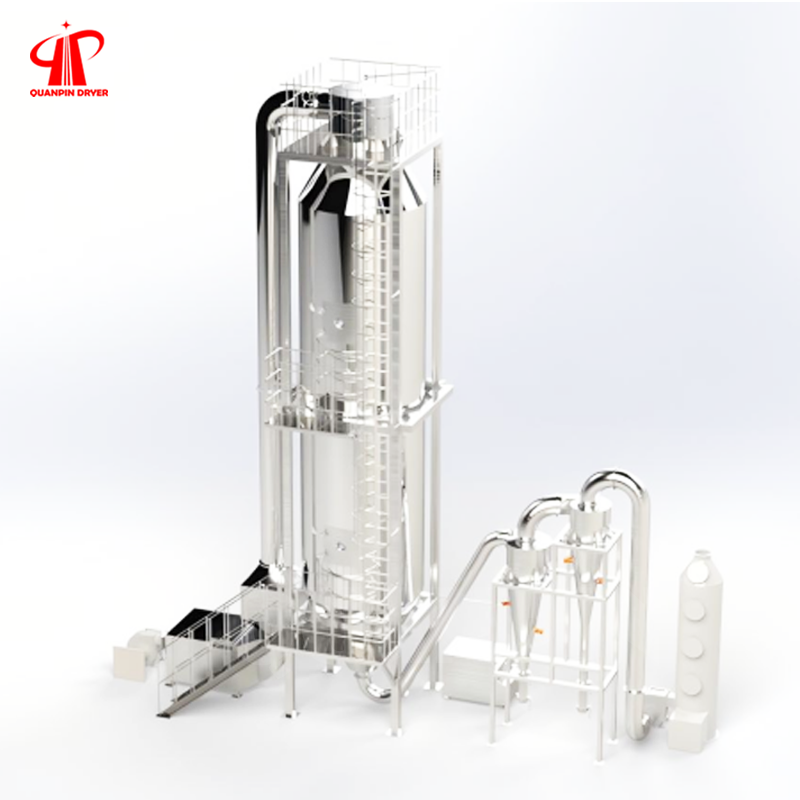
Start with the forming operation
Define what the next process needs from the granules. Record the required size distribution, moisture range, flow behavior and response to handling. If the powder will be pressed, include a representative forming assessment rather than approving the dryer solely from a sample that looks spherical. Different ceramic formulations can require different compromises between granule strength and breakability.
A pressure spray drying machine brief should identify the actual feed rather than use the equipment name as a process specification.
Characterize the slurry at the nozzle
Measure solids concentration, viscosity and temperature under the conditions used during the trial. Record whether the slurry settles during holding and whether agitation restores its original consistency. Identify coarse particles and agglomerates that may interfere with the nozzle. A laboratory viscosity value without its measurement method or temperature is an incomplete basis for equipment selection.
For a pressure nozzle spray dryer, include the tested formulation and nozzle condition in the operating record.
Treat atomization and drying as connected decisions
Pressure, nozzle geometry and slurry properties influence the spray, but the drying chamber must accommodate that spray. Changing atomization can alter both particle distribution and wall contact. Review nozzle inspection, wear monitoring and feed-system stability with the supplier. Do not transfer a successful setting from a different ceramic formulation without checking the resulting granules.
Review pressure atomization spray dryer in relation to both feed behavior and the required finished product.
Build a representative sampling plan
Collect samples after stable operation and identify their collection location. Separate useful product from fines and deposits when reviewing recovery. Test moisture and particle size using consistent methods, then assess bulk handling and the downstream forming response. Keep retained samples so that apparent improvements in flow can be checked against changes in product quality.
The nozzle atomization system belongs inside the complete trial boundary, including feed delivery and recovery.
Compare proposals on the same boundaries
Ask each supplier to explain the stated feed rate, evaporation duty, powder target and recovery arrangement. Include cleaning access and the procedure for changing formulations. A higher throughput is not automatically better if more material falls outside the accepted granule specification. Define acceptance using saleable or usable product under agreed trial conditions.
Compare spray drying equipment using accepted product and documented sampling rather than nominal throughput alone.
Prepare a Trial Record That Supports the Decision
| Trial record | What to document |
|---|---|
| Feed | Actual formulation, preparation and batch variation |
| Loading | Defined mass or feed rate and the tested arrangement |
| Operating conditions | Measurement locations, stable periods and planned changes |
| Product | Sample location, analytical method and acceptance result |
| Recovery | Accepted product, retained material and off-specification output |
| System boundary | Included handling, utilities and cleaning operations |
A spray drying system quotation should identify the included equipment, utilities and downstream interfaces.
What Buyers Should Request Before Ordering
Ask for a trial that connects slurry consistency to granule distribution, handling and a representative forming result. The quotation should identify nozzle service requirements and the recovery boundary.
Frequently Asked Questions
Is a larger granule always better for ceramic pressing?
No. Granule size is only one characteristic. The distribution, moisture, internal structure and response to compaction should be assessed together using the intended ceramic formulation.
Can nozzle pressure alone define the finished particle size?
No. Slurry properties, nozzle condition and the drying process also matter. Use measured granule distributions from representative trials rather than a pressure setting as a product guarantee.
Request a Material-Specific Equipment Proposal from QUANPIN
Ready to compare equipment for your material? Send the feed description, required output, product specification and available utilities through our contact page. You can also browse the drying equipment range and visit QUANPIN to learn about the available process routes. Final equipment configuration follows a review of your actual requirements.
Email sales@quanpinmachine.com or call +86 19850785582.