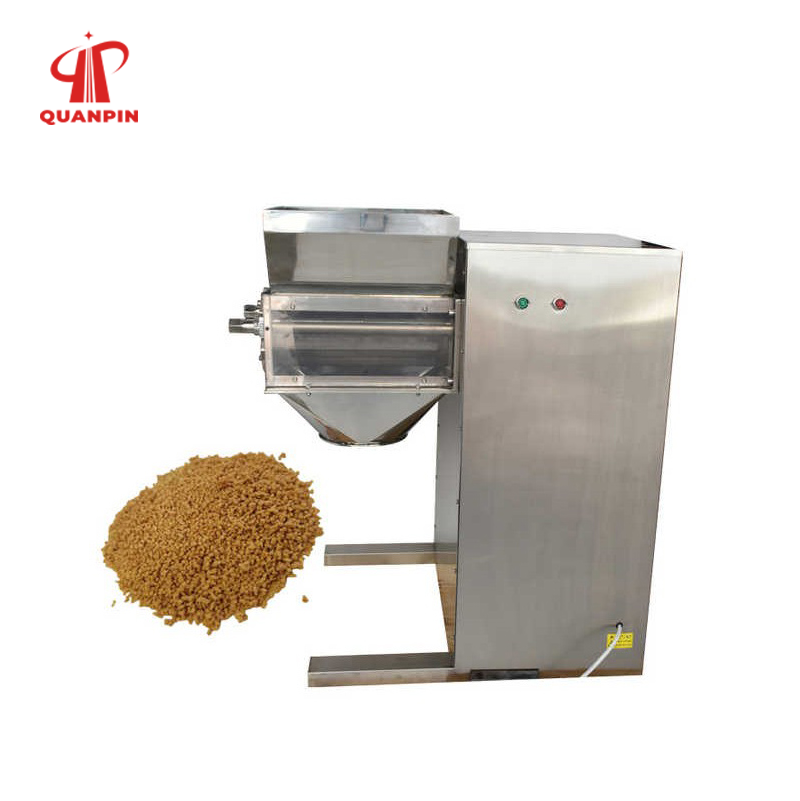
An oscillating granulator works a suitable prepared mass against a screen with a reciprocating rotor. Wet material forms granules as it passes through the openings, while compatible dry agglomerates may be resized by the same type of mechanism. These are different duties and should be specified separately. For a wet pharmaceutical process, the YK stage provides a defined mechanical step between wet-mass preparation and drying, with the feed consistency and screen arrangement determining whether useful granules can be formed. For this duty, review the Oscillating Granulator around the actual feed condition and the required product checks.
The following production sequence explains how prepared pharmaceutical wet masses moves through preparation, processing and discharge. Equipment selection should connect the incoming material with the required finished condition: handling behavior, moisture distribution and cleaning access matter alongside output. A machine can provide the required mechanical or thermal action, but the formulation and operating procedure determine whether the resulting product is acceptable. The oscillating granulator machine should be specified with the complete upstream and downstream process in view.
- State whether the feed is wet or dry. A wet mass requiring granule formation differs from a dry agglomerate requiring size reduction. The distinction affects preparation, handling and the way product quality is assessed. Describe the actual feed condition to the equipment team instead of relying on the general term granulation. For UK workplace use, select suitable equipment and arrangements for safe operation with reference to HSE’s PUWER overview.
- Prepare the wet mass consistently. Powders and binder should be combined upstream according to the formulation procedure. The YK screen cannot correct a blend containing alternating dry pockets and saturated lumps. Define the preparation sequence so that material reaches the hopper in a condition that can be worked through the selected screen. A discussion of swing granulator should include loading, cleaning and the acceptance method.
- Review feed consistency. The mass must pass through the openings without smearing excessively or crumbling into unacceptable fines. Moisture and binder influence this behavior alongside the powder properties. Use representative material to establish suitability rather than assuming that every damp powder can be converted into satisfactory granules by changing the screen alone. Compare the pharmaceutical granulator configuration using representative material rather than equipment size alone.
- Understand the rotor movement. The working element oscillates, repeatedly moving material against the screen. Its function is to make compatible feed pass through the selected openings. This mechanical action is distinct from binder distribution in a high shear mixing vessel, so the upstream preparation stage remains essential in a wet granulation workflow.
- Select the screen around the product. Openings influence the granules produced, but the final distribution also depends on feed consistency, handling and later drying. Agree the desired output range and a measurement method. A nominal opening should be treated as part of the process configuration, rather than a guarantee that every particle will have one dimension.
- Maintain a controlled feed supply. Irregular loading can alter the way the rotor encounters the material and can make production observations harder to interpret. Review hopper access, transfer containers and the operator sequence. The goal is a steady, manageable presentation of prepared mass without compressing it unnecessarily before it reaches the working zone. Operators need training appropriate to their equipment and work; the practical context is described in HSE training and competence guidance.
- Use screen-based preparation where it fits. A selected rotor and screen arrangement offers a clear mechanical path for compatible material and can support a straightforward wet-granule preparation step. Its value depends on matching the feed to the mechanism. Sticky, highly elastic or unsuitable hard material requires a separate suitability review rather than a blanket application claim. Include inspection, maintenance and competence in the equipment management plan; these related topics are collected in HSE’s work equipment guidance.
- Observe the discharge condition. Examine whether granules separate freely, adhere to each other or arrive as compressed accumulations. These observations help distinguish an unsuitable wet mass from a downstream collection problem. Record the conditions that produced the sample, because an isolated sample without its feed and screen history is difficult to interpret.
- Connect granulation to drying. Wet granules must reach the agreed moisture condition without losing their required structure. Review the selected dryer and transfer method before fixing production output. The granulator may produce material faster than the dryer can accept it, creating an intermediate holding step that must be defined within the process.
- Check the finished particle population. Evaluate granules after drying and any permitted sizing step. Compare useful product, fines and oversize against the intended downstream operation. A clean-looking wet discharge is only an intermediate observation; the acceptance criteria should describe the product condition that the next manufacturing step actually needs.
- Make screen access practical. Screens and nearby product-contact areas require inspection for damage, retained material and cleanliness. Define safe removal and replacement practices for the selected configuration. Maintenance personnel should know how rotor access is controlled and how the correct screen is identified before the next batch begins. Before screen access or maintenance, plan safe isolation and competent work; consult HSE maintenance guidance.
- Specify the complete operating duty. Provide QUANPIN with formulation information, wet or dry feed condition, screen requirements, batch volume and target product properties. Include containment, cleaning and downstream handling needs. A representative trial with agreed assessment methods can establish whether oscillating preparation is appropriate for the material, without implying an automatic certification or universal performance result. Set inspection needs and intervals using the equipment risks and operating conditions, as explained in HSE inspection guidance.
YANCHENG QUANPIN MACHINERY CO.. LTD
Sales Manager – Stacie Tang
MP: +86 19850785582
Tel: +86 0515-69038899
E-mail: stacie@qpdryer.com
WhatsAPP: 8615921493205
https://quanpindrying.en.alibaba.com/
Address: Jiangsu Province, China.