Continuous Granulation Tracer Studies: Interpret Residence-Time Distributions Before Comparing Equipment
By QUANPIN
A continuous residence-time distribution describes how a tracer response appears at a defined outlet over time. It is not equivalent to a programmed batch mixing duration.
When comparing a high shear granulator with continuous alternatives, define the operating mode first. Different equipment arrangements require different timing questions and different evidence.
Distinguish a Distribution from a Mixing Duration
The mean residence time summarizes a distribution. It does not show every early arrival, late arrival or other feature relevant to material passage.
The measurement boundary determines the interpretation. An outlet after drying or milling describes a different route from the outlet of a granulator alone.
Understand the Tracer Observation
A tracer creates a detectable signal whose relation to material movement must be justified. Detectability by itself does not establish that the tracer represents the formulation.
Keep the input procedure separate from the response analysis. A short intended pulse that was actually added over an extended period requires appropriate interpretation.
Five Records Needed for a Useful Study
Material and operating state
Record the material identity and process state. A response observed while conditions change should not automatically be described as the behavior of an established operation.
Tracer input history
Record tracer identity, quantity and introduction history. These details are necessary to understand what input produced the response shown in the final graph.
Detection location and method
Record the outlet position and detection method. Different instruments observe different signals and need their own appropriate calibration, sampling and interpretation arrangements.
Timing and signal processing
Record timing and data treatment. Preserve original observations so that averaging or fitting does not conceal important features of the measured response.
Configuration and conditions
Record the equipment configuration and operating conditions. A residence-time graph without the conditions that produced it provides limited guidance for a meaningful process comparison.
Design an Interpretable Tracer Experiment
Start with the material-traceability question. Decide whether the study concerns one operation, an integrated route or the effect of a particular operating change.
Design tracer introduction and response collection together. A detailed detector record cannot recover an input history that was never adequately established.
Preserve the raw response alongside fitted descriptions. A model can summarize useful information while introducing assumptions that remain part of the reported result.
Use appropriate repetition to investigate variability. One clear experiment does not establish that the observed distribution applies to every material or production condition.
Follow Six Steps Through the Study
Map the boundary
First map the observation boundary. Identify the introduction point, outlet and any connecting equipment that contributes to the material route being measured.
Justify the tracer
Next justify the tracer and detector. Explain which information the selected method can provide and any limitation important to interpreting the material response.
Record the input
Then establish the actual input history. Record deviations from the planned pulse instead of assuming that the nominal procedure occurred exactly as intended.
Collect the response
Collect the response over the appropriate observation period. Identify missing samples or detection limits that affect interpretation of the beginning or tail of the response.
Analyze the observation
Analyze observations and predictions separately. State how the distribution and summary metrics were obtained, retaining the processing choices necessary for independent interpretation.
Connect the process question
Finally answer the original question with appropriate limits. Identify which changed materials, operating conditions or configurations would require another investigation rather than an unsupported transfer.
What Original Residence-Time Research Establishes
Parametric twin-screw investigation
An original parametric study investigated residence-time distributions and granulation kinetics during twin-screw wet granulation. Its experimental design connected observations with defined operating conditions.
The parametric investigation provides an example of a structured comparison. Its correlations do not establish universal settings for unrelated batch high-shear equipment.
Matching one mean time is not proof of equivalent material history. Compare the arrangement and observed response as well as the summary number.
Semi-mechanistic prediction
A separate original study developed semi-mechanistic predictions for residence-time metrics. The predictive relationships were assessed through the datasets examined in that work.
The modeling investigation illustrates how prediction can complement measurement. A model is not a direct observation from an installation that has never been tested.
If an experiment disagrees with prediction, investigate the operating domain and assumptions. Changing the output of a model does not explain the underlying discrepancy.
Connected granulation and drying
Another investigation evaluated integrated continuous wet granulation and drying alongside batch processing. Its connected route involved additional operations beyond the granulator in isolation.
The integrated-process study supports defining the complete measurement route. A response across connected operations should not be attributed to one component without evidence.
A rapid mixer granulator proposal should identify whether a batch unit or continuous route is actually required. That distinction changes the relevant development questions.
Compare the Actual Observation Routes
An original conference investigation used chemical imaging to examine residence-time and liquid-distribution information during twin-screw granulation. These were related but distinct observations in its experiment.
The university-hosted conference abstract illustrates the measurement approach. It is an original abstract, not a complete journal validation report or evidence for an unrelated formulation.
Another continuous high-shear investigation studied tracer responses using an impeller-and-scraper arrangement. Its equipment-specific comparison differs from both a batch sequence and a twin-screw configuration.
The official original-study record offers another process example. It does not establish that a batch GHL machine has continuous scraper-controlled residence-time functionality.
Investigate Conflicting Timing Results
When two experiments have similar means but different response shapes, preserve that distinction. The difference may matter to the material-traceability question motivating the study.
When configuration changes alter the response, inspect the complete recorded conditions. An informative result does not automatically provide a universal explanation for all materials.
Prepare the Granulation Development Enquiry
Describe the operating mode when enquiring about a high shear mixer granulator. Explain whether the immediate requirement concerns batch preparation or an alternative continuous route.
Provide the material and the reason for a timing investigation. A defined product or traceability question is more useful than requesting a generically longer residence time.
Agree tracer introduction, observation and analytical responsibilities before the trial. Confirm which instruments and reporting activities are included rather than inferring them from a product photograph.
Identify whether drying, sizing and connecting transfer equipment belong within the study. The quotation and measurement plan should use the same stated boundaries.
When reviewing high shear granulator price, separate equipment supply from specialist measurements and development services. A tracer experiment is not automatically part of a standard quotation.
Request confirmation of the proposed configuration and deliverables. Published continuous-process observations cannot confirm an unlisted function or the performance of a proposed commercial machine.
Confirm the Required Operating Mode
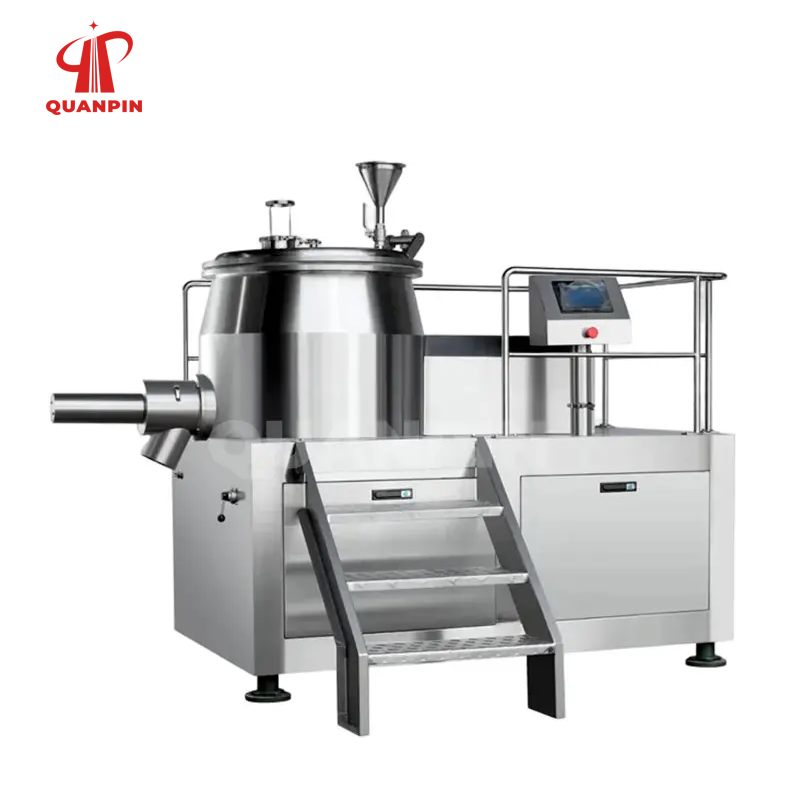
GHL equipment information provides a starting point for discussing a confirmed batch duty. It should not imply equivalence with continuous experimental systems described in published residence-time studies.
Select a high shear wet granulator for the actual operation and material. Its relevant timing assessment may concern the batch sequence rather than an outlet-age distribution.
Preserve the Measured and Modeled Evidence
The final report should retain input history, observation boundary, response data and analysis method. Distinguish measurements from predictions and from inferred product behavior.
State the operating domain represented. A useful investigation can guide further development without establishing a universal setting, final control strategy or guaranteed product outcome.
Frequently Asked Questions
Is residence time the same as batch mixing time?
No. Batch mixing duration is a controlled period in a sequence, while a continuous residence-time distribution describes observed material passage through a specified system.
Does the mean describe the complete response?
No. The mean summarizes the distribution. The response shape, observation boundary and method may also be important to the process question being investigated.
Can any detectable tracer represent the material?
Not automatically. The tracer and detector need a justification for the material and operation. A detectable response alone does not demonstrate representativeness.
Is a model a direct measurement?
No. A model should be identified as a prediction and assessed within its domain. It is not a direct measurement from untested equipment.
Do these studies demonstrate continuous GHL operation?
No. Published continuous high-shear or twin-screw studies use specific arrangements. They do not demonstrate continuous functionality or tracer monitoring in a batch GHL machine.
What belongs in the enquiry?
Provide the material, operating mode, boundary and timing question. Confirm connected equipment, instruments and responsibilities before treating an enquiry as a complete tracer-study proposal.
Discuss Your Granulation Requirements
Discuss the material, processing objective and required trials with QUANPIN. Review the equipment information and the relevant industry applications, or send an enquiry through our contact page.
Email sales@qpdryer.com or stacie@qpdryer.com. Call +86 19850785582 or contact WhatsApp +86 15921493205 to discuss the proposed scope.