Wet Granulation Raw-Material Changes: Design a Lot-Bridge Study Before Adjusting the Recipe
By QUANPIN
A raw-material lot change deserves a bridge study when a high shear granulator recipe was developed using only one lot. Matching the ingredient name and nominal grade does not demonstrate that the new powder will follow the same wetting and agglomeration path.
The practical question is whether the established operating region still produces an acceptable intermediate and downstream product. Start with a material comparison, then challenge the process deliberately instead of correcting an unfamiliar batch by intuition.
Define the Material Change
Define the change precisely: a new lot from the same source, a different particle-size distribution, a replacement grade, or a new supplier. These changes carry different uncertainties and should not be pooled into one generic comparison.
For pharmaceutical granules, identify the downstream decision that matters. A bridge intended to protect tablet disintegration needs different responses from a bridge focused only on transferring wet material to a dryer.
Establish a Reference Population
Record the original development lots as carefully as the proposed replacement. Retained samples, certificates and measured powder attributes create the reference against which any apparent process shift can be interpreted.
Do not make the reference artificially narrow. Where previous acceptable batches cover several material lots, their observed range is more informative than choosing a single attractive batch as the universal target.
Five Incoming-Material Records
Identity and grade
Document identity, grade and lot separately. A commercial grade designation describes the supplied material but does not replace the actual lot measurements required to investigate a suspected processing difference.
Particle-size method
Measure starting particle size using the same preparation and dispersion procedure. A change in how agglomerates are dispersed for analysis can resemble a change in the powder itself.
Water-related behavior
Include moisture and water interaction where relevant. Initial moisture, water-binding behavior and wetting observations address different questions; combining them into one undocumented correction obscures the cause of a changed response.
Density and loading
Record bulk density and loading basis. Equal powder masses may occupy different volumes, so the physical state presented to a rapid mixer granulator can change even when the weighing instruction remains identical.
Storage history
Preserve the history of storage and sample handling. A reference sample conditioned differently from the incoming lot can introduce an avoidable comparison error before the granulation trial begins.
Interpret Starting-Particle Effects
In an original anhydrous-lactose experiment, starting particle size affected growth, porosity and compactibility. The smallest studied grade did not simply behave as a scaled copy of the larger grades.
That result supports measuring the input distribution and several output properties together. It does not establish a universal direction of change for every active ingredient, excipient combination or liquid addition procedure.
If the new lot produces larger granules, first ask whether its starting powder distribution and wet behavior changed. Increasing or decreasing speed immediately may conceal the material effect without establishing a robust operating region.
Retain samples before granulation and after drying. Without both, a changed dried distribution could be attributed incorrectly to raw-material growth when drying and subsequent handling also contributed.
Six Elements of the Bridge Protocol
Relevant attributes
List the attributes plausibly connected to the identified change. Avoid measuring a long catalog simply because an instrument is available; each measurement should support a decision or test a stated mechanism.
Challenge lots
Choose reference and challenge lots that span the observed variation. Conveniently available samples may cluster near the middle and leave the intended robustness question unanswered.
Fixed baseline
Keep the baseline process settings fixed for the first comparison unless the protocol justifies another approach. This reveals the lot effect before it is mixed with deliberate process adjustments.
Controlled adjustments
When adjustments are investigated, define them as experimental factors. Record actual liquid delivery and processing times rather than relying only on controller settings or nominal recipe values.
Acceptance criteria
Select acceptance criteria before reviewing the results. Criteria should reflect the intended pharmaceutical intermediate and downstream product, not a retrospective boundary placed around whichever lot performed best.
Repeated observations
Plan enough repeated observations to distinguish a reproducible lot effect from ordinary variation. The required replication belongs to the development strategy and should be agreed with the responsible quality and formulation team.
What Original Variability Studies Establish
API batch variation
An API batch-variability study used extensive material characterization and a designed twin-screw experiment. Particle-size distribution and related properties were important for the tested formulation’s granule attributes.
The transferable lesson is the study design: quantify incoming variation, connect it with process factors, and evaluate a defined response. The reported continuous-machine settings are not operating instructions for a batch GHL installation.
For a high shear mixer granulator, build the bridge around its actual bowl, mixing arrangement and batch sequence. Do not copy screw-speed factors from a different technology merely because both processes use wet granulation.
Constant-setting experiments
A seven-grade theophylline investigation held continuous-process settings constant and found differences in processability and resulting granule and tablet attributes. The study demonstrates why material variation can remain visible downstream.
A fixed-setting comparison is therefore useful as a diagnostic stage. It answers whether the established process is sensitive to the incoming change, before the team considers how that sensitivity should be managed.
Keep a separate record for unsuccessful or difficult runs. Excluding poor processability from the dataset can produce a misleading picture of a supposedly tolerant operating region.
MCC and liquid interaction
In an MCC batch-to-batch study, raw-material attributes and liquid-to-solid ratio influenced continuous granulation and drying. Its material characterization included water-related behavior rather than relying on grade identity alone.
For a batch bridge, this suggests checking whether an apparent liquid-demand shift follows measurable powder differences. It does not justify importing the paper’s preferred MCC attributes as purchase specifications for an unrelated formulation.
Explain the process boundary in the report. A comparison across granulation, drying and tableting is broader than a wet-mass assessment; conclusions should identify the stages actually investigated.
Build a Traceable Comparison Matrix
Create a matrix with lots as rows and measured attributes as columns. Add units, analytical method and sample condition so a reviewer can distinguish a real material trend from inconsistent reporting.
Add separate columns for process observations and final responses. This preserves the chain from incoming material to wet behavior, dried granules and the product test that motivated the bridge.
Plot the raw observations before selecting a predictive method. A complicated model cannot recover missing lot identities, inconsistent sampling locations or process changes that were never recorded.
If attributes are strongly correlated, avoid treating them as independent explanations. A particle-size shift may travel with density or water interaction; an interpretation should acknowledge those linked changes.
Use Historical Models Within Their Domain
An industrial batch-data study connected material attributes and process evolution with tableting yield and disintegration. Its models were developed from the investigated manufacturing history rather than assumed transferable between products.
Use historical data to generate and test hypotheses for your own process. A prediction model belongs to its documented training domain and requires evaluation before it informs adjustment of a high shear wet granulator.
Confirm the Whole Downstream Route
Preserve the control batch and change batch under comparable downstream conditions. Different drying endpoints or lubrication histories can introduce a second explanation for changed tablet behavior.
Compare distributions rather than only averages. Two granule populations can share a median while containing different fractions of fines and oversize material that affect later handling.
Report yield and material accountability with the quality results. A lot that produces an attractive retained fraction after extensive rejection has not necessarily reproduced the original process performance.
Review any proposed correction against every critical response. Restoring size alone is insufficient if compactibility, disintegration or another required property moves outside the agreed development objective.
Confirm the proposed operating region with material representative of the change. A model prediction or a single successful exploratory run should not silently become a routine manufacturing instruction.
Document unresolved differences explicitly. The responsible team can then decide whether additional characterization, another trial or a narrower material specification is needed before adoption.
Prepare the Equipment Trial Scope
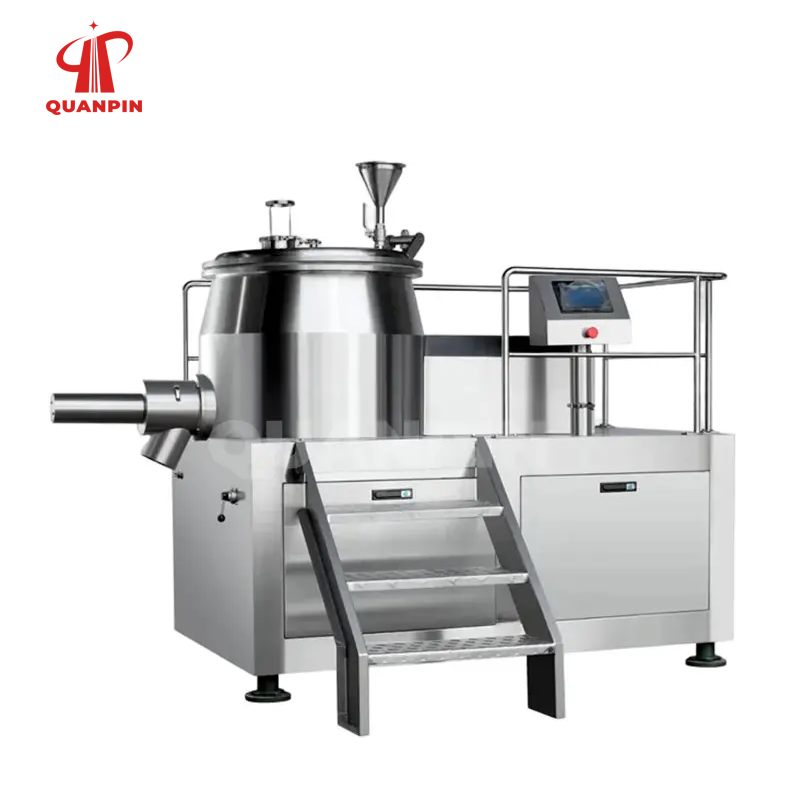
For equipment discussions, provide the material matrix, batch sequence and required observations. This gives QUANPIN a concrete scope for evaluating a GHL trial without implying that the machine diagnoses raw-material causes automatically.
Include sampling access, cleaning needs and the intended downstream route in that scope. These practical requirements can affect how a bridge is executed even when the core formulation is unchanged.
Compare Documentation with Price
A useful high shear granulator price comparison includes the agreed trial scope and documentation responsibilities. Price alone does not establish whether competing offers address the same material-variability question.
Use the GHL product information to begin configuration discussions. Confirm required features for the actual installation instead of assuming that a published research arrangement is supplied as standard.
Raw-Material Bridge Questions
Can one grade vary?
Can the same grade still need a bridge? Yes. Lot variation may exist within a grade, and the need for investigation depends on the process sensitivity and significance of the observed change.
Does every lot need a recipe?
Should every new lot receive a new recipe? No. First establish whether the existing operating region remains suitable. Uncontrolled recipe changes can make the material effect harder to understand.
Is particle size sufficient?
Does particle size alone explain granulation behavior? Not necessarily. It should be interpreted with relevant water interaction, density, formulation and process observations rather than treated as a complete material description.
Can continuous settings transfer?
Can a continuous-process paper set batch GHL conditions? No. It can inform experimental questions, but its screw configuration, residence behavior and process settings are specific to a different operating system.
Is matching size enough?
What if only dried-granule size matches? Continue the agreed comparison. Matching one intermediate response does not establish equivalent downstream tableting or pharmaceutical product performance.
What belongs in the report?
What should the final bridge report contain? Identify the changed lots, methods, process conditions, repeated observations, acceptance decisions and limitations, then state clearly what has and has not been demonstrated.
Discuss a GHL Trial with QUANPIN
Discuss the material, processing objective and required trials with QUANPIN. Review the equipment information and the relevant industry applications, or send an enquiry through our contact page.
Email sales@qpdryer.com or stacie@qpdryer.com. Call +86 19850785582 or contact WhatsApp +86 15921493205 to discuss the proposed scope.
For process evaluation, consider the high speed mixer granulator for high-shear preparation of a suitable wet granulating mass. Confirm suitability with representative material, the required product properties and the proposed process conditions.