Food Drying Models: Audit Independent Runs Before Accepting a Predicted Endpoint
By QUANPIN
A drying curve can closely reproduce the experiment used to fit it and still predict a new batch poorly. Before accepting an endpoint estimate, ask which complete drying runs were withheld from model development and how the prediction was checked against their actual measurements.
For a hot air circulation oven project, this is a purchasing and trial-design question as much as a modelling question. An equation supplied with a report is useful only when its material, measurement basis and intended operating range remain identifiable.
Start with the Decision the Model Must Support
Define the decision first: estimating the time to an agreed moisture target, comparing candidate trial conditions, or planning the next experiment. These tasks require different evidence; a model fitted only to describe a completed run should not quietly become a production release rule.
Specify the predicted quantity and its basis. A moisture ratio, wet-basis moisture content and mass loss are different responses. Retain the conversion and reference information needed to understand any transformation between them.
Identify the Experimental Unit
Treat a complete drying run as an identifiable experimental unit. Many measurements collected during one run improve description of its trajectory, but they do not represent the same evidence as independently repeated loads.
When dividing development and test data, consider whether measurements from the same run appear in both groups. That arrangement can make a model seem more transferable than a test using genuinely separate runs would show.
Five Fields That Make a Drying Dataset Usable
Material and preparation
Record the food identity, lot and preparation. Thickness, piece geometry and loading should be available to the reviewer rather than hidden behind a general ingredient name.
Independent drying run
Give each drying run a stable identifier. Preserve that identifier when observations are exported, pooled, filtered or transformed into a table used for fitting.
Measurement time and basis
Record the time origin, actual observation times and moisture method. An elapsed-time curve is difficult to reproduce when interruptions or collection delays disappear from the record.
Recorded operating history
Preserve measured temperature and relevant airflow or humidity information where available. Distinguish observations from nominal control settings and document which variables were not measured.
Data-processing version
Keep the raw data and the processing version. Corrections, excluded observations and unit conversions need a traceable explanation so that another reviewer can reconstruct the reported curve.
Design the Validation Before Fitting
Choose the validation plan before searching for the equation with the best score. Retain complete runs that can challenge the intended use, and explain how their material and operating conditions relate to the development dataset.
Use independent repeats where the trial plan permits. If only a small number of loads is available, report that limitation plainly instead of presenting hundreds of time points as hundreds of independent experiments.
Decide what prediction error would matter to the process decision. A small average error can hide a consequential error near the requested endpoint, so review the relevant portion of the curve explicitly.
Keep final moisture, product quality and any food-safety acceptance responsibilities separate. Model validation can support process understanding without replacing the laboratory and product-release decisions required for the actual food.
Follow the Model Through Six Review Steps
Define the target
Define the target response and time boundary before collecting data. Document whether a pause is included in elapsed processing time and how the endpoint sample will be identified.
Allocate the runs
Allocate development and retained runs with their independence in mind. Preserve a record of this allocation rather than changing the test set after seeing an unfavorable prediction.
Fit on the development set
Fit candidate models using the designated development observations. Retain parameter definitions, units, initial assumptions and the calculation method used to obtain the result.
Inspect the errors
Inspect the residuals, which are differences between observations and fitted values. Look for structure over time and operating conditions rather than relying only on one overall fit statistic.
Test the retained runs
Apply the selected model to the retained runs using the information that would actually be available at prediction time. Report where it succeeds and where it does not support the intended decision.
Review the use boundary
Review whether the new material or load remains within the tested use boundary. A model is not validated for a new food or dryer configuration simply because the software returns a number.
Read the Evidence Behind a Good-Looking Curve
A field drying investigation
An original solar-drying study of whole charal evaluated empirical curves and exploratory one-step-ahead neural-network predictions. Its original experimental report assigned complete runs to separate evaluation subsets and acknowledged the limited number of independent curves.
That example supports asking how the dataset was divided. It does not establish that a particular neural-network architecture is best for a hot air drying oven, or that a fish result predicts the response of another food.
Distinguish one-step-ahead prediction from forecasting an entire future drying cycle. If a method needs a newly measured moisture value at every step, that requirement belongs in the proposed monitoring and cost scope.
A laboratory comparison
Another laboratory investigation examined thin-layer equations for different materials and dryer types. The publisher-deposited original abstract reports the scope of that comparison and its fitted-model result.
Its preferred fit is not a universal purchasing specification. A model name and parameter set must remain connected to the material, apparatus and conditions from which they were obtained.
Ask for the underlying experimental comparison when a supplier or consultant proposes reusing a published equation. Transferring a curve is a separate question from reproducing the mathematical expression correctly.
Residual analysis and model refinement
The NIST guidance on checking model fit explains why a high coefficient of determination is insufficient by itself. Residual patterns provide information that a single summary statistic can conceal.
NIST also describes residual plots for assessing the model function. For a drying dataset, review residuals against elapsed time and recorded conditions when those comparisons address the proposed use.
The agency’s model-refinement guidance connects diagnosed problems with possible improvements. A revised equation still needs evaluation; adding complexity is not evidence that the prediction has become reliable.
Keep Prediction Separate from Product Release
Separate an engineering forecast from a measured product result. The forecast can help plan sampling or compare an experiment, while the final material still needs the agreed assessment.
Use a documented fallback when a model receives inputs outside its tested range or when required measurements are missing. Do not silently replace missing observations with a convenient default and describe the output as validated.
An endpoint calculation should identify the moisture method on which it depends. Changing the analytical method or reporting basis can change the meaning of the target even if the numerical threshold is unchanged.
Agree who reviews unusual runs and who decides whether the food meets its full specification. Equipment control, analytical testing and product acceptance are related responsibilities that should remain explicit.
Compare Models on the Same Information
Compare candidate models using the same development and retained runs, the same measurement basis and the same prediction task. Otherwise a difference in the reported score may come from the comparison design rather than the equation.
Retain simple models as useful comparators where appropriate. The practical choice includes data requirements, interpretability and the ability to identify when a prediction should not be used.
Prepare a Reproducible Modelling Handover
Provide the original observations, run identities and calculation files. A screenshot of a fitted curve does not allow the recipient to check processing decisions or reconstruct the reported result.
List the permitted input range in actual units. State which material properties, loading arrangements and operating histories were represented by the experiments.
Document the fitting procedure and software version. If several candidate equations were screened, retain that selection history rather than presenting only the winning score.
Report errors for the intended decision, including relevant endpoint behavior and differences between runs. Explain any observations omitted from the final evaluation.
Identify the measurements needed during future use. A prediction based on laboratory moisture measurements may require a different implementation from a model using only routinely recorded process variables.
When comparing hot air tray dryer price, keep modelling, extra sensors and laboratory testing visible as separate confirmed supply items. A standard equipment quotation should not be assumed to include an independently validated prediction system.
Keep the Equipment Claim Within Its Scope
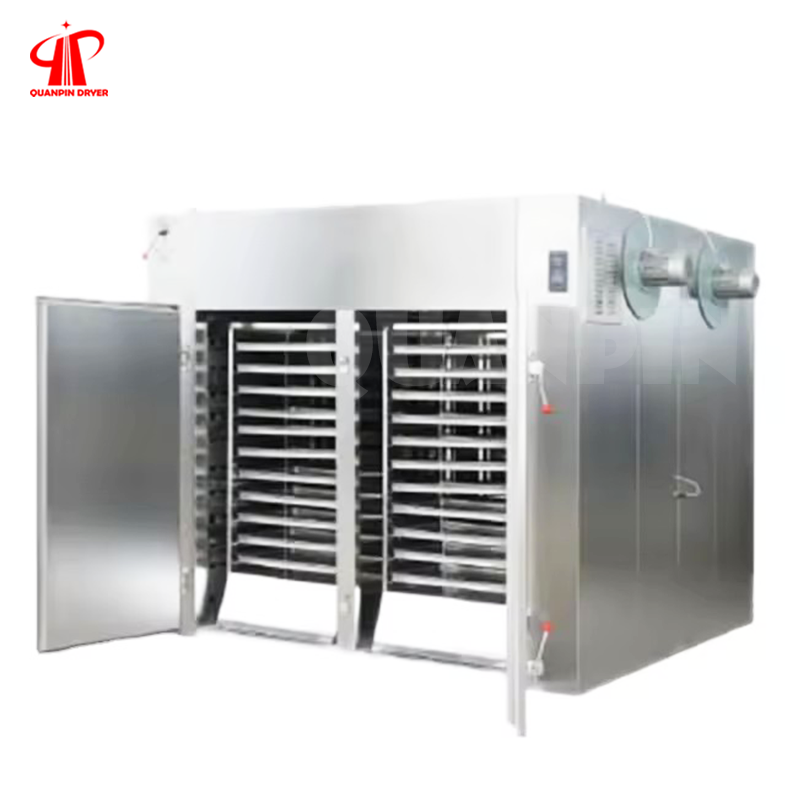
QUANPIN equipment information can support discussion of the actual oven duty and loading arrangement. It does not establish that the machine includes the algorithms, online moisture measurements or independent validation described in another investigation.
Confirm any additional monitoring and data-export requirements in the proposal. Product-specific testing remains necessary before a drying model is adopted for a production decision.
Agree the Acceptance Record
Keep the agreed target, retained-run predictions and measured outcomes together. State whether the evidence supports description, prediction within a tested range, or only a preliminary development lead.
If the evidence is insufficient, identify the next independent experiment needed. A clearly stated limitation is more useful to a buyer than an impressive fit statistic without a reproducible use boundary.
Frequently Asked Questions
Does a high R-squared prove prediction?
No. It describes one aspect of fit to the evaluated data. Check residuals, independent runs and the error that matters to the intended endpoint decision.
Can repeated time points count as independent batches?
No. Observations along a single trajectory share the history of that run. Preserve run identities and evaluate the proposed transfer with genuinely separate experiments where possible.
Is a fitted endpoint a food-safety release?
No. A mathematical endpoint estimate is not independent evidence that the food meets all safety and quality requirements. Keep release responsibilities and actual product tests explicit.
Must every trial use machine learning?
No. Choose a method appropriate to the available independent data and decision. A more complicated model does not remove the need for transparent validation.
Can one food model specify another dryer?
Not without supporting evidence. Material preparation, loading, operating range and required measurements must be assessed for the actual equipment and use.
What should accompany the enquiry?
Include representative food, loading and endpoint requirements, raw run data, available measurements and the proposed validation responsibility. State which modelling work is included in the requested scope.
Discuss Your Food Drying Trial
Discuss the material, processing objective and required trials with QUANPIN. Review the equipment information and the relevant industry applications, or send an enquiry through our contact page.
Email sales@qpdryer.com or stacie@qpdryer.com. Call +86 19850785582 or contact WhatsApp +86 15921493205 to discuss the proposed scope.
For process evaluation, consider the hot air oven for batch tray drying with circulating hot air. Confirm suitability with representative material, the required product properties and the proposed process conditions.