The defining feature of this process is a stationary layer under reduced pressure. Equipment selection becomes clearer when the team follows the material from preparation through the working zone and into the receiving operation. For pharmaceutical manufacturing, that route must be developed around the actual formulation. A supplier description explains the mechanism; a representative trial establishes whether the selected configuration can produce the condition required by the next stage.
This guide focuses on observable material behavior rather than unsupported output or quality promises. Establish the incoming condition, identify samples by their location or collection time, and compare physical handling with the chosen analytical endpoint. The discussion assumes an appropriately assessed pharmaceutical process. It does not establish suitability for every solvent, potent substance or regulated product, and the equipment itself does not confer regulatory approval.
- Begin with the wet cake structure. A dense, sticky cake and a loose crystalline solid can occupy identical trays yet present very different paths for moisture movement. Record whether the material spreads, cracks or forms lumps before deciding how to load a development batch. Discuss the vacuum tray dryer when reviewing this part of the process.
- Prepare the layer deliberately. Break up only those agglomerates that the formulation permits, then distribute the charge evenly across the useful tray area. A thicker center can remain wet after exposed edges have changed appearance. Compare edge and center samples before selecting a routine loading method. For finished-drug operations within its scope, 21 CFR 211.22 addresses quality-unit responsibilities; apply that requirement through the manufacturer’s quality system.
- Follow heat from the utility into the load. Heat reaches stationary material through the installed heating arrangement, while evaporation removes energy from the wet solid. Product temperature can lag the heating surface. A setpoint therefore describes one part of the process rather than the complete thermal history.
- Observe pressure together with evaporation. Reduced pressure changes boiling conditions, but the vacuum system must also remove the generated vapor. Condensation and vacuum capacity belong in the same equipment discussion. A low pressure reading from an empty chamber does not demonstrate performance with a wet production charge. Discuss the vacuum tray drying machine when reviewing this part of the process.
- Track the changing surface. Early evaporation may leave a crust while moisture continues moving from inside the layer. Where crust formation occurs, document its location and thickness during trials. Increasing heat without understanding that barrier can change the exposed material before the interior reaches its intended condition. For finished-drug operations within its scope, 21 CFR 211.25 addresses personnel qualifications; apply that requirement through the manufacturer’s quality system.
- Sample trays as separate locations. Identify upper and lower shelves and positions near the door rather than combining material immediately. Results reveal whether the selected loading arrangement creates important differences. Use those observations to define the eventual sampling plan instead of assuming that one convenient tray represents the chamber.
- Choose suitable aqueous pharmaceutical intermediates through trials. Static drying may be useful when continuous agitation would damage fragile material, but sticky pastes may be difficult to spread and unload. Evaluate adhesion and physical changes alongside moisture. Suitability depends on actual formulation behavior, not the equipment category alone. Discuss the FZG vacuum tray dryer when reviewing this part of the process.
- Define the endpoint from downstream needs. Milling, blending and storage may respond differently to residual moisture and hard lumps. Collect enough material for the receiving operation to evaluate the dried cake. A laboratory moisture result should be interpreted alongside handling observations from the same identified tray position. For finished-drug operations within its scope, 21 CFR 211.28 addresses personnel responsibilities; apply that requirement through the manufacturer’s quality system.
- Restore pressure in a controlled sequence. Determine the appropriate admitted gas and when opening is permitted under the developed procedure. Hot trays and retained vapor require practical handling arrangements. Include cooling and unloading in the production schedule because they can limit usable daily capacity even when evaporation is satisfactory.
- Inspect contact surfaces after unloading. Residue in tray corners may be harder to remove after a long thermal exposure. Review access to shelves, door seals and removable parts during equipment selection. Cleaning observations should inform the loading method and turnaround estimate rather than appearing only after installation. For finished-drug operations within its scope, 21 CFR 211.42 addresses facility design and space; apply that requirement through the manufacturer’s quality system.
- Compare static drying with agitated alternatives using the actual material. Avoiding mechanical motion can preserve fragile structures, while agitation can expose fresh surfaces and assist discharge for other products. Neither arrangement supplies a universal advantage. Record how much acceptable material can be recovered and transferred from each trial. Discuss the vacuum tray dryer for pharma when reviewing this part of the process.
- Prepare the supplier brief around the complete cycle. Give QUANPIN the incoming solids, liquid phase, loading behavior, required final condition and available utilities. Ask for a configuration review and a representative test. Establish pressure, temperature and sampling records before accepting a cycle as a repeatable manufacturing operation. For finished-drug operations within its scope, 21 CFR 211.46 addresses ventilation controls; apply that requirement through the manufacturer’s quality system.
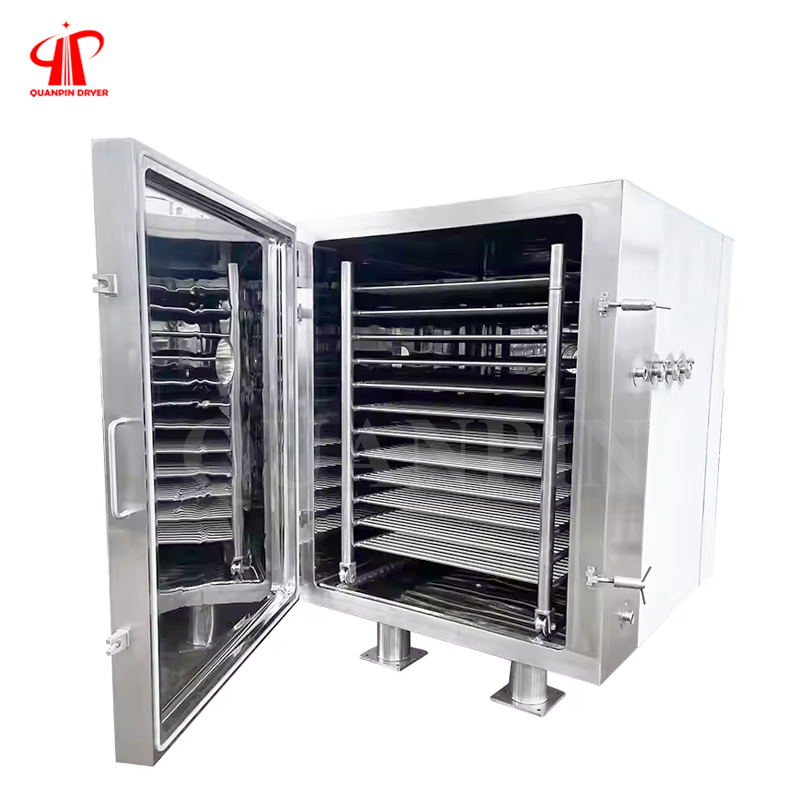
Discuss your material and production route with QUANPIN. Review the corresponding equipment information before arranging a material trial.
YANCHENG QUANPIN MACHINERY CO.. LTD
Sales Manager – Stacie Tang
MP: +86 19850785582
Tel: +86 0515-69038899
E-mail: stacie@qpdryer.com
WhatsAPP: 8615921493205
https://quanpindrying.en.alibaba.com/
Address: Jiangsu Province, China.