Dried pea ingredients can serve very different purposes in a savory premix. A coarse meal contributes texture, while a finer fraction may be wanted for dispersing through a soup base. The milling decision therefore begins with the intended recipe and an agreed powder specification, rather than with a request for the finest powder available.
A WFJ production route brings mechanical grinding and particle classification into one connected system. The practical advantage is the opportunity to retain particles that require additional treatment while recovering an accepted fraction. For a pea ingredient project, the following sequence connects raw-material preparation, grinding, collection and downstream blending without assuming a guaranteed result for an untested feed.
- Write the incoming-material description before sizing the air classifier mill. State whether the peas arrive whole, split, dehulled or already reduced to meal. Include the actual moisture condition and any previous heat treatment. These differences influence how the feed breaks and flows. A material name alone gives the equipment supplier too little information to assess the grinding duty.
- Establish a preparation route that removes unsuitable foreign material before the grinder. Review the incoming lot, transfer points and any upstream screening or other separation required by the plant assessment. Large pieces should meet the agreed inlet condition. An unexpected hard fragment or a sudden lump of material changes the operating duty; neither should be treated as a normal way to challenge the machine.
- Meter prepared solids into the air classifying mill at a controlled rate. The grinding chamber and classifier share the same material flow, so feeding belongs in the process specification. Ask how the feeder responds to variations in bulk behaviour. A stable supply helps make trial results interpretable, whereas intermittent surges make it harder to distinguish a material problem from an operating adjustment.
- Follow the working principle through the ACM mill: mechanical action reduces particles, and the classifier separates material according to its behaviour in the moving air stream. Particles outside the accepted fraction receive further treatment. This arrangement should be assessed as a grinding and separation circuit. Classifier operation alone cannot establish the final quality of every pea formulation or compensate for unsuitable feed preparation.
- Evaluate the fine powder grinder using samples from the intended ingredient supply. Inspect the recovered powder for the properties that matter in the savory premix, including the agreed particle distribution and practical handling behaviour. Record the operating conditions with the samples. A visual impression of fineness is insufficient evidence for acceptance, particularly when a later customer will assess texture after preparation.
- Define the receiver and the next production operation. Pea powder destined for a dry soup blend needs a planned transfer into a batch container or mixer; it should not accumulate indefinitely in an undefined collection stage. Identify all recovery points and decide which fractions belong in the saleable batch. Account for retained material when reconciling the ingredient weight against the usable collected powder.
- FAO describes grinding and particle-size reduction as part of feed preparation, including different reduction mechanisms. The useful lesson for this project is to match preparation to the ingredient and its next use. A process reference does not supply a WFJ performance guarantee. Compare trial powder with the actual recipe requirement before accepting a particular operating arrangement. See the FAO processing reference.
- CCOHS explains the role of safety data sheets in communicating hazardous-product information. Collect available ingredient information when preparing the milling specification and give operators access to the relevant handling instructions. Add the plant assessment where a document does not answer a particular processing question. The name pea powder is not, by itself, a complete description of the conditions around a mill. See the CCOHS safety data sheet guidance.
- HSE separates several flour-handling tasks in its guidance for bakeries, including charging and transfer operations. Where flour also enters the savory recipe, review those tasks alongside pea milling. Enclosing the grinding chamber leaves other points to assess: ingredient bag opening, container emptying and powder movement into the blender all deserve their own practical control arrangements. See the HSE flour-handling guidance.
- CCOHS safeguarding guidance addresses protection from dangerous machine movement. Consider how workers load, inspect and empty the line without access to moving parts. Review the feeder, drives and grinding assembly as well as routine access doors. The production layout should make the intended safe working method practical throughout the cycle, including the less frequent tasks performed between batches. See the CCOHS machinery safeguarding guidance.
- The US food manufacturing equipment provisions in 21 CFR Part 117 address cleanability and contamination prevention. Translate that context into a review of food-contact surfaces, recovery vessels and access for inspection. Confirm the cleaning method for the actual recipe and changeover sequence. A published equipment description should not be substituted for a documented hygiene review of the supplied installation. See the US food equipment provisions.
- Close the specification with a representative production trial and a clear acceptance record. Supply QUANPIN with the ingredient condition, required finished powder, downstream recipe and proposed collection arrangement. Assess the complete cycle, including loading and changeover, when deciding whether the route fits the plant. Retain the agreed samples and operating record so later material changes can be investigated against a useful starting point.
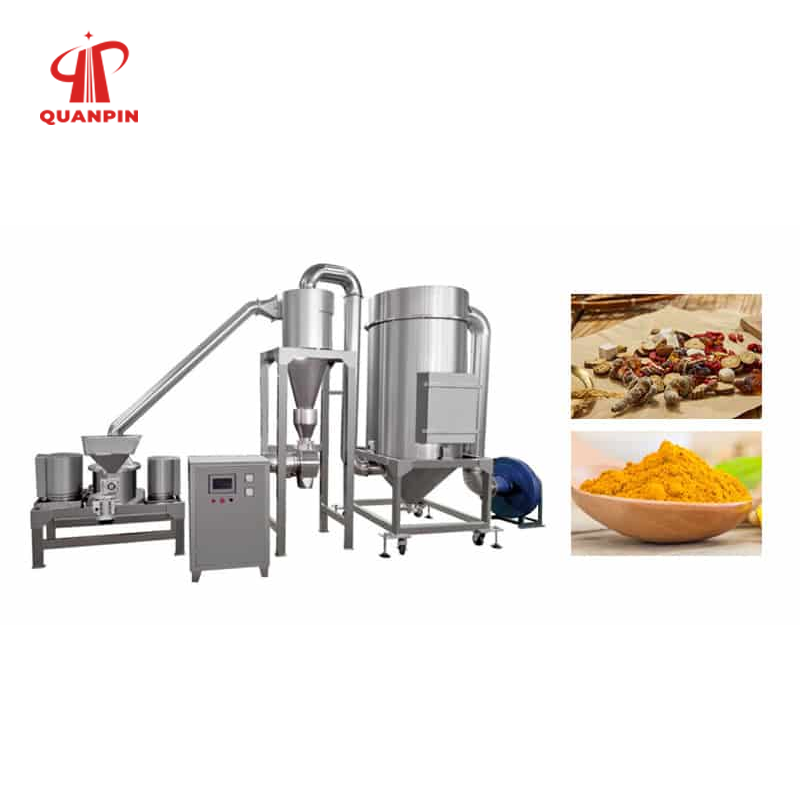
Discuss your material and production route with QUANPIN. Review the corresponding equipment information before arranging a material trial.
YANCHENG QUANPIN MACHINERY CO.. LTD
Sales Manager – Stacie Tang
MP: +86 19850785582
Tel: +86 0515-69038899
E-mail: stacie@qpdryer.com
WhatsAPP: 8615921493205
https://quanpindrying.en.alibaba.com/
Address: Jiangsu Province, China.