Single-Cone Vacuum Drying of Polymers: Distinguish Internal Diffusion from Surface Evaporation
By QUANPIN
A polymer drying curve can become slow even while material remains capable of releasing solvent. Distinguishing internal diffusion from removal at the exposed surface gives a more useful investigation than treating every slow period as the same equipment problem.
For a conical screw vacuum dryer enquiry, describe the polymer–volatile system and the proposed drying duty. The discussion below concerns transport interpretation, not a numerical drying-rate guarantee for a QUANPIN machine.
Trace the Volatile Transport Path
Volatile material must reach an exposed interface before it can leave that interface. Resistance within a polymer-rich region and resistance outside it are different parts of that path.
A low chamber pressure describes a vessel condition. It does not directly measure the volatile concentration inside each polymer particle or establish how quickly that concentration can change.
Separate Diffusion from Evaporation
Diffusion describes movement driven by a concentration difference within the material. Its effective behaviour depends on the particular polymer, volatile species and material state being investigated.
Surface evaporation concerns transfer from the exposed material into the surrounding vapour space. Improving one transfer step does not necessarily remove a limitation in another.
Five Inputs for Interpretable Drying Evidence
Polymer and volatile identity
Identify the polymer grade and the volatile species individually. Water and an organic solvent should not be treated as the same transport system simply because both can evaporate.
Material form
Describe the material’s physical form and characteristic dimensions. A thin film, a droplet and a wet particulate bed present different paths and boundaries.
Initial composition
Record initial composition and any distribution information available. A single bulk average may conceal local concentration differences relevant to a drying interpretation.
Process history
Retain the temperature and pressure histories actually measured. A heating-medium setting should remain distinguishable from the material temperature used in a model.
Analytical method
Define the analytical method and its specimen basis. A mass-loss observation alone may not identify which volatile species was removed.
Use Film Research within Its Actual Scope
Original polyimide-film research combined experiments with a diffusion model that included temperature and concentration dependence. Film-thickness measurements helped assess the drying description. See the original solvent-absorbed polymer-film study.
This film experiment supports keeping transport properties and moving material boundaries in view. It does not supply a diffusion coefficient for an unspecified polymer resin in a GLZ vessel.
A coefficient fitted to one system is not a universal material constant for every condition. Record the composition and temperature range to which the interpretation applies.
For a proposed equipment trial, treat the literature as a way to frame hypotheses. Use representative material and measurements to decide whether those hypotheses describe the observed batch.
Follow Six Material and Measurement Boundaries
Feed preparation
At feed preparation, identify the polymer and volatile inventory. Preserve the difference between a known formulation and an estimated or incompletely characterised wet feed.
Vessel loading
At loading, record the form of the material actually entering the vessel. Prior storage or preparation can change the specimen considered representative of the duty.
Material heating
During heating, retain measured material temperatures where they are available. Unequal local histories should not be silently replaced by one utility setpoint.
Pressure changes
During pressure changes, document their timing beside the sampling record. A change in observed removal rate needs the corresponding process context.
Specimen collection
During sampling, preserve the collection location, time and handling procedure. Subsequent volatile loss during handling can alter the laboratory specimen.
Laboratory analysis
During analysis, retain the species-specific result where required and the method’s reporting basis. Distinguish a concentration observation from a complete transport model.
Investigate a Slowing Drying Curve
Describe the observed trend
Start by plotting the measured drying observations with the actual process history. Describe a slowing trend before assigning it to diffusion, heat supply or vapour removal.
Check whether comparisons use similar initial composition and material form. A different starting solvent level may change both the driving difference and the polymer’s state.
A vacuum ribbon dryer should be evaluated on its confirmed configuration and representative duty. Its name alone does not identify the dominant resistance in a particular batch.
State the modelling assumptions
If a model is used, state its geometry and boundary conditions. A model developed for a stationary film cannot be applied unchanged to an agitated particulate bed.
Identify which parameters were measured and which were fitted. A good numerical fit does not by itself establish that a proposed mechanism is uniquely correct.
Retain uncertainty in specimen size, composition and temperature. An apparently precise fitted coefficient may depend strongly on those inputs.
Distinguish alternative explanations
Compare alternative explanations using measurements that can distinguish them. For example, a changed pressure history and a changed material dimension are different interventions.
Avoid interpreting a faster early stage as proof of a faster complete cycle. The material and controlling resistance can change as volatile content falls.
Discuss these observations with the process and analytical teams before changing a programme. The purpose is to resolve the actual limiting step rather than add adjustments without an interpretable comparison.
Account for Geometry and Changing Composition
Original PVA-film experiments measured diffusion behaviour across concentration ranges and incorporated shrinkage into the drying calculation. Their comparison connected actual measurements with a transport model. See the original coated-film drying experiment.
The material was an aqueous polymer film dried with hot air. This is mechanistic evidence, not a demonstration of equivalent operating conditions in agitated vacuum drying.
Another original experiment studied drying of PAN–DMF droplets and identified a shift from surface-related resistance toward internal diffusion resistance in the modelled process. See the original polymer-droplet drying investigation.
The investigators studied droplets with defined starting conditions. Their size-dependent results cannot establish a commercial batch duration for a different polymer, solvent or material geometry.
Treat Skin Formation as a Testable Hypothesis
An original mesoscopic simulation generated solvent-concentration profiles and surface skin formation during polymer-film drying. It is a model result with stated assumptions. See the original mesoscopic polymer-film model.
Do not diagnose a skin in a resin solely because the drying rate decreases. Demonstrating a local structure or concentration gradient requires evidence appropriate to the actual material.
Keep Spatial and Equipment Boundaries Explicit
Spatially uneven heating can also alter a drying film. Original experimental and modelling work found that local substrate heating changed the final thickness distribution. See the original local-heating study.
That study concerned films on a substrate. It supports examining spatial boundaries, while offering no direct performance comparison between commercial vacuum drying equipment.
A vacuum drying vessel provides a process environment; a representative material trial establishes how the proposed feed behaves within that environment.
For the GLZ discussion, confirm material movement, heating arrangement and vapour-handling scope with QUANPIN. Do not infer unlisted functions from transport models developed for other geometries.
Keep any model prediction beside the measured points it is intended to describe. Report departures rather than hiding them in a single average drying rate.
The useful outcome is an evidence-based explanation of the observed trend, with unresolved mechanisms identified. It is not a promise that increasing vacuum or heating always removes the bottleneck.
Prepare the Polymer-Drying Enquiry
Provide the polymer identity, volatile species, initial composition and physical form. Explain which slowing stage or comparison the proposed trial should investigate.
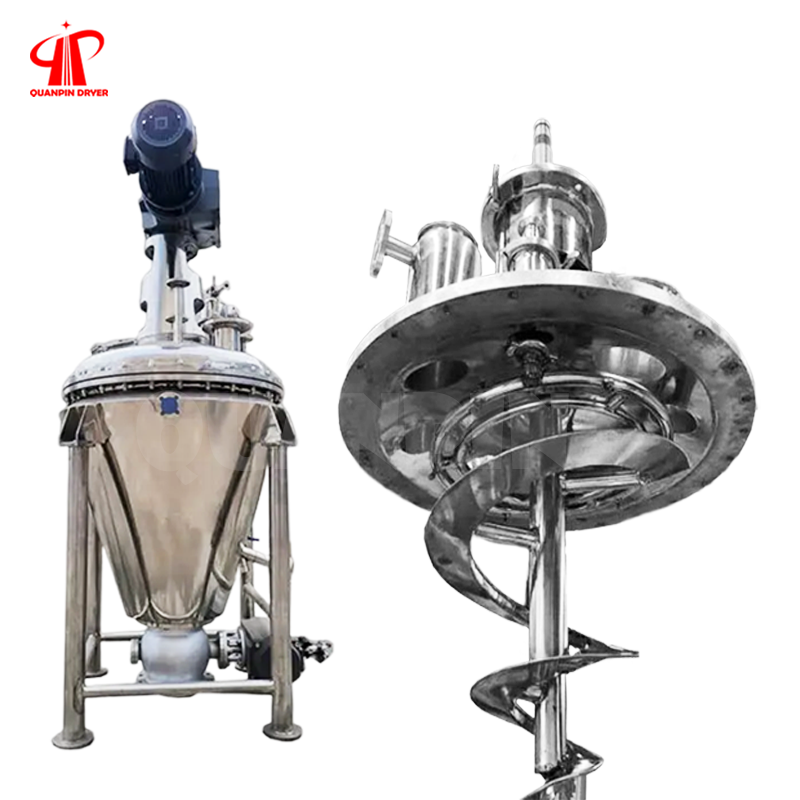
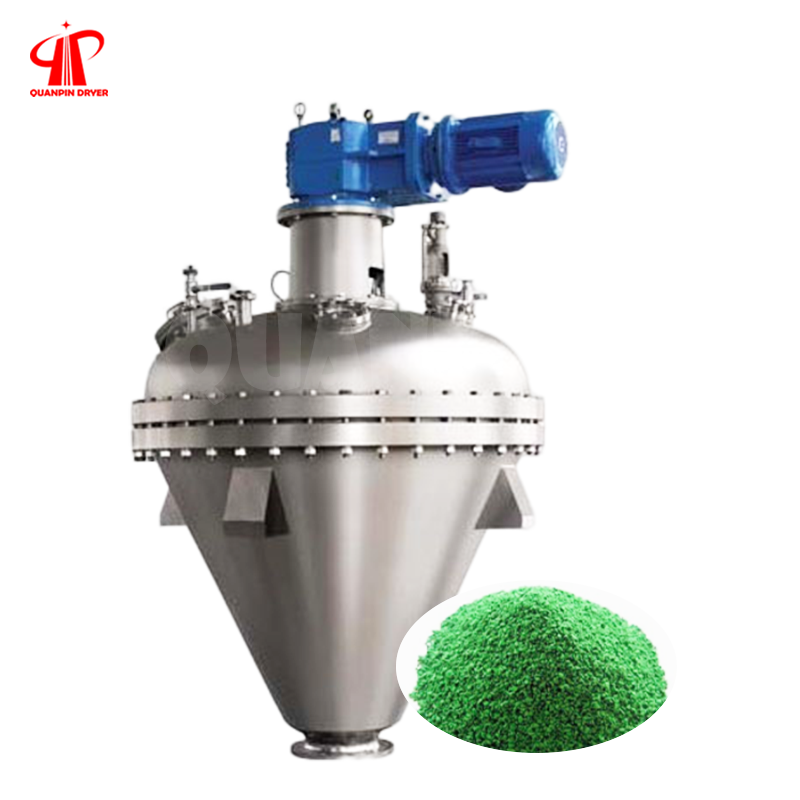
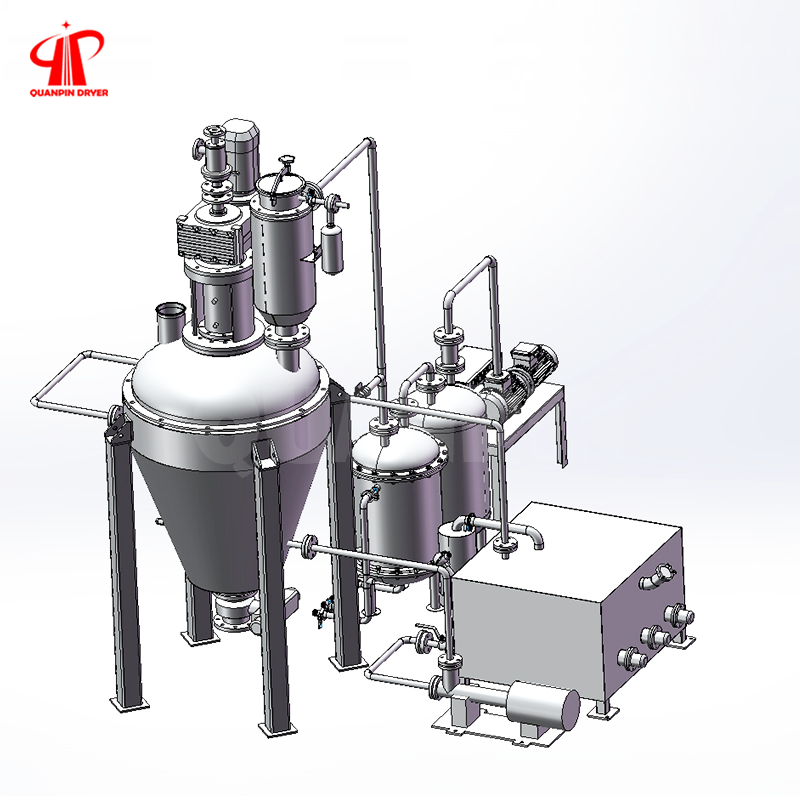
When discussing a Single-Cone Ribbon Vacuum Dryer, identify required sampling and analytical responsibilities as well as the equipment duty. Agree how observations will be compared.
Retain Measurements and Model Assumptions
Retain raw observations, sampling records, analytical methods and model assumptions together. These records make later interpretation possible when formulation or material form changes.
Use the resulting evidence to refine the process question and equipment specification. A credible conclusion remains limited to the tested material and documented conditions.
Frequently Asked Questions
Does low pressure prove low internal solvent?
No. Chamber pressure does not directly quantify the concentration inside every particle or establish which transfer resistance controls the observed removal rate.
Is a diffusion coefficient universal?
No. Diffusion behaviour depends on the polymer–volatile system and conditions. Parameters need a stated source and relevant composition and temperature range.
Does a slowing curve prove skin formation?
No. A falling drying rate can have several explanations. Evidence about the actual material is needed before a skin or concentration gradient is identified.
Can a film model describe an agitated bed?
Only after evaluating geometry, movement and boundary conditions. The cited film and droplet studies are mechanistic references, not validated models of a GLZ production batch.
Is mass loss a species-specific assay?
No. Specify whether the question concerns total mass loss or a particular volatile species and use an analytical method appropriate to that question.
What should accompany an enquiry?
Provide material identity, volatile composition, physical form, process histories and the analytical question. Identify what must be measured to distinguish the competing transport explanations.
Discuss Your GLZ Polymer-Drying Duty
Discuss the material, processing objective and required trials with QUANPIN. Review the equipment information and the relevant industry applications, or send an enquiry through our contact page.
Email sales@qpdryer.com or stacie@qpdryer.com. Call +86 19850785582 or contact WhatsApp +86 15921493205 to discuss the proposed scope.
For process evaluation, consider the vertical ribbon vacuum dryer for conical vacuum drying with screw agitation. Confirm suitability with representative material, the required product properties and the proposed process conditions.