GHL high-speed mixing granulation brings a powder blend, binder liquid and mechanical mixing into one wet-mass operation. The main impeller circulates the charge while the chopper acts on agglomerates. The resulting granules reflect how liquid reaches the powder and how long the developing mass remains under mechanical work. Understanding those actions helps explain both the appeal of the arrangement and the causes of troublesome batches.
For a pharmaceutical blend, the development target is a wet mass that can leave the vessel and produce useful granules after drying. A visually attractive wet sample is only part of that assessment. The following production sequence links charging, wetting, granule growth, discharge and dryer loading without assuming that one binder level or mixing period transfers between formulations.
- Set the charging sequence deliberately. Powders with different bulk behavior may settle or remain near the wall before mixing establishes circulation. Record the order of addition and the condition of cohesive ingredients. A granulator should receive an identified blend rather than an unexplained mixture assembled differently for each trial. Review this stage with the high shear granulator configuration. For finished-drug operations within its scope, 21 CFR 211.89 supports this requirement: keep rejected powder components identified and quarantined so they cannot enter a production charge.
- Check dry circulation before wetting. The impeller must move material through the working zone so that binder can encounter more than one local pocket. Observe the proposed working charge using suitable development methods. Vessel capacity alone cannot show whether a particular blend circulates effectively at that loading. For finished-drug operations within its scope, 21 CFR 211.101 supports this requirement: identify and control the weighing or measuring and addition of components for the batch.
- Prepare binder consistently. Dissolved solids, viscosity and holding conditions influence how the liquid spreads through powder. Keep preparation records linked to the granulation run. Two binder preparations with the same nominal composition may still behave differently if one contains undissolved material or has changed during storage. For finished-drug operations within its scope, 21 CFR 211.87 supports this requirement: consider retesting approved binder components after prolonged storage or exposure that might adversely affect them.
- Match addition with circulation. Introducing liquid faster than powder redistributes can create local wet lumps while another region remains dry. Review the addition point and delivery consistency together. The purpose is controlled wetting of moving powder, not simply achieving the planned total addition as quickly as possible. Review this stage with the high speed mixer granulator configuration. For finished-drug operations within its scope, 21 CFR 211.100 supports this requirement: document the approved binder-addition and mixing procedure, and record and justify deviations when they occur.
- Distinguish the two mechanical actions. The impeller drives bulk movement and wet-mass consolidation; the chopper helps disrupt agglomerates within that moving charge. Their interaction determines the observed structure. Increasing either action should answer a specific process problem rather than serve as a universal response to uneven granules.
- Follow the growth of wetted clusters. Initial liquid bridges hold particles together, and further collisions and deformation change the clusters. Retain samples that show both lumps and remaining fines. Removing unusual pieces before inspection can hide the very distribution problem that development needs to explain.
- Choose an endpoint connected to dried output. Wet appearance, consistency and suitable operating signals can help describe batch development, but they need comparison with the intended final granules. Dry and size representative portions before deciding that a particular wet-mixing condition is acceptable for the formulation. Review this stage with the High-Speed Mixing Granulator configuration.
- Account for continued mechanical work. A batch can keep changing after binder addition ends. Record the interval to discharge and inspect whether the mass becomes denser, stickier or harder to transfer. A practical operating window includes likely production delays rather than only the shortest laboratory sequence.
- Observe the outlet during discharge. Wet material may adhere near the opening while the central charge empties readily. Assess the retained fraction and its condition before cleaning. Recovery matters because the next operation receives the discharged portion, not the idealized composition of the original vessel charge. For finished-drug operations within its scope, 21 CFR 211.103 supports this requirement: calculate actual yield and its percentage of theoretical yield at appropriate production phases.
- Coordinate wet transfer and drying. Long drops, compression in a receiver and prolonged holding can alter the newly formed granules. Reproduce the intended transfer route during development. Comparing granulator settings is less useful when each trial also uses a different collection depth or delay before dryer loading. Review this stage with the rapid mixer granulator configuration.
- Apply the process to a defined blend. Pharmaceutical excipients and active-containing blends can have very different wetting and deformation behavior. State sensitivity to water, binder and mechanical work separately. Granulation may change handling characteristics, but a machine mechanism alone cannot establish dissolution, stability or final dosage performance.
- Ask for a complete demonstration. Supply QUANPIN with the blend, binder preparation and intended receiving dryer. Review dry mixing, addition, discharge and cleaned equipment access in one campaign. Select the configuration using representative batch behavior rather than a brief demonstration with an easy-flowing substitute powder.
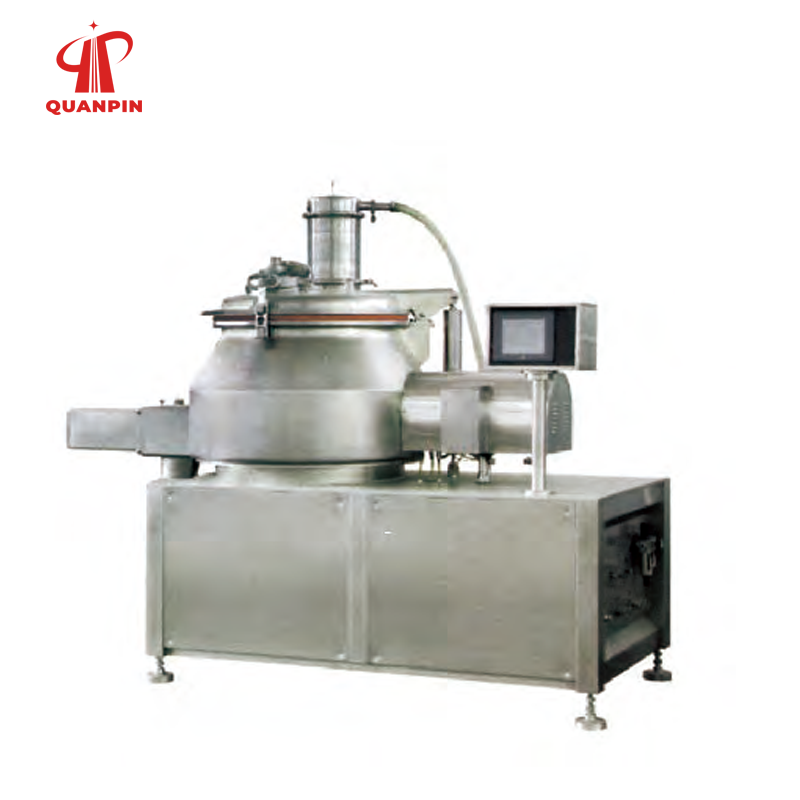
Discuss your material and production route with QUANPIN. Review the corresponding equipment information before arranging a material trial.
YANCHENG QUANPIN MACHINERY CO.. LTD
Sales Manager – Stacie Tang
MP: +86 19850785582
Tel: +86 0515-69038899
E-mail: stacie@qpdryer.com
WhatsAPP: 8615921493205
https://quanpindrying.en.alibaba.com/
Address: Jiangsu Province, China.