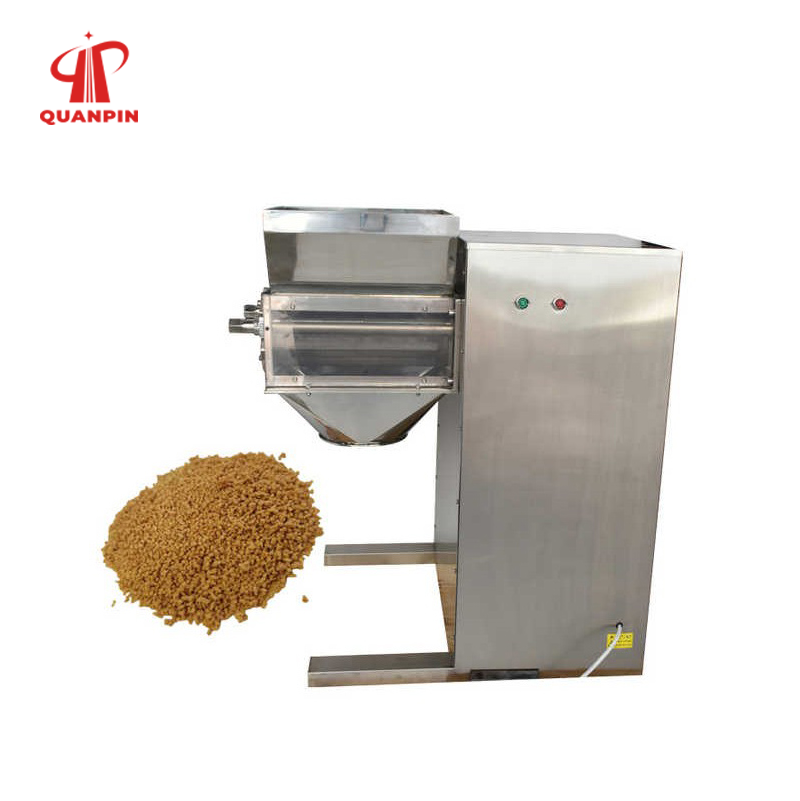
The YK oscillating granulator uses a moving rotor and screen to turn a prepared wet mass into smaller granules. Its task begins after the formulation has acquired the cohesion needed for screening. The machine therefore exposes differences in wet-mass consistency very directly: one portion may pass cleanly while another smears across the openings or breaks into excessive fines.
For pharmaceutical production, screening is part of a longer route from binder preparation to dried granules. The screen helps shape that route, but downstream drying and handling determine whether the output is useful. A practical evaluation follows the material through the hopper, rotor, mesh, collection tray and dryer while preserving the identity of each trial condition.
- Define the material entering the hopper. A prepared wet mass should be identified by formulation, mixing history and holding condition. Loose dry powder and an adhesive paste are different feed challenges. Use representative material during selection rather than assuming that a successful demonstration with one formulation covers another. Review this stage with the Oscillating Granulator configuration.
- Check cohesion before screening. Material must hold together sufficiently to form granules yet yield under the rotor action. Compare a crumbly portion with a more plastic portion from the same development program. Their passage and recovered particle distribution help establish a useful feed window without inventing a universal moisture target.
- Feed the working region consistently. Large intermittent charges can compact the mass differently from a controlled supply. Watch for bridging in the hopper and uneven engagement across the rotor. Record interruptions because a later restart may process material that has rested and changed consistency since preparation.
- Follow the oscillating movement. The rotor repeatedly works material against the screen rather than relying on a continuous high-speed impact route. Observe whether the mass turns over and passes through the available openings. Persistent rolling without passage suggests a different problem from immediate smearing across the mesh. Review this stage with the oscillating granulator machine configuration.
- Select the screen through a material trial. Opening size influences the form emerging from the machine, but wet pieces can deform or join during collection. Compare dried samples as well as wet discharge. A nominal aperture does not alone specify the final granule-size distribution delivered to the next operation.
- Watch for progressive blinding. Sticky feed can coat openings and reduce the area available for passage. A short initial run may miss this development. Observe the condition after sustained processing and record whether output changes as deposits build, rather than judging performance only from the first collected portion.
- Inspect the screen before and after operation. Attachment condition, visible damage and retained material deserve attention together. Keep screen identity with the trial record so that a change in output can be interpreted. An unnoticed screen replacement can otherwise be mistaken for a formulation or binder effect. Review this stage with the swing granulator configuration. For finished-drug operations within its scope, 21 CFR 211.105 supports this requirement: identify major processing equipment with its contents and batch status during production.
- Collect without compacting the output. Fresh wet granules may deform when a receiver becomes deep or when material falls onto an accumulated pile. Arrange prompt spreading or transfer appropriate to the dryer. The screen can produce a useful shape that is subsequently lost through an unsuitable collection arrangement. For finished-drug operations within its scope, 21 CFR 211.111 supports this requirement: establish appropriate time limits for production phases where needed to assure product quality.
- Link screening to drying. Wet granules contain liquid and may shrink, harden or break as drying proceeds. Assess moisture and physical condition using suitable methods after the intended drying route. Do not accept the wet output merely because its appearance is regular at the screen outlet. For finished-drug operations within its scope, 21 CFR 211.110 supports this requirement: use defined in-process sampling and tests to monitor manufacturing output and relevant sources of variability.
- Evaluate a pharmaceutical excipient mass specifically. Binder type and powder characteristics influence screen passage and dried friability. Use the formulation intended for production and include realistic preparation variation. Suitability for one damp blend does not establish that a more elastic or adhesive mass will process in the same way. Review this stage with the pharmaceutical granulator configuration.
- Plan cleaning around both mesh faces. Residue can remain behind openings and near the rotor attachments. Review safe removal, inspection and correct reassembly with operators. Ease of access is a practical selection issue because a screen that cannot be inspected consistently complicates campaign preparation and repeatable setup. For finished-drug operations within its scope, 21 CFR 211.113 supports this requirement: include appropriate written controls against objectionable microorganisms for nonsterile drug products.
- Set acceptance around recovered granules. Ask QUANPIN to demonstrate the actual feed, a sustained screening period and the planned collection method. Retain material from the beginning and end for comparison after drying. A useful result connects passage, screen condition, recovered output and preparation effort in one record. For finished-drug operations within its scope, 21 CFR 211.115 supports this requirement: if a failed granule batch is considered for reprocessing, use written procedures and obtain quality-control review and approval.
Discuss your material and production route with QUANPIN. Review the corresponding equipment information before arranging a material trial.
YANCHENG QUANPIN MACHINERY CO.. LTD
Sales Manager – Stacie Tang
MP: +86 19850785582
Tel: +86 0515-69038899
E-mail: stacie@qpdryer.com
WhatsAPP: 8615921493205
https://quanpindrying.en.alibaba.com/
Address: Jiangsu Province, China.