A three-dimensional blending route repeatedly changes the direction in which dry ingredients move inside a closed vessel. It can suit compatible powders or granules that respond to vessel motion. The useful production plan includes ingredient preparation, usable volume, clearance around the moving assembly and a receiving route that preserves the formulation.
The following production sequence explains how the equipment fits between ingredient preparation and the next operation. Equipment-specific settings, contact materials and performance depend on the selected configuration and actual feed. Define the required product condition and the complete batch or hourly duty before finalizing the supply scope.
- A 3D powder mixer changes vessel orientation along several axes. Each change redirects the material and brings different portions of the batch together. The movement explains the blending mechanism without assuming that every particle follows a prescribed identical path. The actual flow still depends on the formulation and the space available inside the vessel.
- A three dimensional mixer needs ingredients that can redistribute. Dry solids that remain as a cohesive mass may not respond as expected to a changing vessel orientation. Specify whether deagglomeration is required before loading and discuss an appropriate preparation route. Compound motion should not be described as a universal substitute for intensive size reduction.
- A three dimensional powder mixer should be reviewed using working volume and density information. A replacement carrier can occupy a different volume from the previous ingredient at the same weighed mass. Confirm the working fill for the selected configuration and recipe before carrying an existing production instruction over to a changed formulation.
- A multidirectional mixer requires clearance for the complete moving assembly. Review its operating envelope, charging position and receiver access with nearby equipment. A static footprint does not describe every space needed during movement, inspection or cleaning. Use the installation information for the actual configuration when planning aisles and adjacent process equipment.
- One possible advantage of this route is redistribution without an internal ribbon or screw agitator. It may fit a dry-premix workflow where vessel movement is preferred. This is a description of the mechanism, not a guarantee of shorter cycles or universal gentleness. Fragile solids and difficult ingredient combinations still need an application-specific review.
- Complete the route with an identified receiver. Ingredients with different sizes or densities can separate during later pouring or vibration even if they were mixed inside the vessel. Reduce unnecessary transfers where practical and define the path to the next operation. The batch should remain identifiable through charging, blending, discharge and any intermediate storage.
- FAO links ingredient preparation, accurate weighing and mixing in its feed-manufacturing discussion. For a three-dimensional food blending route, the transferable principle is to prepare and measure the components before loading. The source does not establish a SYH operating time or prove that every recipe will resist segregation after discharge. Read the FAO discussion of ingredient preparation and mixing for the supporting context.
- CCOHS explains that finely divided combustible materials can become explosible under suitable conditions and identifies food powders among relevant materials. Include the actual starch or protein recipe in the site assessment. A closed mixing vessel is one part of the installation and does not establish the protection level of its loading and discharge points. Read the CCOHS combustible dust guidance for the supporting context.
- HSE explains dust explosion conditions and precautions in food processing. For a rotating-vessel line, review powder escape during charging and emptying as well as accumulation around nearby equipment. The intended housekeeping method and collection arrangement should suit the material and site rather than depend on a generic equipment description. Read the HSE food dust explosion guidance for the supporting context.
- HSE identifies flour dust and enzyme-containing additives as causes of occupational asthma in bakery work. If these ingredients enter a three-dimensional mixing recipe, review exposure during weighing and charging. This ingredient-specific concern should be communicated alongside the blending duty rather than being inferred from the name of the mixer. Read the HSE bakery asthma guidance for the supporting context.
- HSE advises avoiding dust generation when loading and mixing flour. For a flour-containing batch in a compound-motion vessel, plan an appropriate charging and receiving arrangement. The leaflet provides handling context; it does not establish that this mixer eliminates exposure or that its vessel motion controls airborne powder outside the machine. Read the HSE flour handling leaflet for the supporting context.
- Specify a practical production cycle. Include loading, processing, discharge, inspection and changeover when discussing the required output. Give QUANPIN the complete formulation, feed condition, bulk density, target batch or hourly duty and downstream equipment arrangement. Request a configuration review with representative material before committing to the final scope. Acceptance should describe the usable product and operating conditions, rather than an unsupported promise of perfect powder or uniformity.
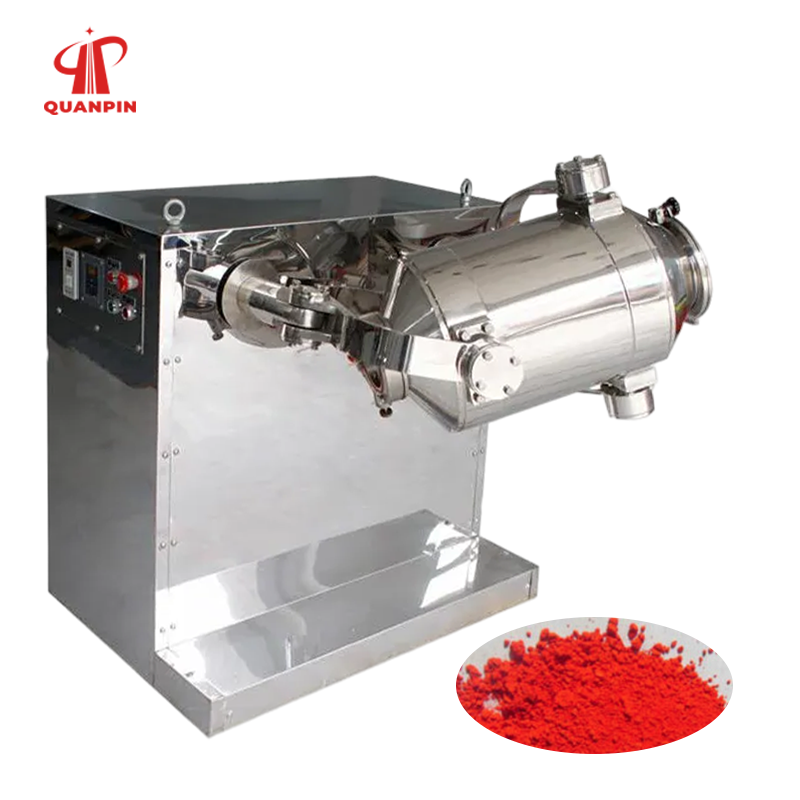
Discuss your material and production route with QUANPIN. Review the corresponding equipment information before arranging a material trial.
YANCHENG QUANPIN MACHINERY CO.. LTD
Sales Manager – Stacie Tang
MP: +86 19850785582
Tel: +86 0515-69038899
E-mail: stacie@qpdryer.com
WhatsAPP: 8615921493205
https://quanpindrying.en.alibaba.com/
Address: Jiangsu Province, China.