A double-cone production cycle combines prepared ingredients with a rotating closed vessel and an agreed discharge route. Gravity-driven redistribution can suit free-flowing dry solids, but the full workflow includes the operations before and after rotation. Working volume, ingredient compatibility and the receiving container all influence the usefulness of this route.
The following production sequence explains how the equipment fits between ingredient preparation and the next operation. Equipment-specific settings, contact materials and performance depend on the selected configuration and actual feed. Define the required product condition and the complete batch or hourly duty before finalizing the supply scope.
- Start the double cone blender cycle with a prepared ingredient set. Identify each component and check whether it can move freely in the vessel. Unwanted lumps should be addressed before loading if the recipe requires their removal. Tumbling is a redistribution mechanism; a cohesive mass may move as one lump rather than disperse into separate particles.
- A double cone mixer rotates its vessel so the solids repeatedly divide and recombine under gravity. The material needs free space to move. Specify an agreed working fill for the selected vessel rather than equating the entire internal volume with usable batch volume. Changing the formulation density can change the occupied volume without changing the intended batch mass.
- The double cone powder mixer may be discussed for compatible dry food carriers and granular blends. Review differences in particle size and density because ingredients that meet during tumbling can separate later. Suitability should be assessed for the actual formulation and receiving arrangement, not inferred solely from the fact that both ingredients are dry.
- A double cone tumble blender can provide a route without an internal ribbon agitator. This structural feature can suit a blending discussion where a rotating vessel is preferred. It does not prove that particles experience no contact or damage. Material moves against other solids and the vessel, so fragile components still need a realistic handling review.
- Plan a repeatable loading order. A small ingredient added against an empty vessel wall may behave differently from one introduced with a compatible carrier. Describe the premixing method where needed and keep the weighed ingredients identified until charging is complete. The machine cannot compensate for an omitted ingredient or an incorrect weighed quantity.
- Decide how the blend leaves the vessel. A long drop or several later transfers may rearrange ingredients with different sizes or densities. Place the receiving container and packing route within the process review. The objective is an acceptable mixture at the next operation, which makes controlled transfer part of blending rather than a separate afterthought.
- CFIA describes allergen cross-contact as unintended transfer and explains that preventive controls are needed through preparation. A double-cone blending changeover includes loading tools, vessel surfaces and the discharge receiver. A later processing step should not be assumed to remove an allergen introduced by retained ingredients from a previous recipe. Read the CFIA allergen preventive controls for the supporting context.
- FAO identifies particle size, measurement, mixer type and mixing duration as influences on mixture homogeneity. These are general formulation principles, not a performance claim for an SZH vessel. For a food powder, define ingredient preparation and accurate weighing before deciding how long the rotating-vessel stage should run. Read the FAO feed preparation chapter for the supporting context.
- HSE identifies flour dust and powdered ingredients as occupational exposure concerns in bakery work. When a double-cone recipe contains flour, include weighing, charging and emptying in the exposure review. Keeping the vessel closed during rotation still leaves handling tasks that need appropriate controls around the machine. Read the HSE bakery dust control messages for the supporting context.
- HSENI explains that flour milling and subsequent handling can release dust and identifies mixing among relevant tasks. Apply this concern specifically to flour-containing formulations rather than assuming every food powder has the same hazard profile. Review the receiving container and transfer method as carefully as the rotating vessel. Read the HSENI flour dust guidance for the supporting context.
- HSE discusses machinery and dust hazards in food manufacturing, including grinding and mixing equipment. For a double-cone installation, consider the movement envelope, access arrangements and routine operating tasks. Confirm the equipment-specific guarding and isolation arrangements with the supplier and the responsible site personnel before fixing the production layout. Read the HSE food manufacturing safety guidance for the supporting context.
- Specify a practical production cycle. Include loading, processing, discharge, inspection and changeover when discussing the required output. Give QUANPIN the complete formulation, feed condition, bulk density, target batch or hourly duty and downstream equipment arrangement. Request a configuration review with representative material before committing to the final scope. Acceptance should describe the usable product and operating conditions, rather than an unsupported promise of perfect powder or uniformity.
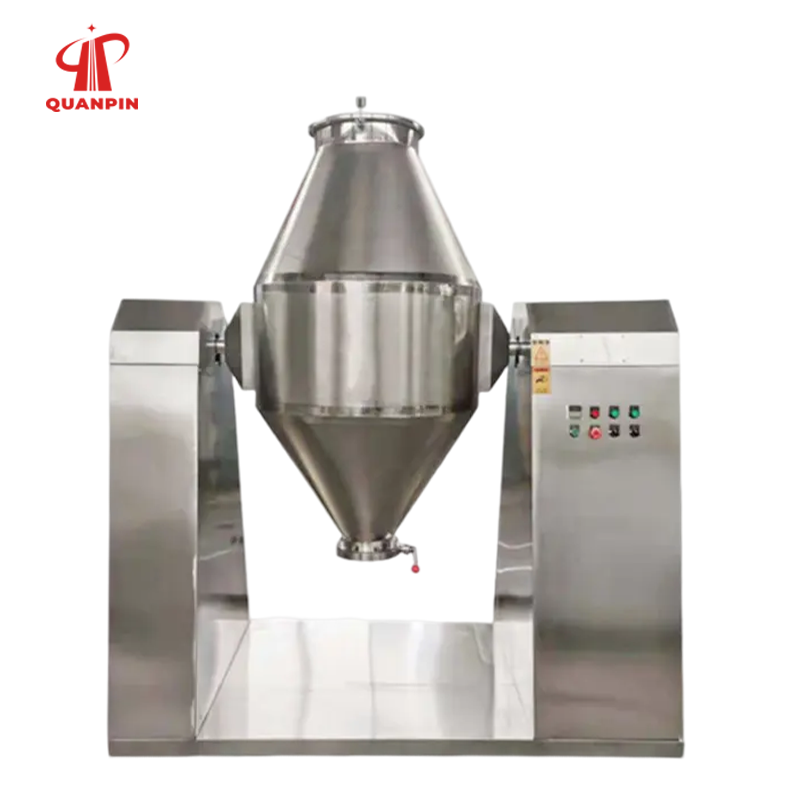
Discuss your material and production route with QUANPIN. Review the corresponding equipment information before arranging a material trial.
YANCHENG QUANPIN MACHINERY CO.. LTD
Sales Manager – Stacie Tang
MP: +86 19850785582
Tel: +86 0515-69038899
E-mail: stacie@qpdryer.com
WhatsAPP: 8615921493205
https://quanpindrying.en.alibaba.com/
Address: Jiangsu Province, China.