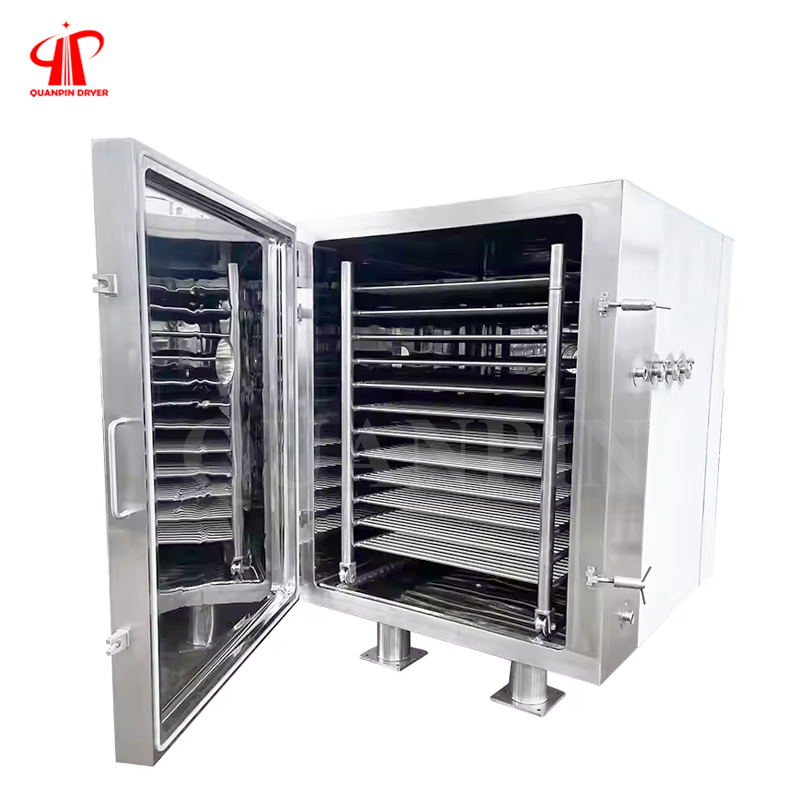
Vacuum tray drying should be evaluated as a production sequence for aqueous pharmaceutical wet solids, rather than as a machine purchased in isolation. The arrangement uses stationary trays inside a sealed chamber. Indirect heat supplies the energy for evaporation while reduced pressure changes the evaporation conditions. Vapor leaves through the coordinated vacuum arrangement. A useful equipment discussion begins with the incoming material and ends with the condition needed by the receiving operation. A nominal output figure cannot establish that the formulation will behave acceptably throughout this sequence.
Static operation avoids continuous mechanical agitation, which may suit delicate granules or other tray-loadable material. Establish the process boundary before a trial: include preparation, transfer, the main operation, collection and cleaning. Formulation development and the manufacturer’s quality system determine the acceptance criteria. The equipment description does not establish pharmaceutical compliance, finished-product quality or a universal operating recipe. This workflow focuses on the observations needed to make a material-specific decision.
- Spread material to a defined tray loading depth. Keep corners and edges comparable with the center rather than leaving isolated heaps. Static operation does not redistribute the batch during drying, so differences created while spreading can persist. Define both the mass per tray and the physical arrangement used in development. Discuss the vacuum tray dryer in relation to this requirement.
- Review the heat path into the stationary layer. The heating utility supplies energy, while reduced pressure supports evaporation at different conditions. Distinguish the heating-medium setting from the temperature measured in the product. Increasing one setting does not prove that every part of the tray load has received comparable treatment. For finished-drug manufacturing within the regulation’s scope, quality-unit approval and rejection responsibilities are defined in 21 CFR 211.22.
- Specify the vacuum arrangement around the vapor duty. Consider expected evaporation, pressure requirement and any condensation equipment together. A chamber pressure reading is useful operating information, but it cannot by itself demonstrate that the system handles the changing vapor load of a wetter or larger charge. Discuss the vacuum tray drying machine in relation to this requirement.
- Inspect the door gasket and vacuum boundary before loading. Define the response to an unsuccessful pressure check rather than compensating with an extended cycle. Arrange trays so loading does not damage seals or obstruct connections. Include safe tray movement and access to shelves in the installation review. For finished-drug manufacturing within the regulation’s scope, operation-specific training is required under 21 CFR 211.25.
- Observe material through the moisture transition using an appropriate trial method. A surface that appears dry may conceal wetter material underneath. Compare samples from defined tray positions and loading conditions. Keep their identities until the team understands the distribution instead of immediately pooling every sample into a single result. Discuss the FZG vacuum tray dryer in relation to this requirement.
- Restore pressure through a defined sequence after the cycle. Confirm when the chamber is safe to open and how hot trays are handled. Review the admitted air or gas against product sensitivity and contamination requirements. Cooling, pressure restoration and unloading are part of the batch duty, not incidental delays. For finished-drug manufacturing within the regulation’s scope, personnel hygiene and protective apparel are addressed in 21 CFR 211.28.
- Define acceptance before interpreting results. Assess the moisture or wet-mass condition alongside the physical properties required downstream. Appearance alone may hide a local difference that matters later. Keep development samples traceable to their collection position and operating period until the process team understands the variation and has chosen a justified routine sampling method. Discuss the vacuum tray dryer for pharma in relation to this requirement.
- Coordinate vapor removal with the receiving operation. Determine how material leaves the working zone and what happens immediately afterward. Avoid unnecessary drops, compression or open holding where they would change the product. A satisfactory sample at the machine outlet does not prove that the material retains the same condition after transfer into a production container. For finished-drug manufacturing within the regulation’s scope, facility space and material flow must prevent contamination and mixups under 21 CFR 211.42.
- Plan pressure restoration before finalizing the installation. State the receiving capacity, holding conditions and response to an interruption. Material retained during a stop may have a different history from normal output. Define how the retained portion is identified and assessed instead of automatically combining it with the next satisfactory production portion.
- Include cleaning and inspection in the batch schedule. Review access with the people who will perform routine work. Identify how assemblies are removed, checked and restored where applicable. Product-contact residue and an incorrectly restored component can influence the next batch even when the main production step appeared stable during the previous run. For finished-drug manufacturing within the regulation’s scope, appropriate ventilation and contaminant controls are required under 21 CFR 211.46.
- Use results to refine the equipment brief. Provide QUANPIN with the actual aqueous pharmaceutical wet solids, intended batch or continuous duty, utilities and final material requirements. Request review of operating interfaces as well as the main machine. Keep unsupported output, energy-saving and quality claims out of the specification until an appropriate test or agreed technical document establishes them.
- Judge the complete production route. Static operation avoids continuous mechanical agitation, which may suit delicate granules or other tray-loadable material. Compare usable product condition, handling reliability and practical turnaround rather than one isolated operating observation. Agree the trial acceptance criteria and document the selected configuration. Routine production should follow the developed procedure, with deviations assessed through the manufacturer’s quality system rather than treated as informal operator preferences.
Discuss your material and production route with QUANPIN. Review the corresponding equipment information before arranging a material trial.
YANCHENG QUANPIN MACHINERY CO.. LTD
Sales Manager – Stacie Tang
MP: +86 19850785582
Tel: +86 0515-69038899
E-mail: stacie@qpdryer.com
WhatsAPP: 8615921493205
https://quanpindrying.en.alibaba.com/
Address: Jiangsu Province, China.