Batch Wet Granulation Scale-Up: Build a Comparability Plan Beyond Matching Speed
By QUANPIN
A batch high shear granulator scale-up should begin with a comparability question: which material and product properties must remain acceptable when bowl size changes? Copying revolutions per minute is an instruction, not evidence that the larger batch follows an equivalent process.
A useful transfer plan compares candidate scaling rules, records the physical equipment differences, and checks downstream performance. The goal is a justified operating region for the actual formulation rather than a universal number borrowed from another installation.
Start with the Comparability Decision
Define whether the project transfers between similar bowls, different machine designs, or laboratory and manufacturing equipment. Each route changes the assumptions behind any proposed relationship between speed, geometry and powder motion.
Specify the pharmaceutical product response before choosing the rule. Granule handling, tabletability and dissolution may respond differently, so a successful transfer needs criteria connected to the intended dosage form.
Recover the Development Reference
Build the reference from a documented development batch and its variation. Include raw-material lots, loading, liquid preparation, delivered quantity, addition sequence, massing duration, drying conditions and the tests used after processing.
An incomplete reference leaves the team comparing two unknown processes. Recover missing records or run a suitable reference trial before treating differences at larger scale as an equipment-scaling problem.
Five Transfer Records
Geometry
Record usable bowl geometry and the relevant mixing dimensions. Nominal capacity alone does not describe blade diameter, clearances or the space through which the wet mass circulates.
Loading basis
State the dry loading basis and occupied volume where available. Matching a powder mass ratio is different from maintaining a comparable fill state, particularly when raw-material density changes.
Liquid delivery
Describe liquid delivery as an actual operation. Delivery rate, addition duration, location and liquid composition should be visible alongside total liquid quantity rather than hidden inside a single recipe label.
Distinct processing phases
Separate liquid-addition time from subsequent wet massing. Increasing total run time without distinguishing these phases can alter wetting history and mechanical exposure in different ways.
Sampling boundary
Identify the downstream sampling boundary. Wet material at discharge, dried granules and lubricated compression blends are different populations, and they should not be compared as if they were interchangeable.
Understand the Candidate Scaling Rule
An original comparison of scale-up rules examined granule properties, tabletability and dissolution in a low-drug-loading cellulose-lactose formulation. Constant tip speed did not produce identical granulation at all scales.
In that study, alternative speed rules and longer wet massing provided routes toward comparable growth and densification. The finding supports testing the proposed rule against several responses instead of assuming geometric similarity is sufficient.
Tip speed describes blade-edge velocity, while a Froude-based rule relates motion and gravity through speed and dimension. They cannot generally both remain constant when the relevant impeller diameter changes.
Write the selected relationship and units into the protocol. A statement such as same speed is too ambiguous to show whether the comparison used rotational speed, tip speed or a dimensionless criterion.
Six Checks Before the Larger Batch
A starting hypothesis
Use a rule as a starting hypothesis. It should predict a reasonable initial comparison, but the trial still needs to establish whether the material actually reaches the intended quality region.
Material history
Keep formulation and raw-material history visible. A process that appears to scale poorly may also have changed excipient lot, particle distribution, initial moisture or binder preparation during transfer.
Mechanical phase
Define the relevant mechanical phase. Dry blending, liquid addition and wet massing need not share the same scaling objective, and a single blanket adjustment can conceal their different functions.
Equipment limits
Keep practical equipment limits in the plan. Available speed ranges, liquid-delivery arrangements and safe loading constraints define which candidate conditions can actually be investigated.
Interpretable observations
Select observations that can challenge the rule. Product-temperature history, process signals and wet-mass observations become useful when tied to the sampled product rather than recorded without an interpretation plan.
Rejection criteria
Predetermine what would reject the initial rule. A transfer exercise is more informative when it includes a decision to revise the hypothesis if a critical downstream response changes.
What Original Scale-Up Studies Establish
Formulation-dependent sensitivity
A lactose down-scaling investigation compared several laboratory bowl volumes with a pilot-scale process. Within its tested region, water concentration influenced yield and granule properties while tip-speed variation did not affect the reported granule or tablet properties.
This is a formulation-specific result, not a reason to ignore speed in every rapid mixer granulator. It shows that the sensitivity of a parameter has to be established within the actual experimental region.
A practical implication is to avoid over-interpreting an apparently insensitive factor. An acceptable range in one liquid level, formulation or bowl arrangement need not remain insensitive after those conditions change.
Internal-stress evidence
An internal-stress scale-up experiment evaluated a lactose, cornstarch and cellulose mixture with a polymer binder. Measured stress and granule properties were related to agitator tip speed in that investigated system.
The work provides a different basis for a scaling hypothesis from the lactose down-scaling experiment. Comparing these results helps explain why a single preferred scaling rule should not be presented as universally valid.
A standard GHL installation should not be assumed to include the study’s internal-stress measurement system. Confirm the observations available on the proposed machine and plan external product tests accordingly.
Normalized impeller work
An impeller-work study calibrated power measurements across equipment and integrated power over time. Work normalized by dry powder mass correlated with granulation and tablet-related changes in its cellulose formulations.
An integrated work value is not the same as a momentary power reading. If work is investigated, preserve calibration, baseline treatment, time interval and normalization so the comparison has a reproducible meaning.
The source does not establish a universal energy target for a high shear mixer granulator. The relevant relationship must be demonstrated for the formulation and equipment being transferred.
Compare the Reference and Candidate Runs
Construct a comparison table with the reference and each candidate larger-scale condition. Display the proposed rule, actual settings and deviations, followed by the observed granule and downstream responses.
Keep full distributions where they inform the decision. Similar median granule size can coexist with different fines, oversize or density populations, which may behave differently in handling and compression.
Compare drying conditions and the state at testing explicitly. If one batch receives a different drying history, the final response cannot be attributed solely to the larger granulation bowl.
Use repeated confirmation where the consequence of transfer requires it. A single successful batch can identify a candidate region but does not describe its reproducibility or sensitivity to ordinary input variation.
Check the Pharmaceutical Response
An scale-dependent granule dissolution study combined concentration and particle-size measurements. It identified populations that disintegrated and populations that released material while retaining size, illustrating a response hidden by a simple size comparison.
For pharmaceutical transfer, select dissolution and disintegration observations appropriate to the product. Do not assume that reproducing a dried size distribution independently proves the required release behavior.
Investigate Divergence Before Correcting It
Review the wet and dry intermediate together. If wet samples look comparable but dried material diverges, inspect the downstream route before changing the granulator scaling rule.
Review flow and compression as separate responses. A condition that improves handling may change densification and later tablet behavior, so selecting the best-looking granules is not a sufficient transfer criterion.
Record material recovery and rejected fractions. A nominally comparable retained fraction can conceal different process yield or deposition, which matters when interpreting the overall batch outcome.
Investigate deviations using the original hypothesis. If a larger batch misses the target, identify whether the evidence challenges loading, liquid distribution, mechanical exposure or a downstream condition.
Change proposed corrective factors deliberately and document why. Adjusting several factors until a batch passes can produce a usable observation but weak evidence about which change made the transfer succeed.
Retain the unsuccessful conditions in the report. They define the boundary of the investigation and prevent a later reader from treating the selected condition as if it were the only one tested.
Prepare a GHL Transfer Discussion
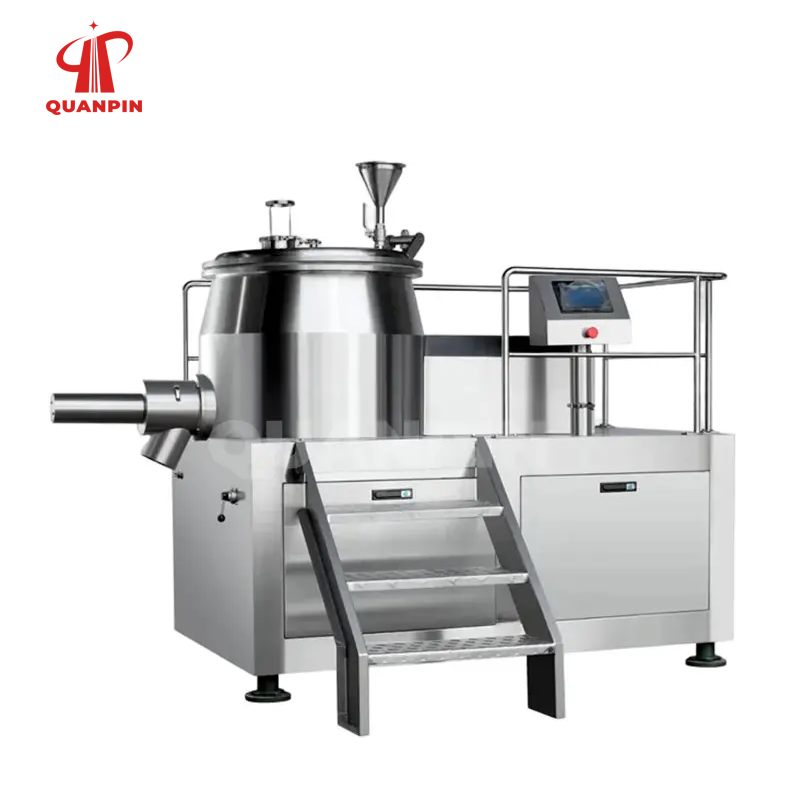
For a QUANPIN discussion, provide the reference sequence, material characteristics, target batch range and comparability tests. This lets the equipment conversation address the actual transfer objective rather than capacity alone.
Use the GHL product page as a starting point and confirm the proposed configuration. Published third-party experimental machines do not establish the supplied features of the requested installation.
Include Verification in the Purchase Scope
A meaningful high shear granulator price comparison includes the scope of trials, measurements and records. Offers covering different verification work are not directly comparable just because their nominal batch capacities match.
Treat the high shear wet granulator as one stage in the transfer route. The purchasing specification should state who evaluates drying, sizing, blending and compression interfaces and how findings return to the granulation decision.
Batch Scale-Up Questions
Can rpm be copied?
Can rotational speed simply be copied? It can be recorded as a setting, but equal revolutions per minute do not by themselves establish comparable mechanical conditions when geometry changes.
Is tip speed always best?
Is constant tip speed always the best rule? No. Original studies support different relationships in different formulations and equipment, so the proposed rule must be tested against the required product responses.
Does Froude prove equivalence?
Does equal Froude number prove product equivalence? No. It describes a selected similarity criterion; material, liquid delivery, loading and downstream results still require assessment.
Can work transfer uncalibrated?
Can an impeller-work value transfer without calibration? A meaningful comparison requires a documented measurement basis and integration interval. Unexplained controller readings should not be treated as directly interchangeable energy measurements.
Is median size enough?
Is a matching median granule size enough? No. Review relevant distribution tails, density or porosity, handling and downstream pharmaceutical performance according to the agreed transfer objective.
What can the report claim?
What should the transfer report conclude? State the equipment and materials tested, supported operating region, critical responses and unresolved limits. Avoid extending a successful formulation-specific result into a universal equipment guarantee.
Discuss the Transfer Plan with QUANPIN
Discuss the material, processing objective and required trials with QUANPIN. Review the equipment information and the relevant industry applications, or send an enquiry through our contact page.
Email sales@qpdryer.com or stacie@qpdryer.com. Call +86 19850785582 or contact WhatsApp +86 15921493205 to discuss the proposed scope.
For process evaluation, consider the high speed mixer granulator for high-shear preparation of a suitable wet granulating mass. Confirm suitability with representative material, the required product properties and the proposed process conditions.