GHL Wet Granulation: Distinguish Granule Growth from Hydrate and Solid-State Changes
By QUANPIN
A high shear granulator can change particle size while water simultaneously changes the solid form of a drug. A larger granule therefore does not establish that the starting crystal form survived processing.
This guide concerns pharmaceutical wet granulation with hydrate-forming or otherwise water-sensitive solids. It separates agglomerate growth from solid-state transformation when planning a GHL development study.
Granule Size and Crystal Form Answer Different Questions
Granule growth describes the assembly and size of particles. Hydrate formation describes a change in a crystal involving water; these can occur together without being the same physical event.
An ordinary size distribution cannot identify the crystal arrangement inside its particles. The analytical question must address solid form directly if that attribute matters to the formulation.
Define the GHL Process and the Sensitive Solid
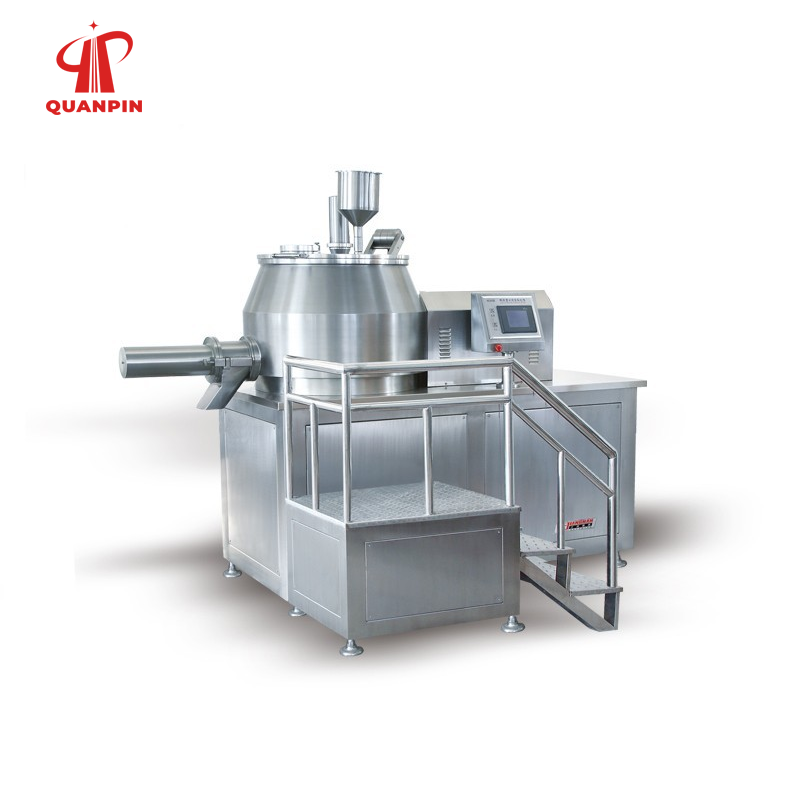
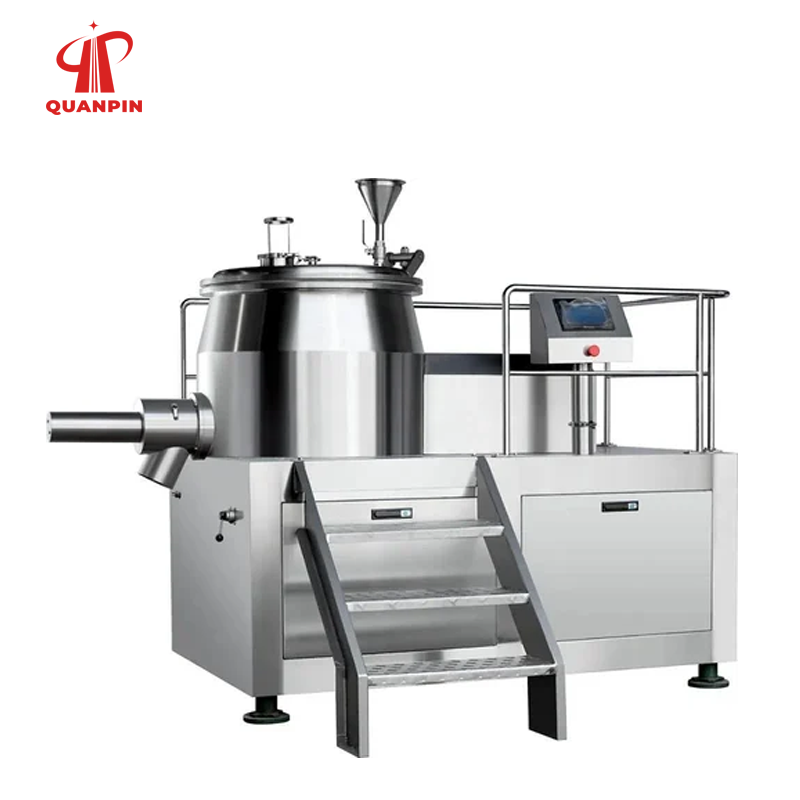
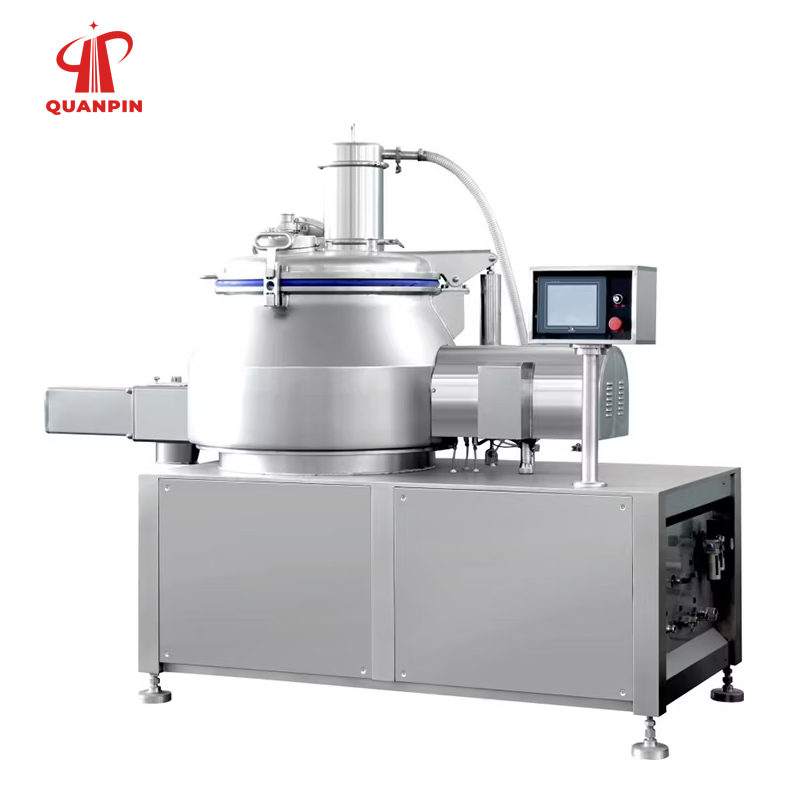
A rapid mixer granulator provides mechanical wet-massing conditions. Whether a particular drug transforms depends on its properties and formulation, rather than on the machine category alone.
Confirm the proposed GHL arrangement with QUANPIN. Raman, NIR and diffraction instruments discussed in research are not assumed accessories or verified functions of the supplied equipment.
Five Analytical Definitions for Development
Starting phase
Define the starting solid form using an appropriate analytical method. An ingredient name alone does not distinguish an anhydrate, hydrate or other crystalline arrangement.
Water interaction
Identify the water source and the stage at which material encounters it. Total water addition and the water available for interaction with a drug are different descriptions.
Excipient context
Keep the excipient composition with the solid-state investigation. Ingredients can alter water availability and the rate of transformation without changing the drug identity.
Granule-size response
Define how granule size will be measured independently. It answers a particle-assembly question that cannot substitute for a crystal-form measurement.
Analytical specificity
Specify which analytical signal represents which attribute. A water-sensitive signal, a molecular spectrum and a diffraction pattern provide different information.
Why Wetting Can Change More than Particle Cohesion
Water can affect more than the cohesion of a wet mass. It can mediate transformation of a drug solid while the material is being agglomerated.
An original theophylline-and-caffeine wet-granulation study compared Raman and NIR observations with X-ray powder diffraction. The methods supplied complementary evidence about hydrate formation and solid-water interactions.
The finding supports choosing measurements for the actual transformation question. It does not imply that every pharmaceutical powder forms a hydrate or that one spectrum identifies all formulation changes.
Keep crystal-form interpretation separate from visual wetness. A granule can appear similar while its internal solid arrangement differs.
Six Stages of a Solid-State Investigation
Before wetting
Before wetting, identify the starting phase. A transformation can only be described clearly when the initial state is known.
During water contact
During water contact, examine whether the drug interacts with water. The presence of liquid does not itself establish how quickly a particular transformation proceeds.
During mechanical massing
During wet massing, distinguish mechanical resistance from solid-state evidence. Torque can change for more than one reason.
During granule growth
During granule growth, retain particle-size results as a separate attribute. Growth and hydrate conversion need not follow an interchangeable time course.
After further processing
After further processing, reassess the phase where relevant. A later specimen does not automatically retain the form present in the wet mass.
During analytical review
During interpretation, compare the signals and their limitations. An unresolved analytical overlap should remain visible rather than being converted into a confident phase assignment.
Read Hydrate Research without Overgeneralizing
Distinguish mechanical and phase signals
Mechanical measurements and spectroscopy can respond differently during the same experiment. A single process trace may therefore be insufficient to distinguish wetting from transformation.
An original high-shear torque and NIR comparison investigated hydrate formation during water addition. Formation history affected the tested material response and liquid requirement.
The study does not make a torque change a universal hydrate detector. A high shear mixer granulator investigation needs material-specific evidence before assigning a mechanical feature to a phase transition.
Assess excipient effects
Excipients introduce another mechanism: they can compete for or interact with water. Nominally equal water addition can therefore lead to different local environments.
An original wet-mass excipient study compared theophylline formulations using NIR and diffraction. The tested excipients affected hydrate-formation kinetics; slower conversion was not equivalent to complete inhibition.
This is a formulation-dependent result. It cannot supply a universal protective excipient, water allowance or GHL processing time for another drug.
Follow later transformations
Changes also need to be interpreted across subsequent operations. Drying can alter a hydrated material, so the final solid-state result may reflect more than the granulation stage.
An original pelletization solid-state investigation followed model drugs through wet processing and drying with complementary analytical methods. NIR water-signal saturation prevented identification of some hydrate changes that other methods resolved.
The apparatus included extrusion and spheronization, rather than a GHL-only process. Its relevant lesson is analytical: a useful water signal can still be insufficient for the phase-identification question.
Cocrystal Dissociation Is a Separate Event
Hydrate formation is not the only possible solid-state event. A pharmaceutical cocrystal can dissociate during wet processing, requiring a different phase interpretation.
An original high-shear cocrystal-dissociation experiment used low-frequency Raman monitoring and diffraction comparisons. Different coformers and disintegrants affected the observed dissociation behaviour in the model formulations.
The study involved small experimental equipment and specific cocrystals. It does not establish that a proposed GHL formulation will dissociate, or that a disintegrant ranking transfers to unrelated solids.
Keep cocrystal dissociation and hydrate formation as distinct events. They share a need for solid-state evidence but should not be treated as identical mechanisms.
Plan Measurements for the Actual Formulation
A high shear wet granulator development plan should identify the potentially sensitive solid first. Choose the measurements that can distinguish its relevant forms.
If spectroscopy is proposed for a trial, confirm feasibility and responsibilities separately. A research example is not evidence that the required optical access or instrument is part of the quoted machine.
Interpret Divergent Analytical Results
If particle size changes without a detected phase change, retain that result within the analytical sensitivity and sampling scope. It does not prove absence of every possible transformation.
If a phase change is detected without a large size change, the observations are compatible. Crystal arrangement and agglomerate size describe different structures.
If torque changes but diffraction does not, investigate alternative mechanical or wetting explanations. Do not force a crystal-form interpretation onto an indirect signal.
If NIR and Raman seem to disagree, examine which attribute each method detects and whether signals overlap or saturate. Complementary methods can answer different questions.
If wet and dried specimens differ, identify the processing stage responsible before assigning the final form solely to granulation.
If an excipient slows conversion during one observation period, avoid describing it as a permanent stabilizer. The demonstrated kinetic range and conditions define the conclusion.
Prepare a Solid-State Development Enquiry
For a GHL enquiry, describe the drug solid form, formulation family and intended granulation duty. Explain whether the unresolved question concerns agglomerate growth, phase stability or both.
Agree how physical samples and analytical results will be connected. The supplier demonstration and the pharmaceutical solid-state analysis may involve different facilities and responsibilities.
Assess the Complete Development Scope
The benefit of a paired size-and-phase investigation is a more complete interpretation of wet granulation. It can reveal when a familiar size result conceals a different material state.
The high shear granulator price alone cannot define this analytical scope. Compare the confirmed equipment arrangement and any separately agreed development work.
Frequently Asked Questions
Does larger size prove phase stability?
No. Granule size describes particle assembly. It does not directly identify the crystal arrangement of the drug within the granule.
Does every drug form a hydrate?
No. Hydrate formation depends on the solid and its formulation conditions. The cited model-drug findings do not apply to every wet-granulated powder.
Can torque identify a hydrate?
Not by itself. Torque is a mechanical response with multiple possible causes; phase assignment requires appropriate material-specific evidence.
Does NIR always resolve phase changes?
Not always. A water-sensitive signal can be useful while overlap or saturation limits identification of the particular solid-state change.
Can drying change the interpretation?
It can. The wet-stage and final specimens must be distinguished when the drug has relevant hydration or dehydration behaviour.
What should the enquiry establish?
Identify the starting form, water interaction, formulation and analytical question. Confirm the supplied machine and any separate measurement arrangements rather than assuming research instruments are included.
Discuss Your GHL Granulation Application
Discuss the material, processing objective and required trials with QUANPIN. Review the equipment information and the relevant industry applications, or send an enquiry through our contact page.
Email sales@qpdryer.com or stacie@qpdryer.com. Call +86 19850785582 or contact WhatsApp +86 15921493205 to discuss the proposed scope.