DSH Conical Screw Mixer Studies: Read Mixing Index, Power and Contact Predictions Separately
By QUANPIN
A conical screw mixer simulation can report a favourable mixing index without establishing motor demand, particle damage or equipment life. These outputs represent different physical questions, and each needs evidence appropriate to the decision.
This guide considers how to read numerical studies when discussing a DSH double screw cone mixer for pharmaceutical powder blending. Research geometries and materials remain distinct from the supplied QUANPIN arrangement.
One Simulation Can Answer Several Different Questions
A mixing index summarizes a defined distribution of particle labels. Power describes mechanical energy transfer over time, while a collision or wear model represents another mechanism with additional assumptions.
No single favourable number establishes all three. A study can compare candidate geometries, but its conclusion is limited to the properties and responses actually represented.
Keep the DSH Geometry and Pharmaceutical Duty Explicit
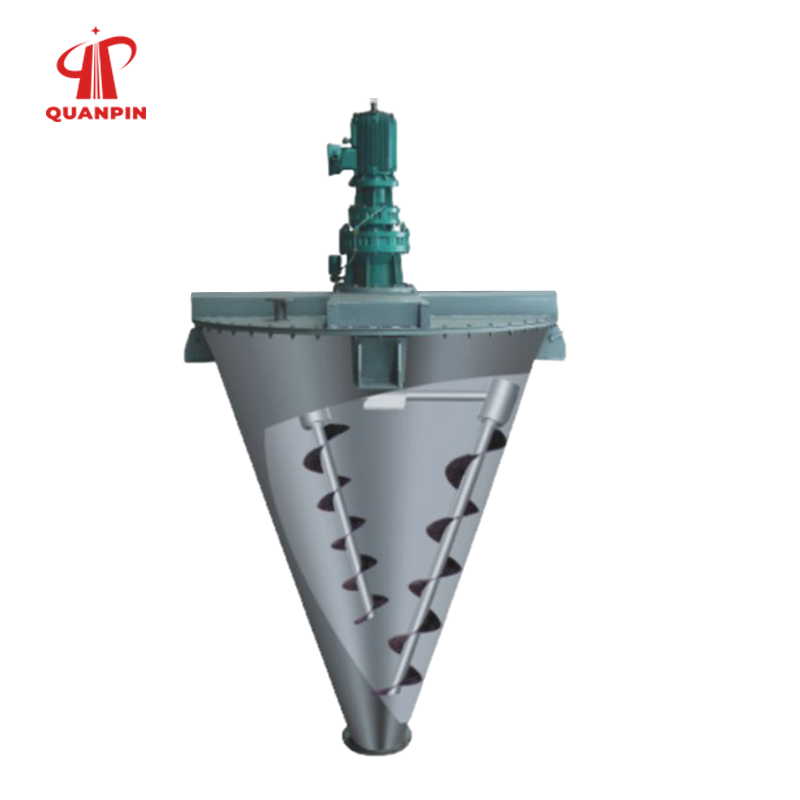
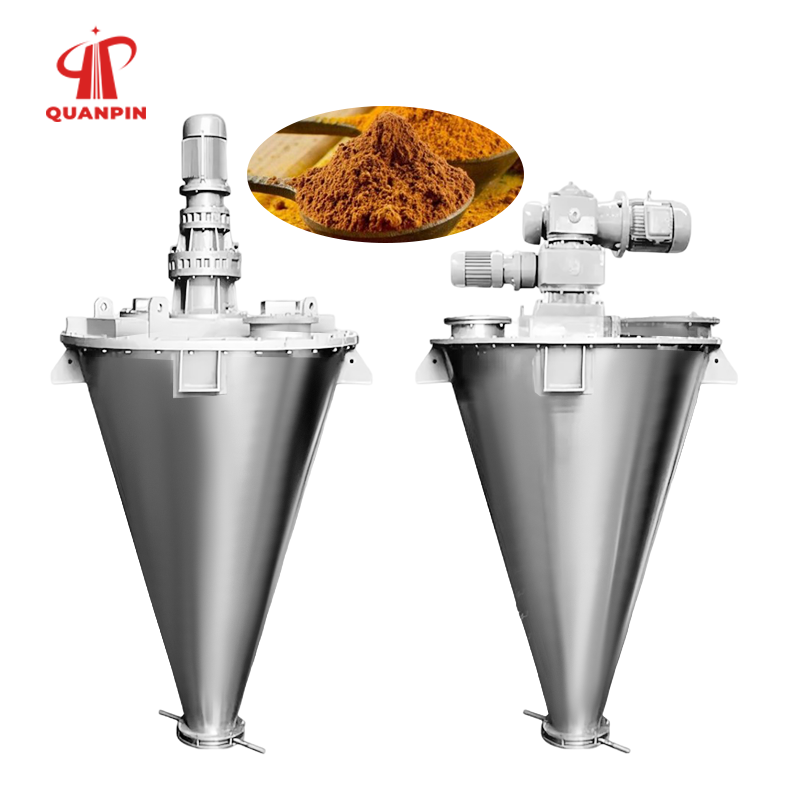
The double screw conical mixer combines screw movement with a conical vessel. Confirm its supplied geometry before assuming that a published single-screw or bladed mixer is equivalent.
For pharmaceutical powders, the eventual composition question remains independent of a numerical tracer score. Modelled redistribution is useful evidence about a mechanism, rather than a dosage-uniformity result.
Five Definitions behind a Model Result
Spatial mixing definition
Define how the mixing index partitions space. A global summary and a local region can show different distributions without either calculation being incorrect.
Particle representation
Identify the particle representation. The shape and size selected for computation determine which contacts and flow restrictions the model can describe.
Contact parameters
Identify the contact properties and how they were obtained. A visually plausible circulation pattern does not establish that those parameters are appropriate.
Power basis
Keep the reported power definition with the result. A numerical mechanical calculation is not automatically a measured electrical consumption of the proposed installation.
Damage and wear law
Describe any damage or wear law separately. Collision energy is a model output, whereas a claim about broken product or component life requires an additional relationship and verification.
Why Screw Geometry Creates Trade-Offs
Geometry can affect multiple outputs differently. This is important when a proposal uses an improved mixing score as evidence of a wider engineering benefit.
An original double-screw conical geometry study investigated screw proportions using DEM and reported mixing, device power and wear responses. Those separate responses did not reduce to a single universally preferred geometry.
The study demonstrates why the optimization question must be stated. A change beneficial for one calculated response can involve a trade-off in another.
It does not identify the internals, power requirement or service life of a supplied DSH machine. Those claims need the actual equipment and material basis.
Six Numerical Outputs with Different Meanings
Particle distribution
Particle position determines the local concentration calculation. Preserve the spatial partition and label definition used to produce a mixing index.
Particle velocity
Particle velocity describes motion. Faster movement is not the same measurement as a lower concentration variation across the charge.
Contact forces
Contact forces contribute to calculated energy transfer. Their interpretation depends on the contact model as well as the motion.
Collision energy
Collision-energy distributions describe events in the simulated bed. They do not independently identify a product-specific fracture threshold.
Wall interaction
Wall-contact calculations can inform a wear model. The resulting prediction also depends on material interaction and the selected erosion relationship.
Time basis
Elapsed simulated time describes the modeled operation. Computational runtime describes the cost of solving it; neither should be mistaken for a demonstrated production cycle.
Assess the Model rather than Its Appearance
Assess particle scaling
Particle enlargement is one method used to make a large calculation tractable. It changes the numerical representation and therefore needs a response-specific assessment.
An original coarse-grain mixing comparison included a conical-screw geometry among several mixers. It compared numerical mixing-index trends across particle-scaling choices.
This supports evaluating whether a computational shortcut preserves the selected output. Agreement in a mixing index alone does not validate wear, collision detail or electrical power.
Separate material and mixer tests
Experiments also help identify what a model reproduces. Matching a bulk measurement and matching the dynamics of a complete mixing experiment are different tests.
An original pharmaceutical powder stirrer study combined measurements and DEM for a conical mixing chamber. Its experiments concern a rotating stirrer, not the DSH double-screw arrangement.
The different apparatus is useful here as a methodological comparison: material characterization and mixer-response assessment should not be treated as the same validation step.
Test shape representation
Particle shape can be particularly important when the target material is not spherical. A calibrated friction value may not compensate for every geometric difference.
An original cylindrical-pellet calibration investigation compared modelled and experimental drum behaviour. Qualitative agreement could coexist with substantial quantitative errors.
This is a drum study rather than a conical-screw performance test. Its direct relevance is the need to evaluate the numerical quantity actually used for a decision, instead of accepting visual similarity.
What Energy-Based Research Can Demonstrate
Kinetic-energy measures can be useful when the question concerns agitation intensity. They still require interpretation in the apparatus and process stage investigated.
An original pharmaceutical high-shear mixer investigation used particle-motion and energy calculations alongside granulation experiments. It assessed a particular operating question in a high-shear vessel.
The research supports connecting a selected model response with an experimental check. Its granulation result does not establish a fill recommendation or a mixing-energy criterion for DSH dry blending.
A numerical study is most useful when it states its intended prediction and its experimental comparison. Several plausible outputs do not compensate for an untested target response.
Translate the Question into an Equipment Enquiry
A conical powder mixer enquiry should identify whether the decision concerns composition distribution, drive duty, fragile-particle handling or component wear. These questions can require different measurements.
Keep model-development information separate from the equipment quotation. A published simulation is not evidence that a commercial proposal includes modeling, monitoring or a particular control function.
Investigate Divergent Results
If the mixing index improves while calculated power rises, report both. This can be a genuine trade-off rather than an inconsistency to remove from the comparison.
If the index is similar but local concentration differs, examine the spatial calculation. A whole-bed score can conceal differences in the regions represented.
If a coarse-grained calculation changes collision statistics, do not assume a previously acceptable index comparison validates those statistics too.
If particles are visibly damaged during an actual trial, an apparently gentle model is insufficient. Review the real material and contact assumptions before assigning a cause.
If electrical consumption differs from calculated mechanical demand, compare definitions and included equipment. The two numbers may describe different system boundaries.
If a model matches its fitting data, assess another condition before calling it predictive. Calibration agreement is the beginning of the assessment, not independent confirmation.

Specify the Required Physical Measurement
Send QUANPIN the pharmaceutical powder properties and the particular response that requires a trial. Explain whether composition, particle integrity or a confirmed equipment duty is the priority.
For a conical screw blender comparison, ask which observations can be measured on the actual machine. Avoid requesting a guarantee derived solely from another geometry or model material.
Report Predictions with Their Limits
A transparent report retains the geometry, contact assumptions, particle representation and output definition alongside the result. It should also retain discrepancies with physical observations.
The practical benefit is a more specific engineering question. It helps prevent a modelled mixing score from becoming an unsupported claim about every aspect of machine performance.
Frequently Asked Questions
Does a mixing index prove all performance?
No. A concentration-based index describes distribution under its stated calculation. It does not independently establish power demand, particle integrity or equipment life.
Can coarse-graining preserve every output?
Not automatically. Enlarged computational particles can preserve one output while changing another. Evaluate each quantity needed for the intended decision.
Can another mixer establish DSH settings?
No. The cited apparatuses have different geometries and processes. Their findings can inform validation practice without supplying DSH operating limits.
Why consider particle shape?
Contact geometry affects particle movement and interaction. A representation that looks similar can still have quantitative errors in the response of interest.
Does collision energy prove damage?
No. A fracture or wear conclusion requires the relevant material relationship and an appropriate experimental assessment beyond a collision-energy plot.
What makes a prediction useful?
Define the response first, then compare the model with an independently measured quantity on representative material and the relevant equipment arrangement.
Discuss Your DSH Mixing Application
Discuss the material, processing objective and required trials with QUANPIN. Review the equipment information and the relevant industry applications, or send an enquiry through our contact page.
Email sales@qpdryer.com or stacie@qpdryer.com. Call +86 19850785582 or contact WhatsApp +86 15921493205 to discuss the proposed scope.