Producing a consistent batch of dry seasoning carriers requires a clear connection between equipment movement and the condition of the material delivered downstream. The vessel moves in multiple directions so that the powder bed repeatedly changes orientation. That changing movement redistributes free-flowing solids without requiring a stationary trough and internal ribbon. The useful selection question is whether that mechanism matches the actual feed and handling route.
This guide organizes the assessment around preparation, operation and verification. Start with representative production material and define what the next process needs to receive. Supplier information establishes the equipment concept; a documented material trial establishes whether the proposed arrangement is suitable for the application, without assuming a universal cycle or guaranteed result.
- For the 3D powder mixer, characterize salt, starch and dried seasoning fractions individually. Particle size and density differences affect movement and can make the final transfer as important as the mixing stage. Record the observation alongside the batch identity and operating arrangement so that a later comparison reflects the same material-handling conditions rather than an undocumented change in preparation or loading.
- For the three dimensional mixer, record the actual loading volume. Multidirectional movement needs an appropriate working fill; selecting equipment by batch weight alone overlooks differences between fluffy starch and dense salt. Record the observation alongside the batch identity and operating arrangement so that a later comparison reflects the same material-handling conditions rather than an undocumented change in preparation or loading.
- For the three dimensional powder mixer, define a reproducible charging sequence. Place low-dose ingredients deliberately and assess a compatible preliminary dilution when direct addition creates a localized pocket. Record the observation alongside the batch identity and operating arrangement so that a later comparison reflects the same material-handling conditions rather than an undocumented change in preparation or loading.
- For the multidirectional mixer, inspect friable seasoning particles after a trial. Changing vessel orientation provides redistribution, but the absence of a conventional agitator does not establish that every particle remains intact. Record the observation alongside the batch identity and operating arrangement so that a later comparison reflects the same material-handling conditions rather than an undocumented change in preparation or loading.
- Follow the mixture through discharge and transport. Test the receiver used in production because vibration and pouring can separate ingredients that were acceptably distributed inside the vessel. Record the observation alongside the batch identity and operating arrangement so that a later comparison reflects the same material-handling conditions rather than an undocumented change in preparation or loading.
- Compare several sampling locations and repeat batches. A marker should represent the recipe question, while the sampling procedure must avoid selecting only accessible surface material. Record the observation alongside the batch identity and operating arrangement so that a later comparison reflects the same material-handling conditions rather than an undocumented change in preparation or loading.
- Feed preparation guidance provides background on ingredient processing and mixing. Use it to frame questions about particle condition, weighing and preparation, while keeping seasoning acceptance criteria specific to the actual recipe. Consult the relevant primary guidance for its stated scope. This source supports the handling or governance issue described here; it supplies no model-specific production rate, drying endpoint or blend-uniformity guarantee.
- Combustible dust hazards depend on material properties and the conditions under which dust disperses and accumulates. Assess the ingredients and powder-handling tasks rather than assuming the mixer mechanism establishes safe operation. Consult the relevant primary guidance for its stated scope. This source supports the handling or governance issue described here; it supplies no model-specific production rate, drying endpoint or blend-uniformity guarantee.
- Food dust can present an explosion hazard when combustible particles become suspended under hazardous conditions. Evaluate dust generation, collection and ignition sources across charging and discharge with competent site personnel. Consult the relevant primary guidance for its stated scope. This source supports the handling or governance issue described here; it supplies no model-specific production rate, drying endpoint or blend-uniformity guarantee.
- Flour and other food powders require material-specific handling controls. Review dust release at emptying and receiver changes with the site team. Consult the relevant primary guidance for its stated scope. This source supports the handling or governance issue described here; it supplies no model-specific production rate, drying endpoint or blend-uniformity guarantee.
- Flour dust can cause occupational asthma. Review opportunities to reduce dust release during weighing, bag emptying and cleaning, and select suitable exposure controls for the complete handling task. Consult the relevant primary guidance for its stated scope. This source supports the handling or governance issue described here; it supplies no model-specific production rate, drying endpoint or blend-uniformity guarantee.
- Prepare the supplier inquiry around representative dry seasoning carriers, incoming condition, required outgoing condition and the complete transfer route. Include loading, emptying, inspection and changeover when comparing the production cycle. Request a trial that records these variables and retains samples for the agreed assessment. Select the configuration on the strength of that evidence and the actual installation requirements.
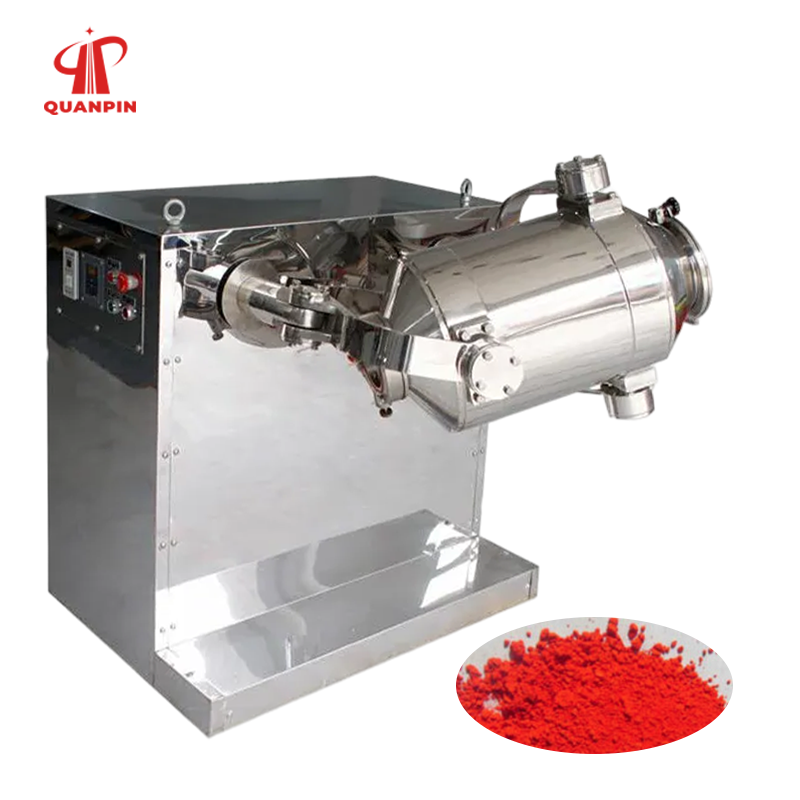
Discuss your material and production route with QUANPIN. Review the corresponding equipment information before arranging a material trial.
YANCHENG QUANPIN MACHINERY CO.. LTD
Sales Manager – Stacie Tang
MP: +86 19850785582
Tel: +86 0515-69038899
E-mail: stacie@qpdryer.com
WhatsAPP: 8615921493205
https://quanpindrying.en.alibaba.com/
Address: Jiangsu Province, China.