SYH Three-Dimensional Mixing: Assess Agglomerate Changes alongside Blend Uniformity
By QUANPIN
A 3D powder mixer repeatedly changes the orientation of a vessel, redistributing suitable powders along changing paths. For pharmaceutical blends, assess ingredient distribution separately from any change in particle associations or agglomerates.
The SYH’s compound motion describes how the equipment moves. It does not independently establish that a cohesive drug formulation has reached its required composition, particle condition or downstream function.
Define Redistribution and Structural Change
Redistribution concerns where ingredients occur within the assessed blend. A composition test can examine that question under an appropriate sampling and analytical method.
Agglomerate change concerns associations between particles. A blend can have a measured composition result while its particle interactions or response during use still require separate investigation.
Describe the Actual Compound Motion
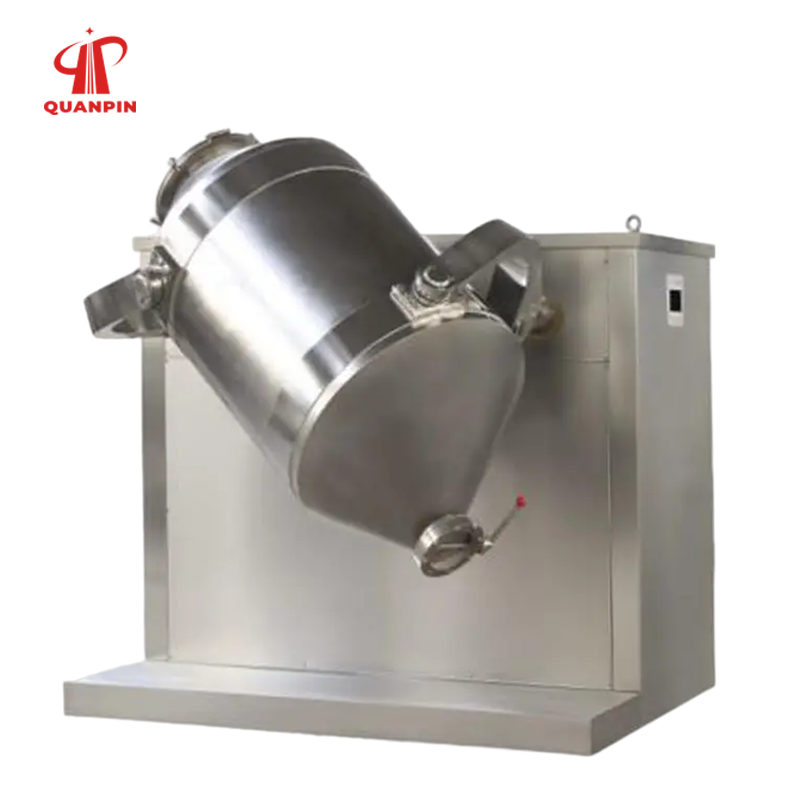
The SYH Series Three-Dimensional Motion Mixer redirects material by changing vessel orientation; its confirmed principle does not require an internal ribbon or screw agitator.
Do not treat that movement as equivalent to a high-shear impeller or grinding operation. The actual effect on cohesive material belongs to a representative formulation trial.
Five Inputs for a Pharmaceutical Comparison
Ingredient condition
Describe ingredient identity and incoming particle condition. A nominally identical formulation can begin with a different extent of agglomeration or preparation history.
Agglomerate description
Identify what is meant by an agglomerate in the proposed study. State the observation or test used rather than relying only on an informal description of lumps.
Movement programme
Record the supplied vessel arrangement and mixing programme. A research apparatus bearing another name does not establish the SYH’s exact motion or operating range.
Composition method
Choose a suitable composition measurement and sampling plan. The result needs to identify which material portions and ingredient concentrations were assessed.
Functional objective
State any required functional evaluation separately. Powder composition, dispersion in a selected medium and subsequent dosage-form behaviour answer different questions.
Read Formulation Experiments within Their Scope
An original Charles University pharmaceutical study examined mixing speed and time for acetylsalicylic acid with microcrystalline cellulose in a research tumbler.
Its homogeneity evaluation used the measured drug content of prepared samples. That analytical question is distinct from assuming that the equipment’s movement alone proves a suitable blend.
The preferred conditions belonged to the studied formulation and apparatus. They provide no validated speed, cycle duration or pharmaceutical acceptance limit for a SYH machine.
A three dimensional mixer enquiry should retain this formulation-specific interpretation. A different ingredient system needs its own relevant evidence rather than a borrowed research programme.
Six Boundaries in a Mixing Trial
Identify the prepared charge
Identify the prepared charge and its history before mixing. State whether prior screening, premixing or another preparation has changed the incoming particle population.
Confirm the vessel arrangement
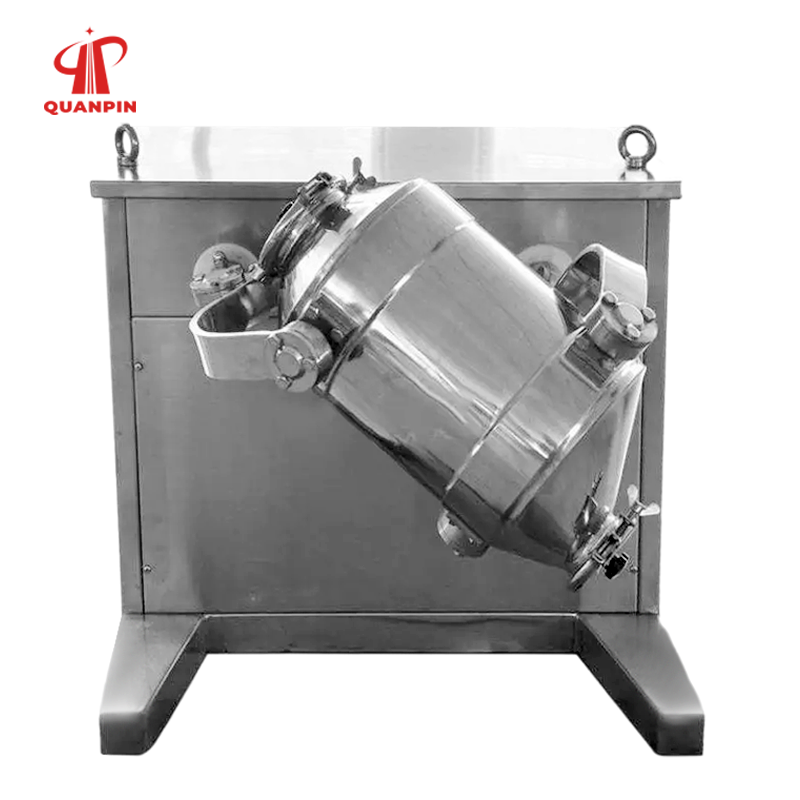
Confirm the supplied vessel and loading arrangement. Do not add mixing beads, internal tools or other research accessories to the equipment scope without confirmation.
Record the mixing cycle
Record the actual cycle under the approved operating procedure. Material observations should remain connected with the programme that produced the assessed sample.
Collect the assessed material
Collect material under a defined method. Sample withdrawal and discharge can affect what is represented, so an unidentified specimen weakens the interpretation.
Perform separate measurements
Perform composition and particle-condition measurements separately where both are required. An easy test should not silently substitute for the attribute that matters.
Interpret the complete result
Interpret the complete result against the intended formulation requirements. A favourable composition result cannot erase an unacceptable change in another relevant product property.
Compare Different Forms of Mixing Evidence
Ingredient distribution
Ingredient distribution needs a suitable analytical basis. Specify the component measured and the sample quantity or product unit it represents.
A second Charles University oral-powder investigation examined container loading and homogenization time for a defined drug-filler formulation, using divided-dose content uniformity as its endpoint.
That study demonstrates a formulation-specific evaluation boundary. It does not show that equal elapsed time or a familiar motion label establishes the same outcome for another vessel and formulation.
Particle associations
Particle associations require their own description. Distinguish visible coarse agglomerates from smaller structures that may influence dispersion or interactions between ingredients.
A University of Basel original investigation developed sampling equipment for a research tumbler and studied mixing and dry-coated particle systems in pharmaceutical technology.
Its treatment of particle properties and sampling shows why a mixture result depends on what was sampled and examined. The apparatus and results should not be presented as SYH validation.
Intended formulation function
A functional evaluation concerns the formulated material under specified test conditions. It can detect a response that a composition measurement alone does not describe.
State how the specimen enters that test, including the relevant dispersing medium or preparation. Particle associations can behave differently under different application conditions.
Keep each outcome identifiable rather than declaring one overall mixing score. The proposed process may need satisfactory distribution and acceptable particle condition together.
Evaluate Agglomerates and Function Separately
An original Monash drug-powder investigation examined mixing, agglomerate structure and formulation functionality using a research tumbler. It evaluated more than one subsequent test response.
The authors found that formulation and particle associations mattered to the evaluated response. Their work supports separate assessment rather than assuming every aspect of performance moves together.
Its micronized drug-excipient systems are not a specification for SYH operation. No dissolution, respiratory-deposition or deagglomeration outcome is promised for an untested QUANPIN application.
For a three dimensional powder mixer, the practical question is which particle associations matter to the customer’s formulation. Define those attributes before selecting an evaluation programme.
Keep the Formulation Context Explicit
An original capsule-powder study compared mixing conditions, fillers and vessel-related arrangements in a pharmacy-scale three-dimensional device.
The resulting capsule-content measurements belonged to those tested systems. They do not establish that a different formulation, industrial vessel or programme gives an equivalent dosage result.
Investigate Conflicting Quality Results
If composition is acceptable but a functional result changes, investigate particle condition and test preparation. Do not assume that the content assay measured every relevant material change.
If visible agglomerates remain, identify their composition and relevant effect through suitable analysis. Their appearance alone does not establish the entire blend’s uniformity or suitability.
If a longer cycle changes a result, retain the full programme and preparation history. More movement does not automatically mean every quality attribute improves.
A multidirectional mixer should be reviewed as a defined physical arrangement. Avoid using the word three-dimensional as a substitute for evidence about a particular material.
Keep the sampling boundary visible during troubleshooting. A vessel specimen, discharged portion and prepared dosage sample can represent different material histories.
Bring conflicting observations into the trial review rather than selecting the preferred metric. They can identify a real formulation trade-off or a measurement question needing investigation.
Prepare the SYH Application Enquiry
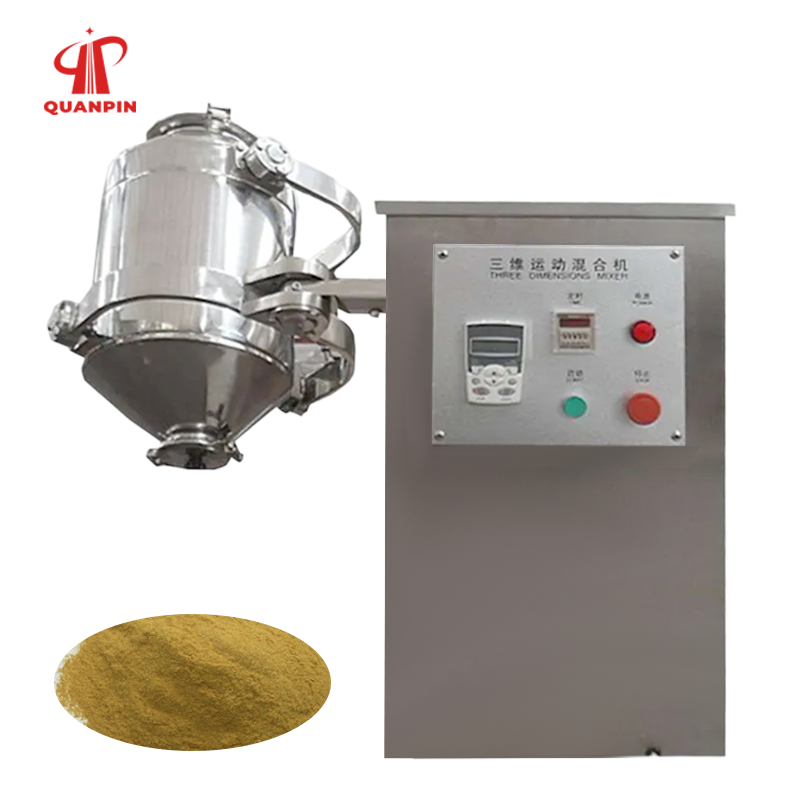
Prepare the SYH enquiry with ingredient forms, known cohesive behaviour and the required distribution and particle-condition tests. Identify which analyses the customer will provide.
Review the proposed pharmaceutical duty within the relevant QUANPIN industry application, keeping containment, cleaning and documentation requirements separate from the blend measurements.
Retain Each Measured Attribute
Retain the specimen identity, programme, sampling method and analytical basis with each outcome. This allows a later material or formulation change to be assessed against the original evidence.
A useful equipment proposal explains which attributes have been demonstrated and which remain to be investigated. It should not promise that compound motion removes every agglomerate.
Frequently Asked Questions
Does three-dimensional motion guarantee deagglomeration?
No. The effect depends on material, particle associations and the actual programme. A representative test is needed where agglomerate change matters.
Does composition uniformity prove unchanged particles?
No. Composition and particle condition are different attributes. A uniform concentration result does not independently establish that agglomerate structure is unchanged or acceptable.
Is the SYH an internally agitated mixer?
The verified SYH principle redirects material through compound vessel motion without an internal ribbon or screw. Confirm the actual supplied arrangement directly with QUANPIN.
Can faster mixing always improve the product?
Not universally. Published formulation studies evaluate particular responses, and a change in movement can affect different quality attributes differently. Test the intended formulation.
Can research dosage results specify a SYH?
No. Results from another formulation and research apparatus belong to that study. They do not establish SYH settings or pharmaceutical product acceptance.
What information supports a trial?
Provide formulation identity, incoming particle and agglomerate condition, proposed loading, separate quality objectives and available analytical methods. Explain what the material trial must demonstrate.
Discuss Your Compound-Motion Blending Trial
Discuss the material, processing objective and required trials with QUANPIN. Review the equipment information and the relevant industry applications, or send an enquiry through our contact page.
Email sales@qpdryer.com or stacie@qpdryer.com. Call +86 19850785582 or contact WhatsApp +86 15921493205 to discuss the proposed scope.