SYH Blending Trials: Distinguish Particle Attrition from Apparent Size Change
By QUANPIN
A 3D powder mixer trial can produce a uniform ingredient assay while the powder particle-size distribution changes. Establish whether the change represents primary-particle damage, altered particle associations or the analytical dispersion itself.
For pharmaceutical powders, this guide focuses on diagnosing attrition rather than treating every smaller measured particle as evidence of beneficial mixing. Composition, particle integrity and product response require separate measurements.
Particle Breakdown and Apparent Size Are Different
Attrition is unintended particle breakdown during processing. Surface abrasion can generate a small fine fraction while leaving most parent particles intact; fragmentation can shift a wider portion of the size distribution.
An apparent size change is broader: it may reflect particle separation, renewed association or measurement conditions. A lower median alone cannot identify which mechanism occurred.
Define the SYH Trial Boundary
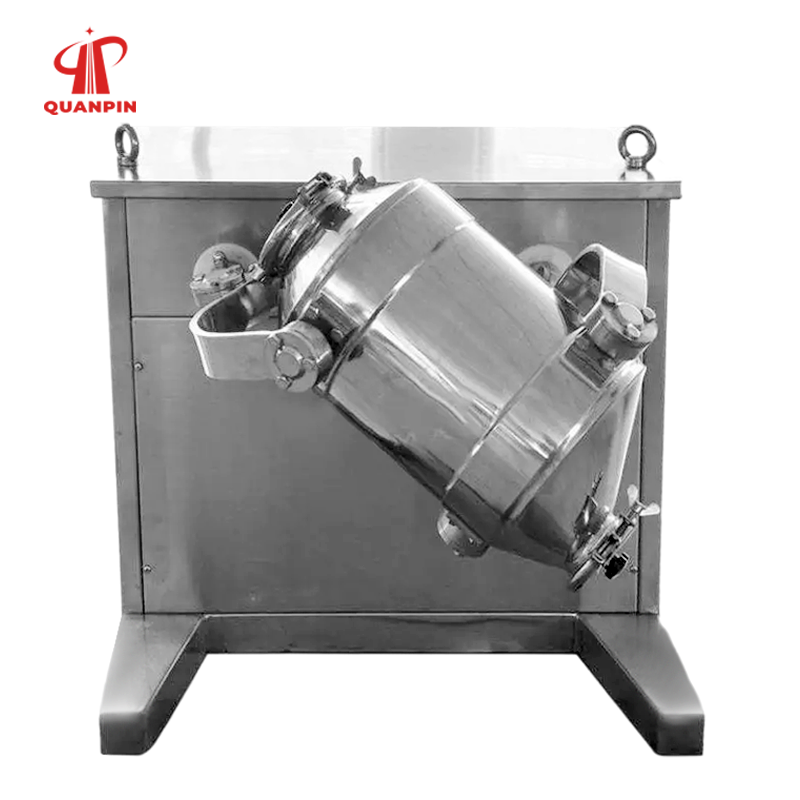
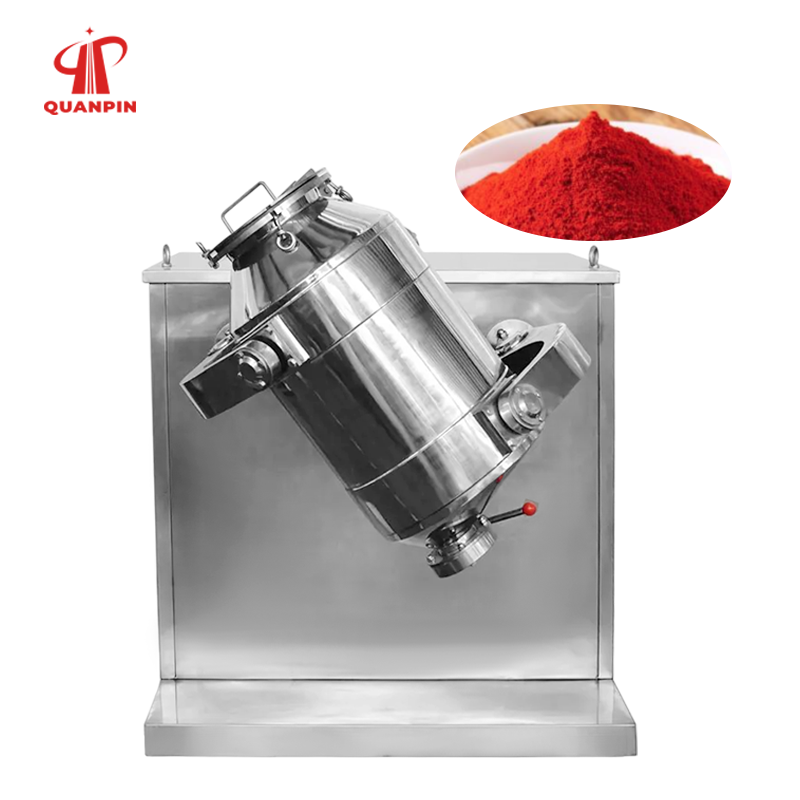
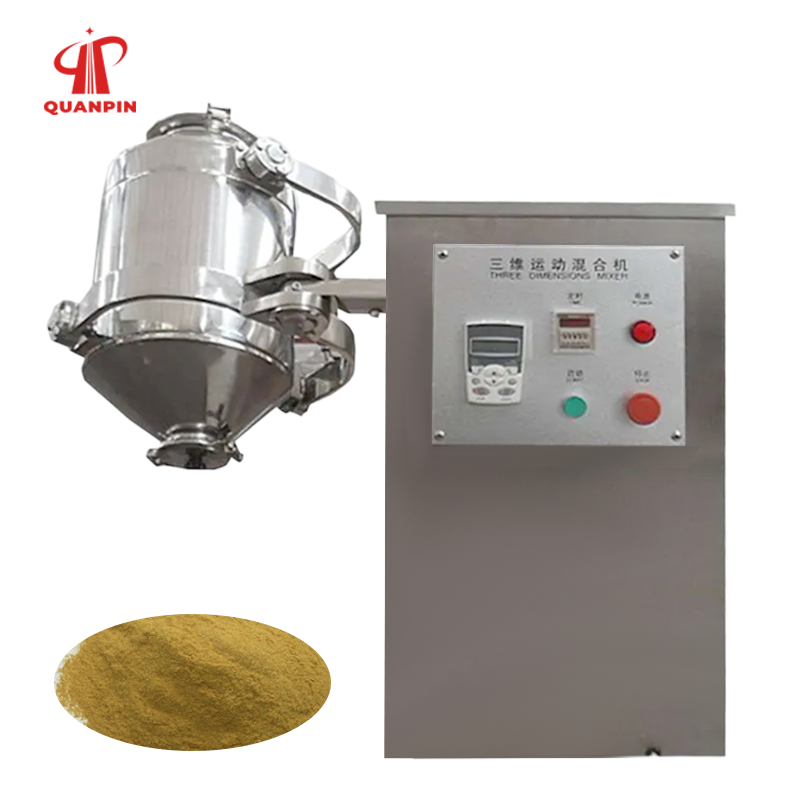
The SYH three dimensional mixer changes vessel orientation to redistribute suitable powders. Its compound motion does not establish a particular particle-breakage mechanism or a pharmaceutical acceptance result.
High-shear impellers, laboratory Turbula equipment and another three-axis device apply different material histories. Their settings and results must remain within the original experimental boundaries.
Five Inputs for a Particle-Integrity Comparison
Material grade
Identify each excipient grade and its morphology. A granulated grade can respond differently from a sieved or spray-dried grade of the same chemical material.
Incoming distribution
Define the starting particle-size distribution, including the fine tail. Retain the analytical preparation used for the incoming specimen so the processed specimen can be compared fairly.
Movement history
Record the vessel, working load and movement history. Elapsed minutes alone do not describe the contacts experienced by a powder in another apparatus.
Composition method
Define composition uniformity through a stated sampling plan and ingredient assay. Particle-size measurements do not independently measure how an active ingredient is distributed across portions.
Particle-integrity method
Select a particle-integrity measurement alongside the assay. Size distributions and microscopy can provide complementary evidence when the question concerns abrasion or fragmentation.
Recognize Abrasion and Fragmentation in Original Evidence
A direct excipient experiment helps distinguish genuine breakage mechanisms from a generic observation that a powder became finer.
In an original high-shear excipient attrition study, Kulkarni and colleagues compared pharmaceutical materials using particle-size distributions, microscopy, density, flow and tablet tensile strength before and after processing.
Their observed fine-tail changes with relatively limited parent-size changes were consistent with surface abrasion for selected materials. Granular mannitol and granular dicalcium phosphate showed fragmentation in the microscopy comparison.
These were material-specific high-shear experiments. They do not establish that SYH tumbling generates the same damage, or that a measured size reduction improves composition uniformity.
Six Stages from Reference Powder to Interpretation
Incoming reference
Before blending, preserve an incoming reference specimen with a clearly documented preparation history.
Blending history
During blending, record the actual movement programme and interruptions. Sampling interruptions can change the subsequent history of a small experimental batch.
Sample identity
During sampling, label the represented material and processing stage. Keep composition specimens distinguishable from specimens allocated to particle characterization.
Analytical dispersion
During analytical dispersion, retain the pressure or other dispersion conditions. A method that breaks fragile particles can create an apparent processing effect.
Microscopy
During microscopy, compare comparable specimens and magnifications. Images can help identify intact parent particles with surface wear versus visibly fractured material.
Interpretation
During interpretation, relate each observation to its own measurement. A composition statistic, a size percentile and a functional test do not share an interchangeable endpoint.
Check the Measurement before Attributing Damage
Check analytical breakage
A measurement procedure should first be checked for its ability to change the specimen it is intended to characterize.
In the original University of Birmingham high-shear blending investigation, pressure titration examined whether dry dispersion could fracture lactose. The thesis also assessed chemical homogeneity separately from subsequent size-distribution evolution.
Later blending could change the formulation size distribution without further improving homogeneity. Some reported increases were attributed to renewed agglomeration; they must not be relabeled as evidence of attrition.
Retain formulation identity
Composition comparisons also depend on the actual material and blending route. A response observed for one excipient grade need not describe another.
An original batch-versus-continuous pharmaceutical blending study compared paracetamol mixtures containing different lactose grades and microcrystalline cellulose. Ingredient assays quantified blend uniformity separately from starting powder characterization.
The effect of excipient properties depended on the process and composition. Those comparisons support retaining formulation identity; they do not validate a continuous process or its settings for a batch SYH installation.
Keep functional testing distinct
A further boundary is the distinction between particle characterization and a selected functional test. Neither substitutes automatically for an ingredient assay.
The original mixing-time experiment on inhalation mixtures combined content measurements, microscopy, laser diffraction and apparent-solubility observations. The authors found no simple mixing-time trend in content uniformity while other measured responses changed.
This study provides a comparison of measurement objectives in defined inhalation formulations. It does not establish that a changed dispersion response proves primary-particle damage or predicts an unrelated pharmaceutical product.
Compare Ingredient and Product Evidence Separately
Dosage-unit assays can be useful evidence for a defined formulation study while leaving the particle-integrity question unanswered.
An original three-axis mixing evaluation examined capsule content uniformity for selected pharmaceutical and supplement formulations using ingredient-specific analytical methods.
Its reported operating range concerned the evaluated device and formulations. It did not constitute a primary-particle attrition validation, and the numerical conditions cannot be transferred directly to SYH equipment.
Together these experiments show why a useful mixing conclusion identifies the tested attribute and the method supporting it. A favorable result for one attribute leaves the other questions open.
Define a Trial That Can Distinguish Mechanisms
A three dimensional powder mixer trial should define its composition objective and the particle changes considered unacceptable for the intended formulation.
Where particle damage is suspected, agree how incoming references, processed samples, size distributions and microscopy will be compared. The proposed evidence should discriminate among plausible mechanisms.
Interpret Contrasting Observations
If the fine tail changes while the larger size percentiles remain similar, investigate surface abrasion and analytical dispersion. That pattern alone does not prove either explanation.
If a broad size shift accompanies visible fragments, fragmentation becomes a stronger interpretation. Preserve the images and distribution rather than reporting only a single median.
If assay uniformity stabilizes while size continues changing, assess the value of additional blending against particle and product requirements. More elapsed time need not provide more useful mixing.
If apparent size increases, consider renewed particle association as well as sample preparation. Increasing size cannot automatically be described as preservation of the original particles.
If flow or tablet response changes, evaluate that response directly. The attrition experiment showed that functional changes depended on material properties rather than following one universal direction.
If incoming and processed specimens were measured at different dispersion conditions, resolve that analytical difference before attributing the contrast to the mixer.
Prepare a Pharmaceutical Mixing Enquiry
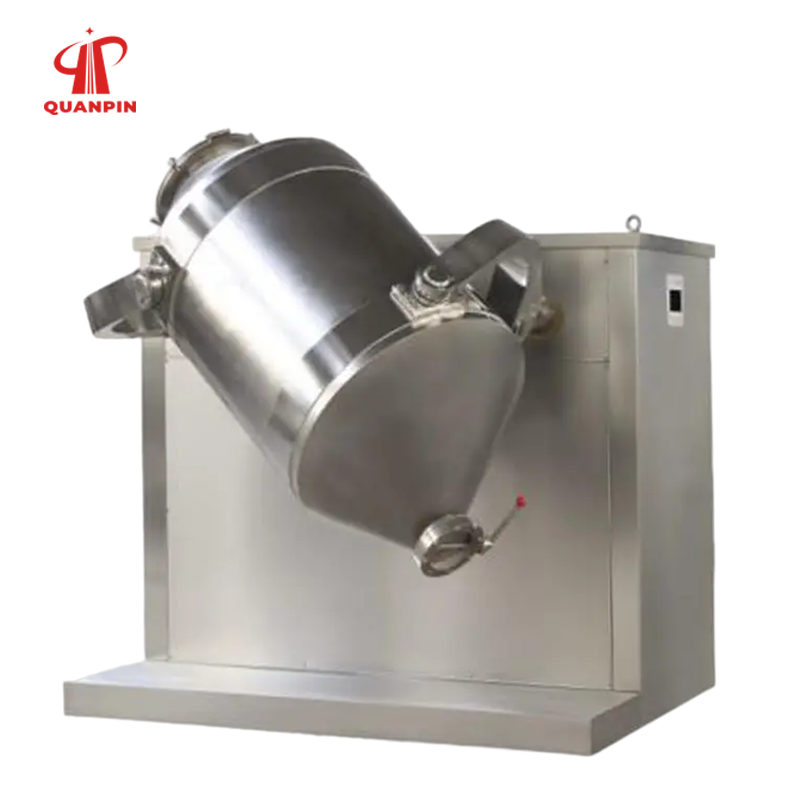
For a 3D mixer enquiry, provide ingredient grades, incoming particle distributions, the working-load basis and the particular particle-integrity concern alongside the composition objective.
Identify which laboratory measurements and representative material trials are available. Ask QUANPIN to confirm the proposed equipment scope for the actual formulation and handling arrangement.
Compare the Confirmed Equipment Scope
When comparing a 3D powder mixer manufacturer proposal, retain the same trial question and analytical responsibilities. A quoted vessel does not by itself include particle-integrity or formulation validation.
The useful conclusion distinguishes demonstrated composition uniformity, demonstrated particle changes and any remaining mechanism uncertainty. It should state which evidence belongs to the proposed SYH configuration.
Frequently Asked Questions
Does smaller size prove attrition?
No. A smaller measured size can result from particle separation or analytical dispersion as well as particle damage. Additional evidence is needed to identify the mechanism.
Can the median miss abrasion?
No. Surface abrasion can generate fines while leaving much of the parent distribution similar. Inspect the fine tail and supporting microscopy rather than relying only on the median.
Does uniformity prove intact particles?
No. Consistent ingredient concentrations across sampled portions do not demonstrate that primary particles remained intact.
Does longer blending always help?
No. Some mixtures reach a composition plateau while their physical state continues changing. The required particle and product attributes determine whether additional processing is useful.
Can research settings specify a SYH?
No. A separate device, movement history and formulation establish their own experimental boundary. Representative SYH trials are needed for the proposed application.
What should the enquiry include?
Describe the formulation, incoming particle condition, working load, composition target and suspected damage mechanism. Identify the measurements that must resolve the distinction.
Discuss Your SYH Blending Trial
Discuss the material, processing objective and required trials with QUANPIN. Review the equipment information and the relevant industry applications, or send an enquiry through our contact page.
Email sales@qpdryer.com or stacie@qpdryer.com. Call +86 19850785582 or contact WhatsApp +86 15921493205 to discuss the proposed scope.