Seasoning Powder Mixing: Separate Incoming Spice Authenticity from Recipe Uniformity
By QUANPIN
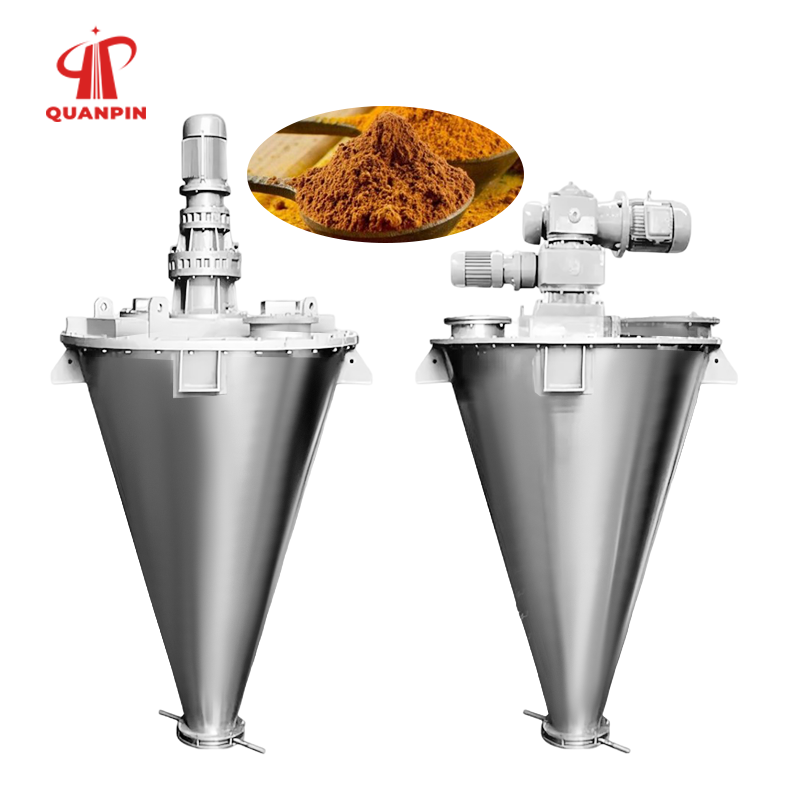
A conical screw mixer trial can evaluate distribution of a seasoning recipe. It cannot establish whether the incoming paprika or turmeric has the claimed identity.
Authenticity concerns what the supplied ingredient actually contains or represents. Uniformity concerns distribution of the defined formulation across representative portions after mixing.
Identity and Distribution Are Separate Questions
An adulterated ingredient can be distributed consistently throughout a batch. A uniform result therefore cannot resolve a separate raw-material identity question.
Define those decisions separately before the trial. Representative ingredient records and appropriate laboratory evidence support interpretation without turning the mixer into an authentication instrument.
Define the Mixing and Laboratory Duties
For a double screw cone mixer enquiry, describe the intended food ingredients and dry processing duty. Specialized spectroscopy and molecular analysis are separate laboratory functions.
The cited research evaluates particular adulteration or classification questions. Its analytical results do not demonstrate supplied QUANPIN instrumentation or universal detection of unknown substances.

Five Inputs for Ingredient Assessment
Ingredient specification
Record the actual spice identity and declared ingredient specification. A general name such as paprika leaves important distinctions unresolved for some authenticity questions.
Lot identity
Keep supplier and lot identity connected to the incoming specimen. Testing an unidentified reference powder cannot establish the status of a different delivered lot.
Analytical target
Define the suspected substitution or claim being examined. Detecting botanical substitution differs from assessing declared geographic origin or an added chemical substance.
Reference materials
Specify the laboratory method and relevant reference materials. A model trained for one comparison does not automatically classify every possible adulterant.
Independent distribution plan
Preserve an independent blend-uniformity plan for the intended recipe. Raw-material identity evidence does not establish adequate distribution during the actual mixing operation.
Respect the Analytical Target
Keep ingredient assessment and mixed-product assessment distinguishable. Deliberately adding several legitimate spices can change the analytical matrix presented to an authentication method.
An original spice authentication experiment investigated paprika substituted with spent paprika after oleoresin extraction.
The researchers used near infrared and infrared spectroscopy with chemometric models. Their classification results concerned the prepared comparison and validation samples, rather than every possible commercial paprika.
For a conical powder mixer trial, this supports confirming ingredient status separately. A satisfactory physical mixing observation cannot establish that oleoresin was never removed from an ingredient.

Six Stages from Ingredient to Mixed Product
Formulation records
First establish the intended formulation and ingredient specifications. Record which incoming lots have the laboratory evidence required for their intended use.
Reference specimens
Next identify reference samples and the question each comparison addresses. A genuine reference should represent the claimed material rather than simply resemble its appearance.
Ingredient sampling
Collect ingredient specimens under an appropriate documented plan. Preserve their identities before different powders are deliberately combined in the trial formulation.
Mixing programme
Record the actual blending programme and charging history. These describe the mixing operation and remain separate from the earlier authenticity assessment.
Mixed-product sampling
Collect mixed-product portions for the agreed distribution evaluation. Associate each specimen with the relevant batch and sampling location or material fraction.
Joint interpretation
Interpret ingredient and mixture findings together. State what each assessment establishes rather than treating one favourable result as evidence for both decisions.
Interpret Paprika Fingerprint Evidence
Paprika substitution
An original spice authentication experiment investigated adulterated paprika samples using second-order liquid chromatography fluorescence fingerprints and chemometric analysis.
The experiment considered paired region or cultivar comparisons using chromatographic fingerprints and regression. Its external prediction results belonged to the defined sample sets and adulteration cases.
This distinguishes a quantitative comparison from a general declaration of purity. A useful report specifies which mixture or substitution the calibration was designed to evaluate.
Paprika origin classification
An original spice authentication experiment evaluated paprika classification and authentication using high-resolution chromatographic mass-spectrometry fingerprints.
Chemical fingerprints supported classification of the investigated production regions and taste varieties. That is a different question from measuring uniform distribution of a seasoning recipe.
These two paprika studies used different analytical designs and sample comparisons. Neither establishes that a physical blender can authenticate origin or declared variety.
Botanical and chemical additions
For a conical screw blender programme, retain the ingredient specification alongside the mixing objective. Avoid redefining an unresolved identity claim as a mechanical processing issue.
An original spice authentication experiment developed and validated a real-time PCR assay for corn material in commercial turmeric powder products.
Species-specific primers were evaluated with reference species, blind samples and commercial products. A positive botanical finding concerns the targeted material rather than every possible contaminant.
Distinguish Botanical and Chemical Targets
The method therefore illustrates a targeted identity question. It cannot automatically replace an assessment for an unrelated dye, exhausted spice or another unspecified adulterant.
An original spice authentication experiment examined white turmeric and Sudan Red G additions to yellow turmeric using infrared spectroscopy.
The researchers prepared defined mixtures and developed separate infrared models. Their results concern those substances, preparation ranges and analytical conditions rather than unrestricted unknown-adulterant screening.
This demonstrates why the analytical target belongs in the test plan. Similar product appearance does not identify which chemical or botanical question a method can answer.
Define the Material-Release Responsibilities
Discuss the actual dry formulation before selecting a double screw conical mixer arrangement. Identify the ingredient-release responsibilities separately from the proposed material handling trial.
Explain whether testing will concern incoming powders or a finished multicomponent seasoning. A method developed for an individual spice requires assessment before application to another matrix.
Interpret Different Assessment Results
If an ingredient identity remains unresolved, keep that finding explicit. More mixing does not demonstrate correction of an incoming-material authenticity problem.
If ingredient evidence is satisfactory but blend variation persists, investigate the mixing question. An identity result does not establish distribution throughout the collected batch.
If a method classifies declared origin, do not silently interpret it as testing every chemical adulterant. Different analytical claims require their supporting evidence.
If a legitimate recipe contains corn-derived material, interpret a botanical result against that recipe. Detection alone does not establish unauthorized substitution in every finished food.
If a reference or ingredient lot changes, consider the comparison basis. A previous model result should not be transferred without regard to its intended sample population.
If results from different methods disagree, examine their targets and specimen matrices. They may address different questions rather than provide interchangeable verdicts.
Prepare the Seasoning Mixing Enquiry
Prepare the enquiry with ingredient identities, lot records and the actual recipe. State the physical distribution objective that the proposed equipment trial must investigate.
Describe the laboratory information available for the incoming materials. Identify any unresolved claim separately from the supplier’s proposed mixing and transfer duties.
Confirm Sampling and Analytical Responsibilities
Review responsibilities for sampling, ingredient assessment and mixed-product analysis. The cited research does not establish that these services are included with mechanical equipment.
A useful report states what was established about incoming identity and what was established about mixture distribution. It preserves the boundaries of each analytical conclusion.
Frequently Asked Questions
Does uniformity establish authenticity?
No. Consistent distribution can occur even when an incoming ingredient differs from its specification. Mixing uniformity and raw-material authenticity require separate evidence.
Does a mixer authenticate spices?
No. Spectroscopy, chromatography and molecular methods are specialized laboratory activities. They are not assumed functions of a proposed dry powder mixer.
Does one method detect everything?
Not automatically. The cited methods addressed particular materials and comparisons. Their scope must match the ingredient claim and analytical target being evaluated.
Does corn detection always mean substitution?
Not necessarily. A botanical finding must be interpreted against the intended food composition, specimen matrix and question the analytical method addresses.
Does origin classification test chemical additions?
No. Origin classification and detection of a particular added substance are different analytical claims. Each needs evidence appropriate to its target.
What should the enquiry include?
Provide ingredient specifications, lot identity, intended recipe and a separate distribution plan. Clarify the laboratory responsibility for any authenticity question before evaluating the mixing trial.
Discuss Your Food Powder Application
Discuss the material, processing objective and required trials with QUANPIN. Review the equipment information and the relevant industry applications, or send an enquiry through our contact page.
Email sales@qpdryer.com or stacie@qpdryer.com. Call +86 19850785582 or contact WhatsApp +86 15921493205 to discuss the proposed scope.