Pharmaceutical V Blender for Low-Proportion Ingredients: Decide Whether to Preblend
By QUANPIN
A pharmaceutical V blender mixes compatible dry ingredients by repeated division and recombination. When one ingredient occupies a small proportion of the formulation, decide whether a separate preblending stage needs investigation.
This is a formulation-development question, not a claim that a particular loading sequence guarantees uniformity. The actual ingredients and downstream handling remain part of the assessment. See the corresponding pharmaceutical industry applications.
When Should a Preblend Be Investigated?
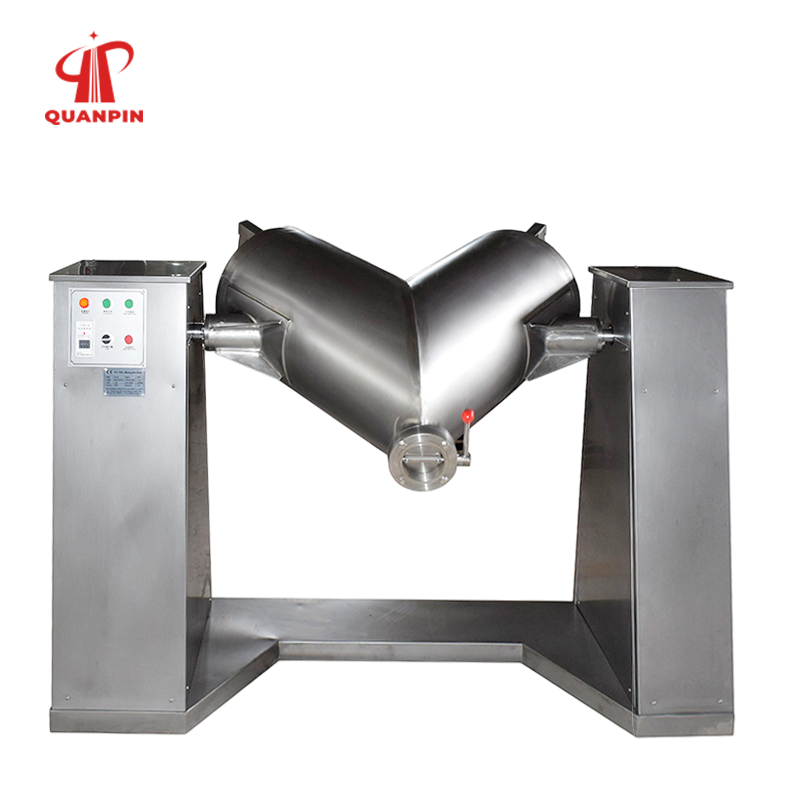
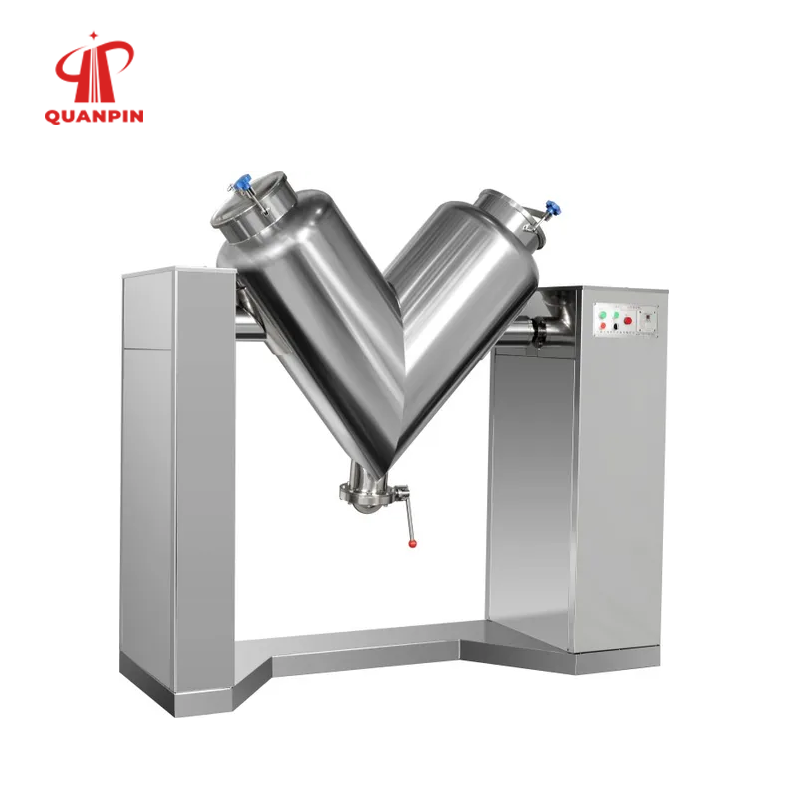
In the QUANPIN V blender, the rotating vessel repeatedly separates material between its branches and brings it together again.
The V mixer principle depends on compatible dry-solid movement. It does not establish that every trace ingredient will distribute acceptably without preparation. Use product-specific development knowledge to justify the attributes being examined. See FDA ICH Q8 pharmaceutical development.
Equipment Principle and Material Requirements
Define the function and proportion of the ingredient that creates the blending challenge.
Compare a direct-charge route with a justified preblend route using representative material and a suitable analytical method.
Five Steps for the Application Review
Identify the formulation question
Define the formulation and low-proportion ingredient.
Define the comparison routes
Document direct charging and the proposed alternative.
Prepare representative batches
Prepare comparable development batches.
Sample relevant boundaries
Sample the defined blend and discharge stages.
Evaluate the complete route
Evaluate uniformity alongside the full handling route.
Four Process Boundaries to Define
A preblend has its own composition, preparation and transfer history.
Adding that intermediate stage creates another material boundary to identify and control.
An apparently uniform preblend does not demonstrate the final blend’s acceptance.
The subsequent dilution and discharge steps require their own representative evidence.
ZKH(V) V-Type Mixer Components and Interfaces
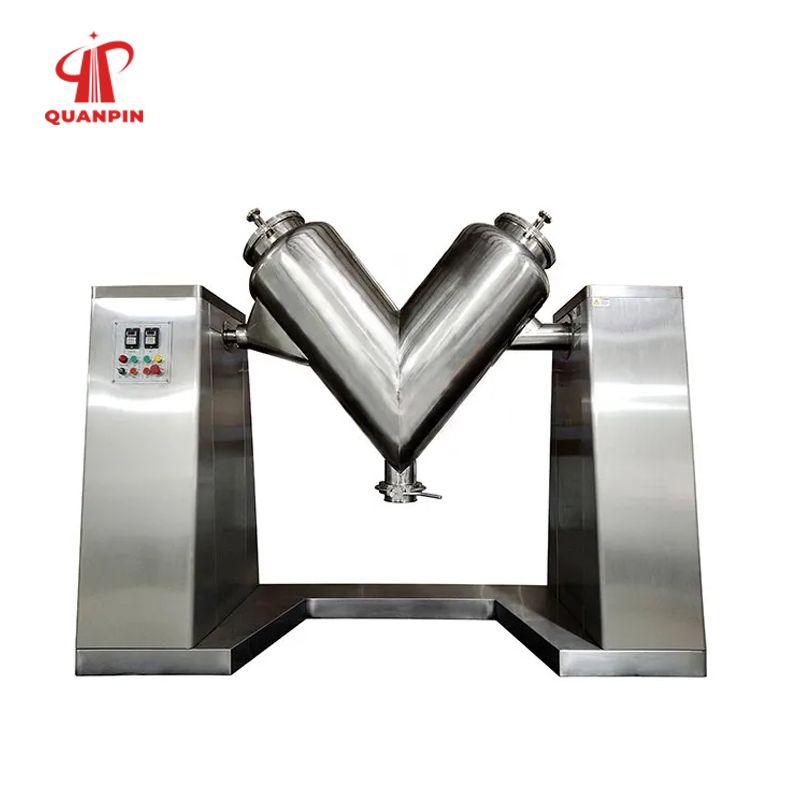
Vessel geometry
The vessel geometry supplies the division-and-recombination action.
Loading arrangement
The loading arrangement defines how the direct charge or preblend enters.
Rotating assembly
The rotating assembly needs the confirmed operating configuration.
Sampling access
Sampling access should support the development study without assuming every location is accessible during operation.
Discharge connections
Discharge connections define where the completed blend enters the next process.
Cleaning provisions
Cleaning provisions must address the actual ingredients and all relevant contact surfaces.
Comparison Choices and Application Evidence
Define the Reference Basis
A V cone blender enquiry should identify whether the product contains a low-proportion active or another ingredient with a critical distribution requirement.
Do not infer that similar-looking powders have identical mixing behavior.
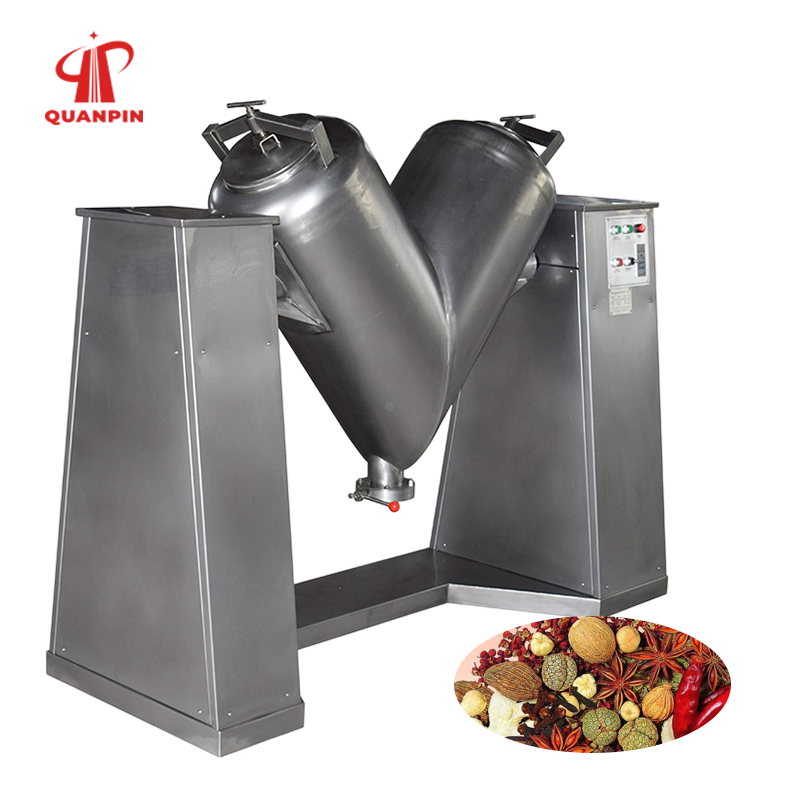
Particle properties, agglomeration and ingredient preparation can influence a trial and should be described.
Keep the Comparison Interpretable
A V type mixer comparison should preserve the actual charging sequence for each route.
If a preblend is used, identify its ingredients and contribution to the final formulation.
A V powder blender study should test individual representative samples rather than hide variation in an unexplained composite.
Assess the Receiving Process
Separate laboratory preparation from the process sampling plan.
Include downstream handling when it can affect the material delivered to the receiving operation.
Use the formulation’s justified acceptance criteria rather than inventing a universal mixing time or uniformity limit.
Industry Application and Acceptance
A preblend may be worth investigating when direct charging does not answer the formulation’s distribution needs.
It also adds preparation, transfer and cleaning steps that need evaluation. A development comparison should not be presented as complete validation of an untested production process. See FDA process validation guidance.
The preferred route is the one supported by relevant development evidence.
A V-shaped vessel alone does not prove which route is suitable.
Benefits and Practical Limits
Follow the approved procedures for loading, sampling and safe access.
Pharmaceutical blend acceptance and equipment safety require their own application-specific review. Assess relevant quality risks using the actual material and process context. See FDA ICH Q9 quality risk management.
Six Details for the Equipment Enquiry
Describe the complete formulation and ingredient properties.
Identify the low-proportion ingredient and analytical method.
State the direct-charge route and proposed preblend route.
Define sampling locations and discharge boundaries. Interpret measurements through process understanding rather than treating an isolated instrument reading as product acceptance. See FDA process analytical technology framework.
Record cleaning and containment requirements.
Explain the final receiving process and required product attributes.
Safety and Operating Requirements
Send QUANPIN the actual formulation-handling problem and planned comparison.
Request a V-type blending configuration review without treating an untested preparation route as established.
Prepare Your Equipment Enquiry
Retain the evidence for both the preblend and final blend where applicable.
Document the selected route and any conditions outside the development study. Retain knowledge and manage adopted process changes through the pharmaceutical quality system. See FDA ICH Q10 pharmaceutical quality system.
Frequently Asked Questions
Does preblending prove final uniformity?
A preblend is an intermediate mixture, not automatic proof of final uniformity.
Is one loading sequence suitable for every minor ingredient?
A low ingredient proportion does not prescribe one universal charging sequence.
Can appearance replace analysis?
Ingredient appearance cannot replace an appropriate analytical method.
How should the two preparation routes be compared?
Direct charging and preblending should be compared on a justified basis.
Does vessel acceptance establish downstream acceptance?
A successful vessel sample does not establish every downstream handling result.
What does a V-blending enquiry need?
The enquiry should identify the actual ingredients, preparation route and acceptance method.
Discuss Your ZKH(V) V-Type Mixer Application with QUANPIN
Discuss the confirmed ZKH(V) V-Type Mixer application with QUANPIN. Use the enquiry form or the contact page to describe your project.
Email sales@qpdryer.com or stacie@qpdryer.com. Call +86 19850785582, or contact us on WhatsApp: +86 15921493205.