Mushroom Powder Milling: Build an Umami Analysis Plan Before the Equipment Trial
By QUANPIN
A mushroom powder specification should connect the milling trial with the ingredient’s intended use. For a savoury seasoning, that connection requires a defined extraction and tasting plan, rather than a promise that finer particles automatically deliver stronger umami.
An air classifier mill can be considered for a fine-powder duty, but its suitability must be tested on the actual dried mushroom. Ingredient identity, previous processing and analytical preparation belong in the same trial record as particle size.
Define the intended mushroom ingredient
Begin with the food developer’s question: will this powder be stirred directly into a soup, extracted and filtered, or incorporated into a dry seasoning? Those routes expose different fractions of the mushroom to water.
The purchase specification should therefore describe both the accepted powder and the intended preparation. A fine powder grinder quotation cannot replace a product-development decision about flavour, texture or the acceptable amount of insoluble material.
Specify what the laboratory will measure
Umami-related analysis usually examines particular amino acids and nucleotides. A bulk extract can also contain sugars, organic acids and other soluble components, so total extract mass does not identify which substances created a flavour response.
The measured amount depends on the extraction procedure. Keep solvent, sample-to-liquid ratio, mixing, temperature and time explicit whenever a laboratory compares candidate powders or reports an apparent milling effect.
Document five feed and application inputs
Mushroom identity
Record the mushroom’s scientific identity and commercial lot. Results from a shiitake ingredient cannot be assigned to button mushroom powder simply because both materials were processed through the same equipment.
Caps and stipes
State whether the feed contains caps, stipes or a defined mixture. Changes in the anatomical proportion can change the incoming composition and may otherwise be incorrectly attributed to the mill.
Previous processing
Describe washing, blanching and drying before grinding. These operations can alter the ingredient that enters the trial; they are not background details to be omitted from the comparison.
Moisture and reporting basis
Measure and report feed moisture using an agreed method. Retain the reporting basis for chemical results so that a change in water content does not appear as an increase in flavour compounds.
Actual food application
Identify the intended food matrix and its preparation conditions. A clear broth and a concentrated seasoning paste impose different texture and dispersion questions even when their ingredient specifications use similar particle-size language.
Connect powder samples with analytical records
An original study of two Agaricus bisporus powders quantified multiple taste-related groups, including free amino acids and nucleotides. Its useful lesson for procurement is to request named measurements rather than an undefined flavour-strength number. See the Agaricus bisporus powder composition for the specific experimental scope.
The investigation does not establish the performance of a QUANPIN machine. Its powder compositions describe the tested materials and should not be treated as guaranteed specifications for a different supplier’s mushrooms.
When commissioning laboratory work, ask which compounds the method actually detects and quantifies. Keep calibration, sample preparation and reporting units with the report, rather than retaining only a final concentration table.
An air classifying mill trial should pair its powder samples with those analytical records. The resulting comparison can then support an application decision without confusing equipment selection with an ingredient composition certificate.
Run a controlled milling and extraction comparison
Divide the reference feed
Split a documented feed lot into the compared trial conditions. Preserve a reference portion before milling so that the laboratory can investigate whether unexpected differences were already present in the starting material.
Record the configuration
Record the actual tested equipment configuration and collection arrangement. Keep accepted powder, retained material and other collected fractions identifiable instead of combining them into an undocumented laboratory sample.
Collect representative samples
Collect representative samples according to an agreed procedure. A convenient scoop from the surface of a container may not represent the whole collected batch, especially if particles segregate during transfer.
Control laboratory preparation
Prepare laboratory portions consistently and randomise their analysis order where appropriate. A change in storage time or extraction sequence should not systematically coincide with one milling condition.
Fix the extraction procedure
Run the defined extraction procedure for every comparison. If the developer also wants to investigate extraction time, design that as a separately recorded factor rather than silently modifying the method for finer powder.
Evaluate the recipe
Evaluate the ingredient in its actual recipe after analytical review. Keep formulation concentration and preparation conditions constant when the purpose is to compare milling conditions, and retain the developer’s sensory observations.
Read the research within its actual boundaries
Pretreatment and anatomical fraction
Research comparing fresh, washed and blanched shiitake examined caps and stipes separately. It demonstrates why the treatment history and anatomical fraction must remain traceable when interpreting taste-related measurements. See the shiitake washing and blanching study for the specific experimental scope.
That work used prepared laboratory powders and specific analytical methods. It is evidence for controlling the comparison, rather than a universal processing prescription or a recommended commercial milling setting.
A purchaser can translate that lesson into a feed specification: identify the fraction, pretreatment and lot, then compare powders within that boundary before exploring additional raw-material changes.
Volatile and nonvolatile flavour
A separate shiitake drying investigation measured volatile and nonvolatile flavour components. Its headspace analysis and taste-compound measurements addressed different fractions of flavour and used different preparation procedures. See the shiitake volatile and nonvolatile flavour study for the specific experimental scope.
Consequently, an aroma assessment should not be substituted for a nucleotide assay. A powder that smells different may require further investigation without implying a corresponding change in every umami-related component.
If aroma retention is commercially important, specify an appropriate separate test with a qualified laboratory. Avoid expanding a result about one analysed component into a claim about the entire mushroom flavour profile.
Aging and calculated umami
A dry-moist-heat aging experiment on dried shiitake showed that the assessed quality attributes did not all change in the same direction. A single favourable laboratory endpoint is therefore an incomplete development criterion. See the dried shiitake aging study for the specific experimental scope.
The study’s treatment conditions are not milling settings, and its conclusions do not qualify the equipment proposed for a customer’s powder. Use it to frame the incoming-material history and the required outcome measurements.
An analytical trial report should distinguish measured concentrations from calculated equivalent umami concentration. The latter combines selected results through a model and is not a direct tasting score for the finished recipe.
Set acceptance criteria before reviewing results
The food developer should define the acceptance decision before seeing trial results. Possible requirements include an acceptable texture, a documented flavour profile and compatibility with the planned extraction or formulation route.
Keep analytical acceptance separate from throughput acceptance. A commercially useful comparison needs both product-quality evidence and a clearly defined accepted-output quantity, without assuming that a laboratory study establishes machine capacity.
Do not add universal temperature, capacity or mesh guarantees to the enquiry. Ask the supplier to propose a tested configuration and identify the evidence needed for the particular mushroom feed and target product.
If the finer sample gives an unexpected result, check sample identity, moisture basis, extraction recovery and prior treatment first. Repeating the comparison may be more informative than immediately increasing grinding severity.
Investigate unexpected analytical outcomes
An original research study developed a shiitake-byproduct flavour ingredient through extraction optimisation and subsequent application work. Its sequence illustrates that producing an ingredient includes extraction and recipe validation beyond making a smaller dry particle. See the shiitake ingredient development study for the specific experimental scope.
The thesis describing the same development work should not be counted as independent confirmation of this journal study. Its development approach does not justify an untested flavour-enhancement claim for a commercial mill.
Prepare an enquiry that can be tested
Provide the supplier with the mushroom identity, anatomical fraction and pretreatment description. Include the condition in which the material will actually arrive, rather than substituting a generic photograph or another ingredient’s description.
Describe the powder-quality targets and the measurement methods behind them. If the specification uses a distribution rather than a single cut-off, attach the agreed reporting format and sampling procedure.
Explain how the customer will use the powder after collection. Extraction and filtration, direct addition to a food and dry blending each create different requirements for handling and application testing.
List the samples and records required from a trial, including the reference feed, accepted powder, relevant fractions and tested configuration. Agree their identification before the run begins.
Ask which contact materials, cleaning arrangements and collection interfaces are proposed for this duty. Confirm the supplier’s actual offer rather than inferring those details from an ACM mill category name.
Request a quotation against that defined scope. Price comparisons are meaningful when the included equipment, trial obligations and documentation are stated consistently, without invented catalogue figures.
Choose equipment against the real duty
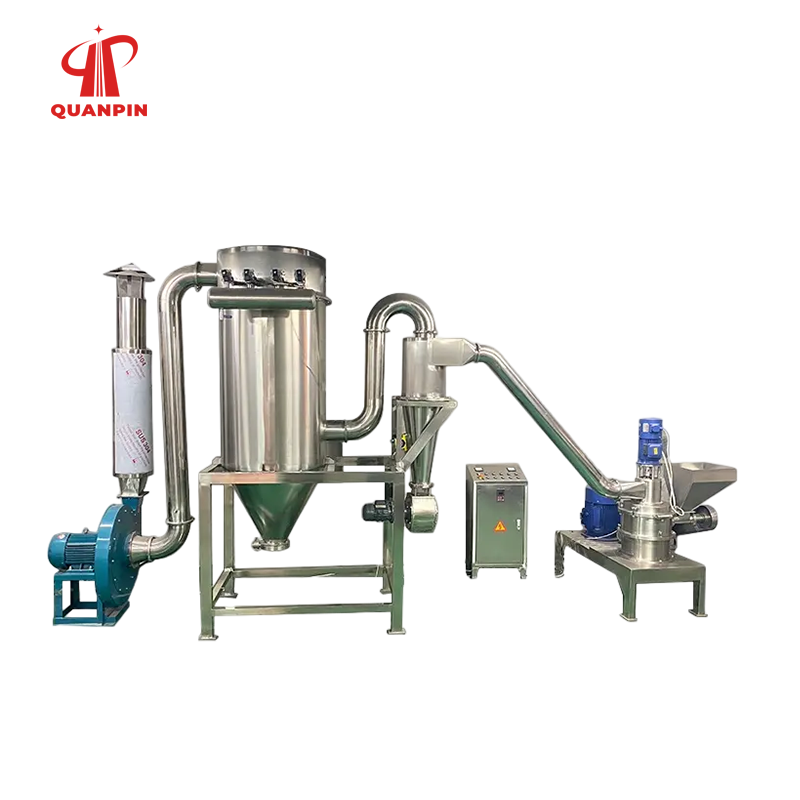
A suitable machine proposal should explain its grinding and classification duty for the actual material. It should also identify any preparation stage needed before the feed can enter the proposed configuration.
Select the process through testing and a documented acceptance decision. The available research helps formulate that decision, while the supplier’s own verified trial evidence must support claims about the offered equipment.
Keep development evidence connected
Keep the final development record readable: feed identity, prior treatment, milling configuration, sampling, extraction method, analytical results and application assessment should remain connected through consistent sample identifiers.
Use the accepted trial to define the next verification step and the remaining uncertainties. An unresolved flavour or texture question should remain explicit rather than disappear into a general statement that the powder is fine enough.
Frequently asked questions
Does finer powder guarantee stronger umami?
No. Particle-size reduction changes the physical preparation, while an umami claim requires relevant composition and application evidence. The actual ingredient and recipe must be evaluated under documented conditions.
Are different extraction methods comparable?
No. An extraction result belongs to its method and reporting basis. Two laboratories can obtain different results if their solvent, temperature, time or sample preparation differs, even when both analyse the same powder.
Can caps replace stipes without testing?
Not automatically. Caps and stipes should be identified because their incoming compositions can differ. A change in their proportion requires a controlled comparison rather than an assumption of interchangeability.
Is EUC a direct sensory score?
No. Equivalent umami concentration is calculated from selected analytical inputs. A finished product also needs assessment in its intended recipe, where salt, other ingredients and preparation influence the eating experience.
Can research qualify a commercial mill?
Not by itself. Published work can explain which factors deserve testing, but it cannot establish commercial capacity, cleaning suitability or flavour performance of an untested QUANPIN installation.
What should an equipment enquiry include?
Provide a traceable feed description, a defined powder target and an application test plan. These inputs allow a supplier to discuss the proposed scope and the evidence needed before purchase.
Discuss your mushroom powder project
Discuss the material, processing objective and required trials with QUANPIN. Review the equipment information and the relevant industry applications, or send an enquiry through our contact page.
Email sales@qpdryer.com or stacie@qpdryer.com. Call +86 19850785582 or contact WhatsApp +86 15921493205 to discuss the proposed scope.