Hopper Mixer Trials: Assess Fill Level through Particle Motion and Scale
By QUANPIN
A hopper mixer trial should describe the space occupied by the charge and the movement available during tumbling. Batch mass alone does not establish either condition.
For pharmaceutical powders, blend composition and later handling behaviour are separate evaluation questions. State the intended outcome before comparing different charge sizes.
Define the Fill-Level Question
Begin with the formulation and incoming condition. Free-flowing granules and cohesive powders containing persistent agglomerates need not respond similarly to the same vessel movement.
Specify whether the comparison changes charge size, vessel size or both. These experiments introduce different variables and deserve different conclusions.
Describe Mass and Occupied Volume
Mass describes material quantity, while occupied volume also depends on packing and powder condition. Keep the measurement basis visible in a fill description.
Vessel shape and orientation influence the environment for particle movement. Equal nominal volumes do not independently establish equivalent mixing arrangements.
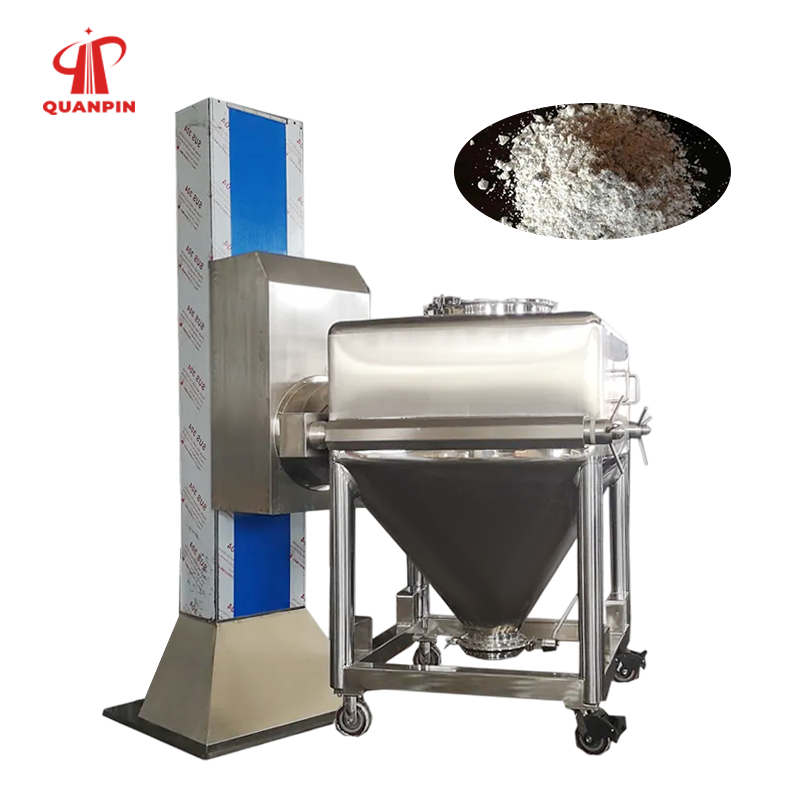
Record Five Trial Inputs
Formulation condition
Record formulation revision and lot identity. A familiar recipe name does not demonstrate identical particle properties or agglomerate condition between trials.
Charged mass
Identify the mass actually charged and its measurement basis. Material remaining in a transfer container should not silently count as material entering the vessel.
Occupied-volume basis
Describe how occupied volume was estimated. An unrelated bulk-density measurement may not represent the preparation and packing state of the actual charge.
Vessel configuration
Identify the supplied vessel and accessories. Research apparatus features must not be assumed present on a QUANPIN hopper mixer machine.
Charging arrangement
Describe the charging sequence and analytical objectives. An explicit starting condition helps distinguish the intended comparison from an accidental material-handling difference.
Interpret Cohesive-Powder Research
An original cohesive-placebo experiment found that fill capacity and aggregate condition influenced homogeneity. Longer operation did not universally overcome those material-dependent differences.
The tote-blender investigation supports examining fill and material condition together. Its preferred settings belong to the tested formulation and apparatus.
Do not convert a published optimum into a general operating instruction. Representative testing remains necessary for a different formulation, vessel or installation.
A useful trial can expose an unresolved mixing problem. Retain that observation instead of reporting every charge change as an improvement.
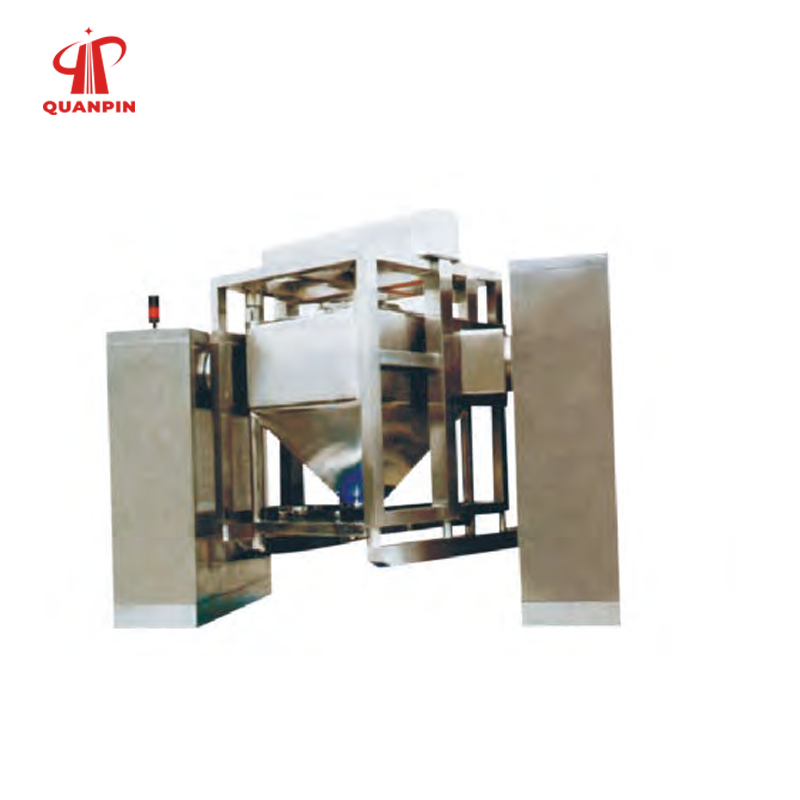
Follow Six Trial Stages
Before charging
Before charging, verify material identities and the agreed equipment state. Readiness decisions belong within the operation’s procedures and applicable supplier instructions.
At charging
At charging, preserve the actual sequence and interruptions. Distinguish planned additions from material that entered later or remained outside the vessel.
During tumbling
During tumbling, record the approved operation and duration. Observation must not require bypassing safeguards or opening equipment during an unsafe condition.
At sampling
At sampling, identify location, timing and method. Each analytical result describes its collected specimen rather than automatically establishing the condition of the whole charge.
During discharge
During discharge, retain the link between collected material and the trial condition. Combining different trial charges can erase the intended comparison.
At subsequent handling
At subsequent handling, evaluate the relevant powder property independently. A composition result cannot describe every flow behaviour in downstream equipment.
Make the Comparison Interpretable
Compare relevant observations
Describe whether the reported duration means elapsed operation or another explicitly defined basis. Preserve that basis when comparing results from different studies.
Counting revolutions describes operation but does not independently establish equal particle motion or shear exposure across different charges and vessel geometries.
A powder blender model needs an explicit material representation. A convincing animation is not proof that the actual pharmaceutical formulation has been represented adequately.
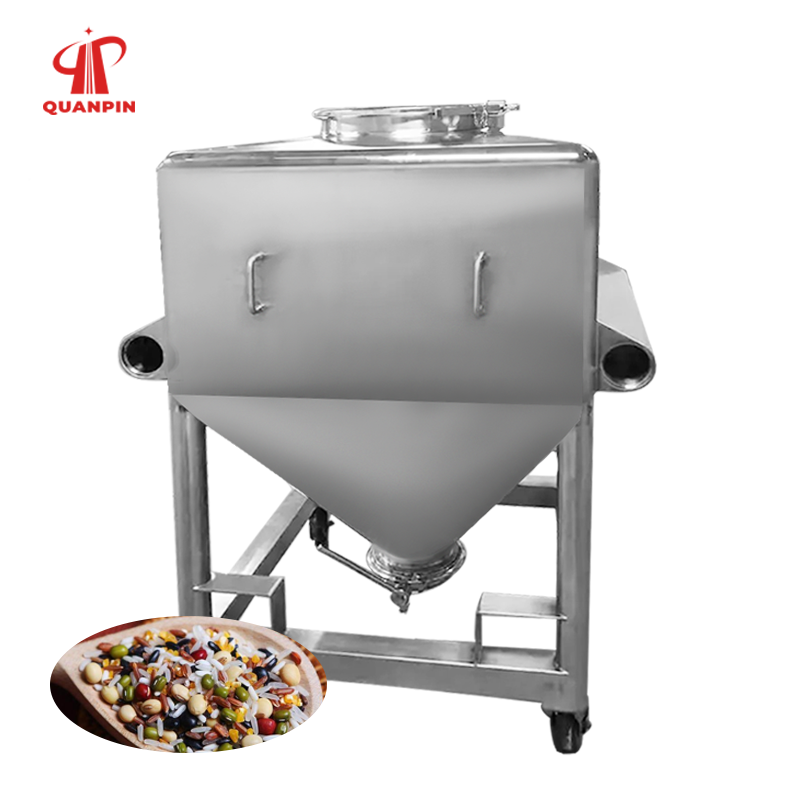
Keep methods consistent
Compare the observations required by the objective. Composition, particle movement and handling properties answer related questions but are not interchangeable measurements.
Keep sampling and analytical methods consistent where feasible. Otherwise a change in collection procedure may resemble a fill-related process effect.
Preserve unexpected and adverse results. A proposed condition should be evaluated against the whole evidence rather than only the preferred specimen.
Retain ambiguous results
Original bin-blender research measured lubricant distribution with near-infrared spectroscopy. Its cohesive-powder experiment found that fill and internal features influenced mixing behaviour.
That study used particular laboratory equipment and materials. Its findings do not establish the outcome of an unconfirmed accessory on QUANPIN equipment.
Motion may differ by direction within the vessel. A rapidly changing visible region does not demonstrate equally effective redistribution throughout the entire powder charge.
Investigate Particle Movement
An original pharmaceutical bin-blending study compared the effects of scale, rotation, cohesion and fill while retaining geometry and loading method. Within its studied ranges, fill was the least influential of those parameters; this does not establish a universal fill rule.
Use the reported mechanisms to frame a trial question. They provide context without guaranteeing a numerical outcome for the proposed material or duty.
Scale changes more than the equipment label. Particle interactions and cumulative exposure may change even when a familiar programme is repeated on another vessel.
A multiscale bin-blending investigation connected simulated shear exposure with experimental flow measurements. It supports assessing handling properties alongside blend composition.
Assess Scale and Shear Exposure
Its findings depend on its powder and modelling arrangements. They do not provide a universal equation for commercial batch size or production mixing time.
An open industrial-bin modelling paper studied operating variables and particle-level dynamics. The authors identified further experimental validation as a next step, which limits how predictions should be used.
Resolve Conflicting Observations
If larger charges give different concentration patterns, first confirm material and method comparability. Then investigate the actual process differences introduced by changing the charge.
If composition appears suitable but later powder movement changes, assess handling separately. An acceptable composition measurement does not settle a flowability question.
Prepare a powder mixer enquiry with the formulation family, material condition and intended charge range. Explain the receiving arrangements and the observations required.
Ask QUANPIN to confirm the supplied vessel and interfaces. Request evidence for relevant features rather than assuming them from a generic equipment photograph.
Identify supplier observations and customer analytical responsibilities. A clear division helps produce useful evidence without implying that a supplier trial establishes pharmaceutical process acceptance.
Agree how the results will be reviewed before selecting production conditions. Published mechanisms support study design, while operational acceptance needs appropriate evidence.
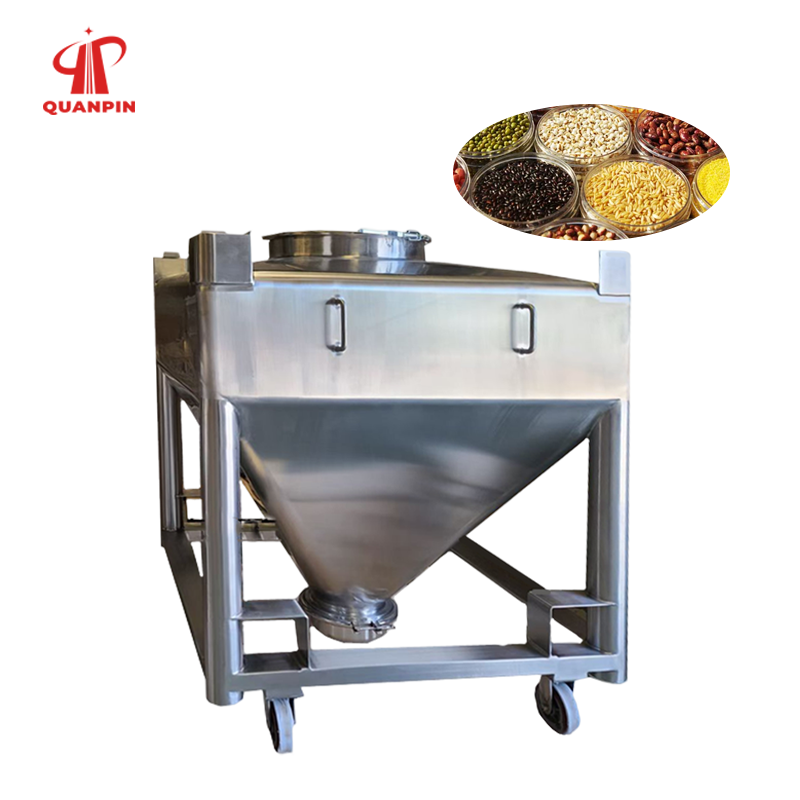
Prepare the Bin-Blending Enquiry
Retain the actual charge description with sample identities and analytical reports. Later reviewers should understand the vessel, material and comparison behind each result.
State unresolved explanations explicitly. Evidence for a change is different from evidence that fill level alone caused it.
Preserve the Applicability Limits
Discuss your bin blender application with QUANPIN using the verified product and contact links below. Describe the intended range and the questions requiring investigation.
A representative trial connects material behaviour with the supplied equipment arrangement. Keep the proposal and its conclusions within the evidence actually obtained.
Frequently Asked Questions
Does batch mass define fill level?
No. Batch mass does not independently establish occupied volume or motion. Material packing, powder condition and vessel geometry also belong in the description.
Is there one optimum fill percentage?
No universal optimum is supplied here. Research conditions apply to their tested apparatus and formulations, and cannot automatically define another operation’s settings.
Do equal revolutions establish equivalence?
Not necessarily. Equal revolution counts do not demonstrate equivalent motion, shear exposure or blend composition across different vessel geometries and charges.
Can simulation replace experimental evidence?
No. A simulation requires an applicability assessment and suitable validation for its intended use. A mechanistic prediction differs from demonstrated production performance.
Does composition establish flowability?
No. Composition and flowability are different properties. Evaluate each using evidence suited to the actual question and downstream handling requirements.
What information supports an enquiry?
Provide formulation family, incoming condition, intended mass, occupied-volume basis, vessel identity and required tests. Identify analytical responsibilities before the study begins.
Discuss Your Bin-Blending Trial
Discuss the QUANPIN HLD hopper mixer with QUANPIN. Use our contact page or the enquiry form to explain the intended material-processing application.
Email sales@qpdryer.com or stacie@qpdryer.com. Call +86 19850785582, or contact us on WhatsApp: +86 15921493205.
For process evaluation, consider the single-arm lifting hopper mixer for lifting and blending in a single-arm hopper arrangement. Confirm suitability with representative material, the required product properties and the proposed process conditions.