Food Powder Blending: Distinguish Micronutrient Uniformity from Nutrient Retention during Storage
By QUANPIN
A conical screw mixer can distribute micronutrient ingredients through a food powder without establishing how much of each nutrient remains after storage. Initial distribution and later chemical retention require separate evidence.
Assess the mixed material at a defined initial time, then follow the relevant nutrients in the intended product matrix and package. One favourable measurement cannot answer both questions.
Distribution and Retention Are Different Attributes
Uniformity concerns the distribution of an ingredient among sampled portions. It does not establish that the ingredient remains chemically unchanged during a later storage interval.
Retention compares the measured nutrient amount at a later time with an appropriate initial amount. Keep the reporting basis and analytical method consistent throughout that comparison.
Define the Mixer and Stability Boundaries
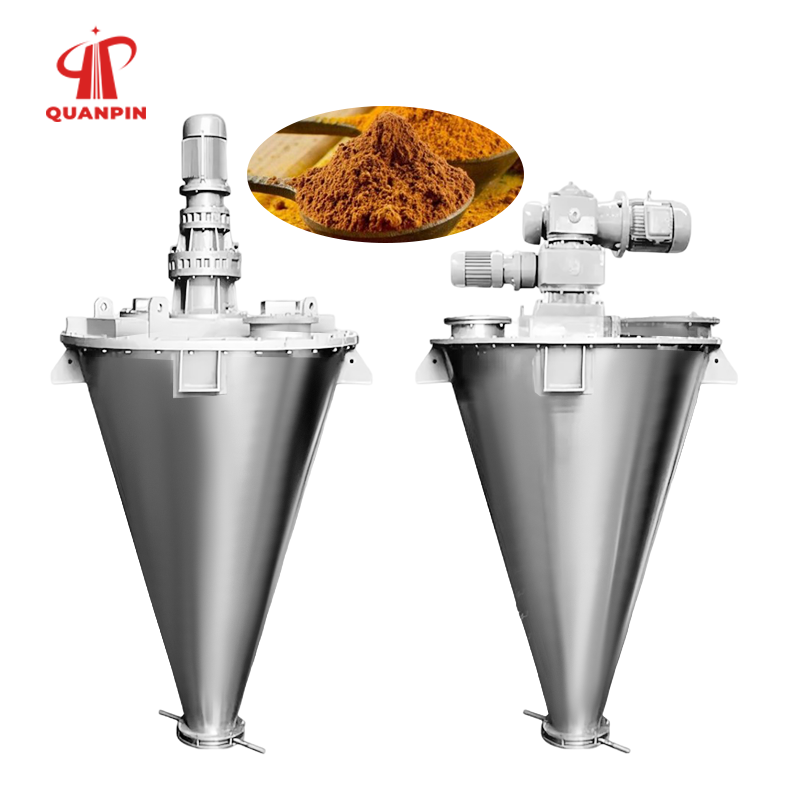
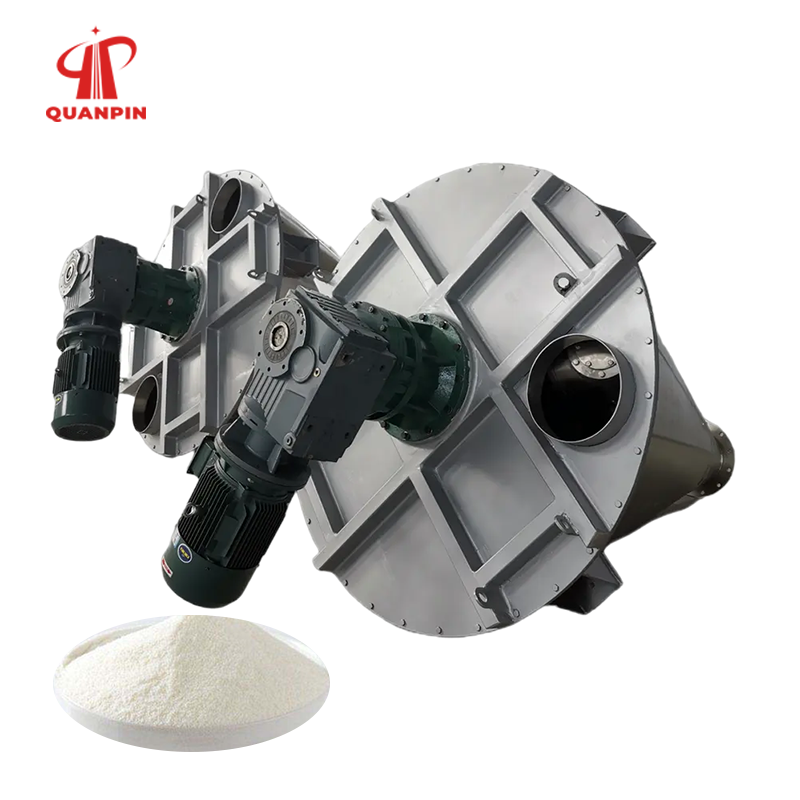
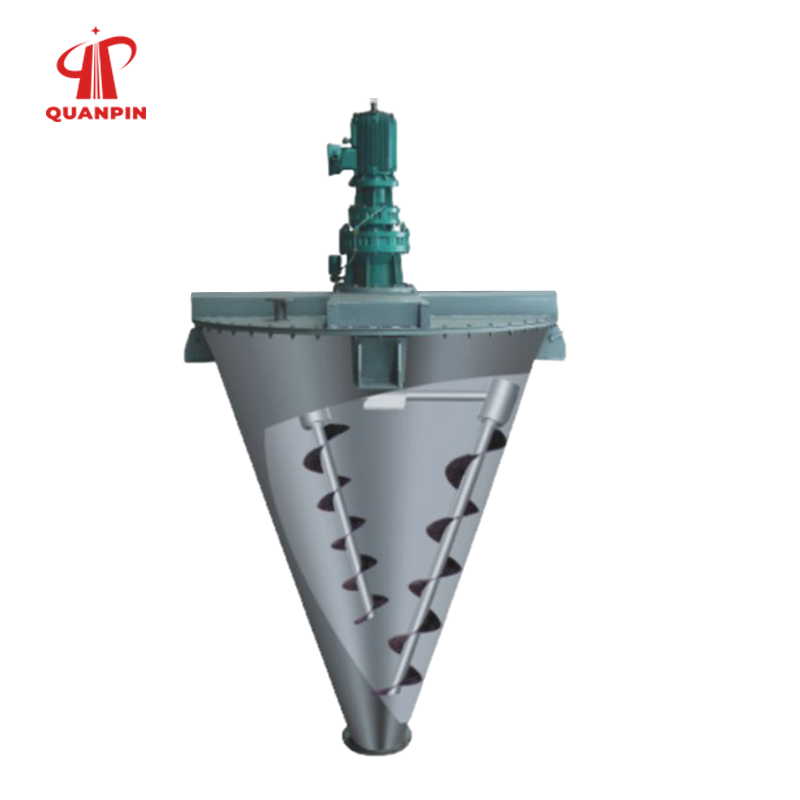
The proposed double screw cone mixer must be evaluated for the actual food ingredients and required distribution. Research on commercial formulated foods does not validate its mixing performance.
Storage experiments can inform which questions deserve testing, but they cannot assign shelf life to an untested formulation or supplied equipment configuration.
Five Definitions for a Nutrient Comparison
Fortificant identity
Identify each nutrient’s chemical form and carrier. A vitamin name alone may omit relevant differences in the fortificant or protective preparation.
Food matrix
Describe the surrounding food matrix, including whether it is a concentrated premix or the final product. Their chemical environments need not be equivalent.
Initial time point
Define the initial analytical time point. Material immediately after blending and material after later processing represent different starting states for a retention calculation.
Packaging condition
Record packaging and storage conditions for the actual comparison. A result from an opened package is not interchangeable with a sealed-package experiment.
Analytical method
Use suitable nutrient-specific analytical methods. An iron measurement cannot independently establish the retained amount of a vitamin incorporated in the same blend.
Interpret Mineral and Vitamin Results Separately
A stable mineral result should not be used as a universal indicator that accompanying vitamins also remained stable during storage.
An original fortified-wheat-flour experiment measured iron, zinc and folic acid over storage. Iron and zinc showed little loss, while folic acid showed significant losses.
The broad wording of its conclusion should therefore not replace its nutrient-specific results. Retain the distinction between the measured minerals and folate.
This flour study does not provide a retention guarantee for a different premix. It illustrates why the analytical panel must reflect the actual formulation.
Six Stages from Ingredients to Analysis
Incoming ingredients
Before blending, identify ingredient forms and the intended food application. Preserve the basis used to calculate the amount of each nutrient introduced.
Distribution trial
During blending, investigate the required spatial distribution using representative specimens. A later stability result does not prove that the original blend was uniform.
Further processing
After any further processing, define whether a new initial sample is required. Processing changes should remain distinguishable from subsequent storage changes.
Packaging
During packaging, identify the material condition and closure state. Stability specimens need to represent the product and package being assessed.
Storage
During storage, retain the actual duration and conditions. Accelerated and ordinary conditions answer related but different experimental questions.
Nutrient analysis
During analysis, preserve methods and the nutrient reporting basis. Method changes can complicate an apparent comparison between initial and later content.
Read Formula-Specific and Pooled Evidence Carefully
Individual formula studies
Food-matrix evidence can show different responses even when the same broad nutrient names appear on the analytical panel.
An original powdered-enteral-formula investigation evaluated two formulations under different storage conditions and measured vitamins A, E, C and thiamine separately.
Vitamin A, E and thiamine declined under the investigated conditions, whereas vitamin C remained comparatively stable. The findings are specific to those formulations and experiments.

Pooled shelf-life analysis
Broader datasets provide another perspective, but their pooled associations should not erase differences observed in individual products.
An original analysis of medical-food shelf-life studies compared nutrient stability across many recipes, formats and conditions using company-generated storage data.
Powder vitamin A was among the responses associated with degradation. The analysis does not establish that every other nutrient remains stable in every powder.
Fortificant preparation
The method of preparing a fortificant can also be part of its storage response. Keep that processing history distinguishable from final blending.
An original fortified-rice study compared extruded and coated preparations mixed with ordinary rice and subsequently stored under different environmental conditions.
Vitamin A retention differed with preparation and storage while iron and zinc were comparatively stable. Rice kernels and their processing methods are not conical powder-mixer performance evidence.
Distinguish Opened and Sealed Packages
Opened-package observations require their own boundary. Exposure history after opening differs from storage in a sealed original package.
An original infant-formula analysis reproduced in a university collection measured vitamins A and E after opening commercial powder packages at several time points.
Meeting a stated minimum in that historical experiment did not mean the measured amount never changed. Its historical regulatory comparisons are not current operating instructions.
No infant-feeding, patient-use or microbial-safety recommendation follows from these equipment-development comparisons. They concern analytical distinctions in food formulation and storage research.
Plan the Equipment and Laboratory Work
For a double screw conical mixer trial, state the distribution objective separately from the later retention programme. Confirm which material specimens can be provided.
The necessary analytical and storage studies may involve facilities outside the equipment supply. Identify those responsibilities before comparing quotations or trial schedules.
Investigate Different Analytical Outcomes
If initial uniformity is acceptable but a vitamin declines during storage, investigate the formulation and storage history rather than assuming the mixer failed to distribute it.
If average nutrient content is correct but portions differ, an average result cannot settle the distribution question. Retain the individual portion evidence required by the plan.
If minerals remain stable while a vitamin declines, keep the results separate. Shared incorporation into a premix does not establish shared chemical stability.
If accelerated and normal-storage results differ, preserve the actual conditions. A model or extrapolation needs its own justification rather than an assumed conversion.
If a different fortificant form changes retention, identify the preparation difference. Do not attribute the whole result to a change in mixing duration.
If a later assay differs after opening a package, distinguish the exposure history from the original sealed-storage study before drawing a process conclusion.
Prepare a Food-Powder Mixing Enquiry
Prepare a conical screw blender enquiry with the food matrix, ingredient forms, required distribution and available analytical methods. Explain which question the equipment trial must resolve.
Specify the product stage represented by each sample. A concentrated vitamin premix and the completed food may require different evaluation plans.
Confirm the Actual Development Scope
A conical powder mixer proposal should confirm the actual processing and transfer scope. It does not independently establish nutrient-label compliance or a validated shelf life.
The useful development record separates initial distribution, initial chemical amount, later retention and remaining uncertainty. It connects each conclusion to the specimens and method supporting it.
Frequently Asked Questions
Does uniformity establish retention?
No. Uniformity describes distribution across portions, whereas retention concerns how the measured nutrient amount changes over a defined interval.
Does stable iron establish vitamin stability?
No. The flour and rice studies found different responses for minerals and selected vitamins. Each relevant nutrient needs appropriate evidence.
Can premix data establish final-food stability?
No. A concentrated premix and a finished food provide different matrices, so the same storage behaviour cannot be assumed without investigation.
Does accelerated testing directly predict shelf life?
Not automatically. Accelerated conditions and any extrapolation method need validation for the actual formulation and intended storage claim.
Does this guide give infant-storage instructions?
No. Historical opened-package analytical findings do not provide present-day infant-use instructions, microbial safety guarantees or permission to change labelled storage conditions.
What should the enquiry include?
Provide ingredient forms, food matrix, initial sampling point, distribution objective, packaging and analytical responsibilities. Keep mixing acceptance separate from shelf-life development.
Discuss Your Food Powder Application
Discuss the material, processing objective and required trials with QUANPIN. Review the equipment information and the relevant industry applications, or send an enquiry through our contact page.
Email sales@qpdryer.com or stacie@qpdryer.com. Call +86 19850785582 or contact WhatsApp +86 15921493205 to discuss the proposed scope.