DSH Food-Premix Blending: Why Ingredient Humidity Limits May Not Describe the Mixture
By QUANPIN
A conical screw mixer can combine dry food ingredients whose moisture sensitivity differs from that of the separate components. Individual ingredient limits therefore cannot automatically define the behaviour of the completed blend.
This guide examines deliquescence in food premixes: water-vapour uptake can produce a liquid phase even though no process water was added.
Deliquescence Is a Mixture-Level Question
Deliquescence concerns dissolution driven by environmental water uptake. It differs from deliberate preparation of a powder-and-water paste.
The relative humidity at which a mixture changes need not equal an arithmetic average of its ingredients.
Separate DSH Circulation from Moisture Response
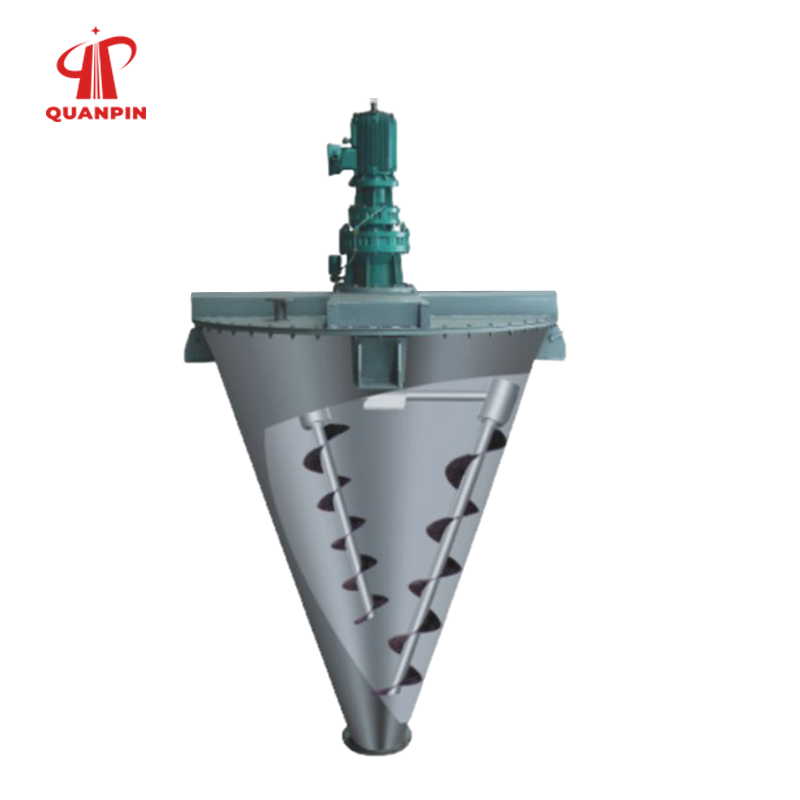
A double screw cone mixer circulates the powder charge. It does not independently control the thermodynamic response of the formulation.
Confirm environmental and transfer arrangements separately from the DSH machine specification.
Five Definitions for the Exposure Study
Ingredient state
Identify the crystalline components and their actual forms.
Mixture composition
State the blend composition rather than listing ingredients alone.
Temperature
Retain temperature with the humidity condition.
Equilibrium and kinetics
Distinguish an equilibrium boundary from the observed speed of change.
Required response
Define whether the response concerns liquid formation, caking or chemical stability.
Why Separate Ingredient Data Can Be Insufficient
Blending can introduce moisture behaviour that a single-ingredient observation misses.
Original multicomponent food-system research measured ingredients and mixtures and observed deliquescence lowering in selected blends.
This does not establish that every blend deliquesces. It identifies a formulation-specific question.
Do not infer a safe mixture condition from the least sensitive ingredient alone.
Six Stages from Ingredient to Stored Blend
Before blending
Before blending, characterize the incoming ingredients.
During charging
During charging, retain the formulation identity.
During circulation
During circulation, distinguish mixing motion from atmospheric exposure.
During transfer
During transfer, identify the environmental conditions encountered.
During storage
During storage, retain exposure duration and temperature.
During evaluation
During evaluation, distinguish physical and chemical outcomes.
Read Food-Powder Research within Its Scope
Assess chemical stability separately
Chemical stability can change alongside moisture-induced physical changes.
Original vitamin-C food-blend research examined deliquescence and formulation effects on chemical stability.
The studied vitamin systems do not provide a universal shelf-life rule for DSH blends.
Assess physical flow changes
The observed flow response also depends on how moisture is acquired.
Original crystalline-ingredient research investigated water-solid interactions, formulation, particle size and powder flow.
A flow observation is not itself a measurement of every phase boundary.
Review additive effects
Added anticaking material introduces another interaction rather than eliminating the need for evaluation.
Original food-powder anticaking research examined additives, humidity cycling and ingredient stability.
Its results do not establish a universally protective additive or an equipment operating limit.
Choose an Appropriate Transition Measurement
The measurement method can affect how a transition is identified.
Original deliquescence measurement research compared several experimental approaches and preparation conditions.
This supports method-specific interpretation rather than treating every reported humidity value as interchangeable.
Measurements should address the actual mixture and environmental question.
Identify the Actual Mixer Requirement
A double screw conical mixer enquiry should identify whether moisture sensitivity creates a handling requirement.
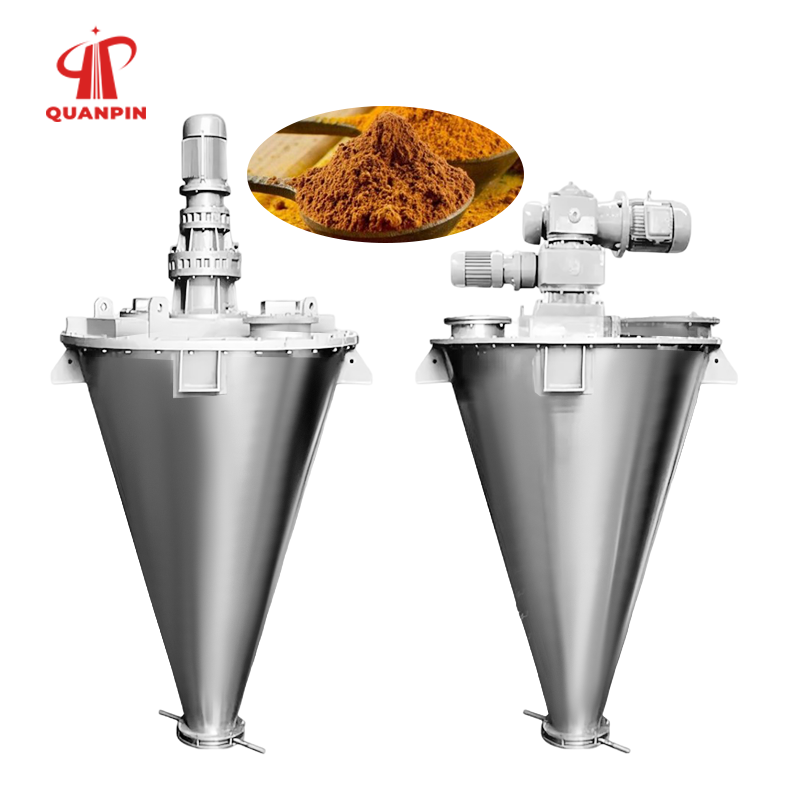
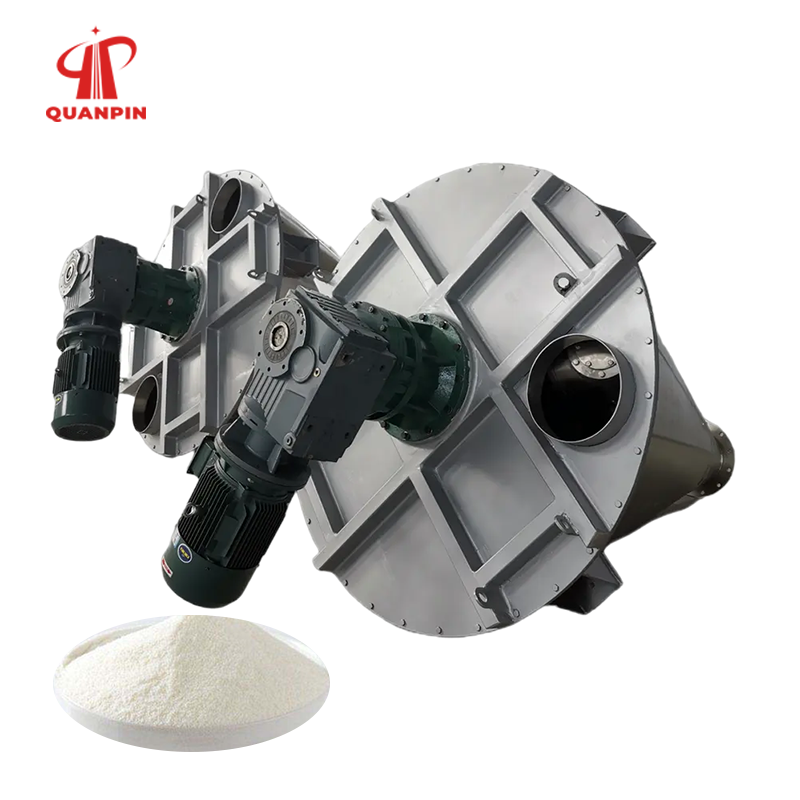
A mixer photograph cannot establish whether the proposed blend remains dry under its intended exposure.
Investigate Different Moisture Observations
If ingredients remain dry individually but their blend changes, investigate mixture interactions.
If caking appears without visible liquid, assess the mechanism rather than assuming deliquescence.
If two methods identify different transition points, compare preparation and observation conditions.
If temperature changes, review whether the earlier humidity comparison remains applicable.
If colour and chemical assay differ, retain their separate meanings.
If an additive improves one response, evaluate the other required product attributes independently.

Prepare the Blend-and-Exposure Enquiry
For a conical screw blender trial, identify the mixture and the exposure question.
Agree which powder observations can be collected and which require a separate moisture-sorption study.
State the Confirmed Environmental Scope
A conical powder mixer proposal should state confirmed environmental interfaces rather than imply complete humidity control.
The practical result connects formulation behaviour with its handling context without turning research observations into machine guarantees.
Frequently Asked Questions
Do ingredient limits define the mixture?
No. Mixture interactions can change the response relative to separate ingredients.
Is deliquescence intentional wet mixing?
No. Deliquescence involves environmental water uptake rather than intentional liquid addition.
Does caking prove deliquescence?
Not necessarily. Caking can have several mechanisms and requires investigation.
Is relative humidity sufficient alone?
No. Temperature and formulation affect the interpretation of humidity conditions.
Does anticaking guarantee stability?
No. Anticaking performance is formulation-specific and does not establish every stability attribute.
What should the enquiry describe?
Describe the components, proportions, temperature, humidity exposure and required physical or chemical measurement.
Discuss Your DSH Application
Discuss the material, processing objective and required trials with QUANPIN. Review the equipment information and the relevant industry applications, or send an enquiry through our contact page.
Email sales@qpdryer.com or stacie@qpdryer.com. Call +86 19850785582 or contact WhatsApp +86 15921493205 to discuss the proposed scope.