Double Cone Blending: Distinguish Bulk Uniformity from Fine-Particle Carrier Adhesion
By QUANPIN
A double cone blender redistributes particles, but fine particles can also attach to larger carrier surfaces. That interactive mixture differs from a random spatial arrangement of freely moving particles.
This pharmaceutical discussion separates blend composition from particle association. It does not claim that SZH tumbling provides the surface treatment or inhaler performance achieved by specialized research equipment.
Two Structural Scales in a Powder Blend
Spatial uniformity describes how composition varies among collected portions. Particle association describes which particles contact or adhere to others.
A blend can have consistent composition across portions while remaining deliberately nonrandom at the individual-particle scale. The two observations are compatible.
Define the SZH Redistribution Duty
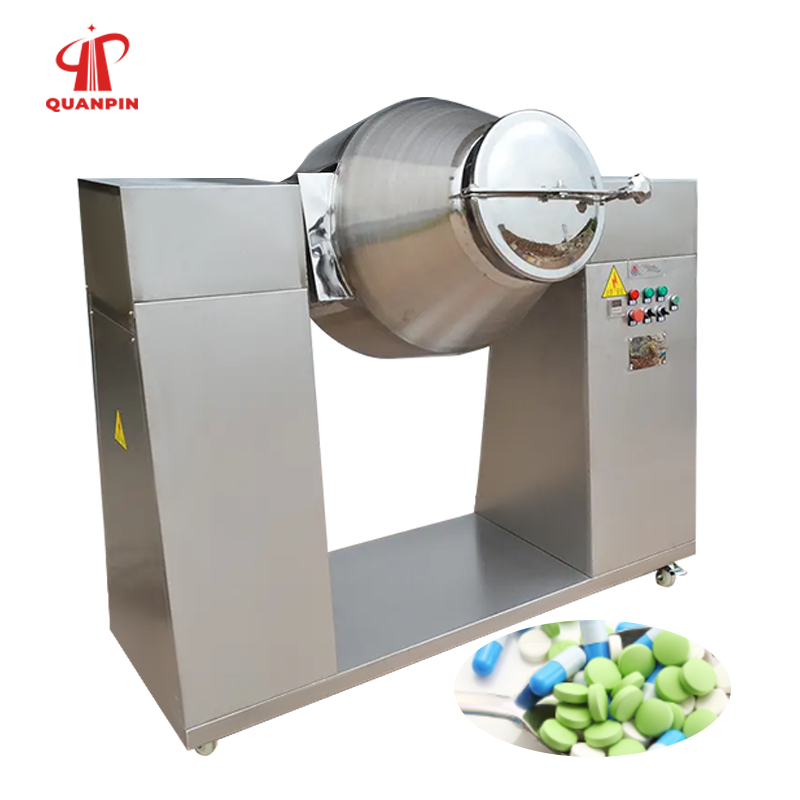
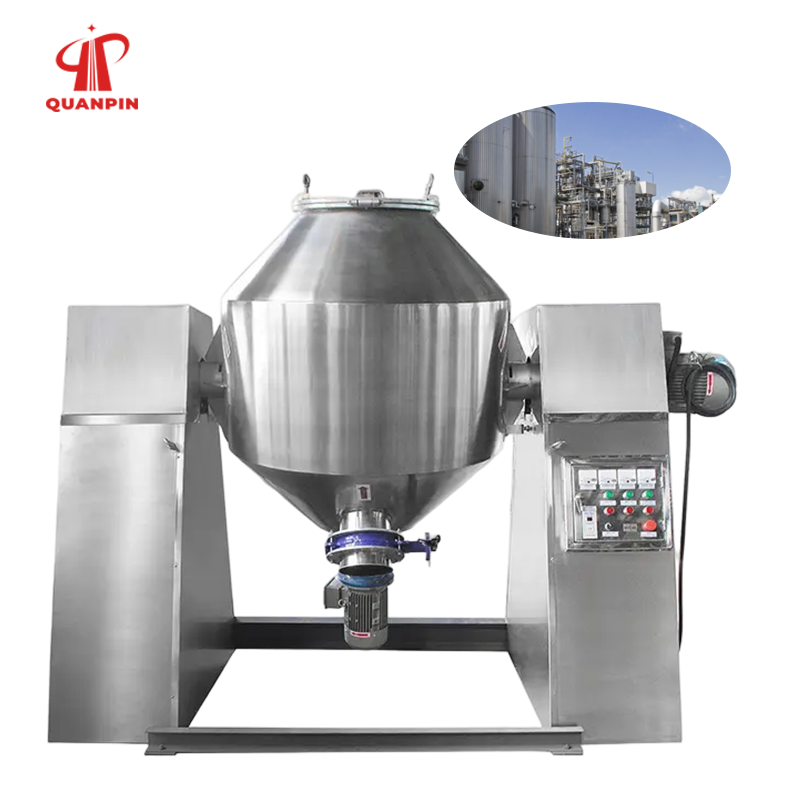
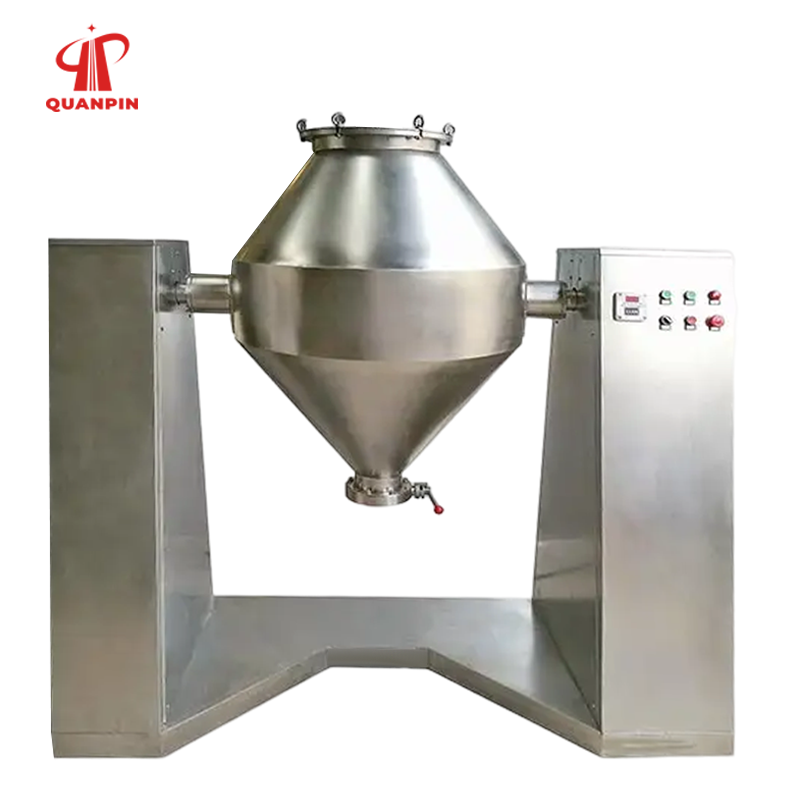
A double cone mixer operates through vessel tumbling. Any ability to create a particular carrier surface or detach a fine drug requires separate evidence.
The supplied SZH configuration should be confirmed for the intended powder duty. Neither high-energy coating nor an inhalation device is implied by the mixer name.
Five Definitions for an Interactive-Mixture Study
Particle populations
Identify the fine component and the carrier separately. Their relative sizes affect the meaning of a particle-scale observation.
Adhesion and cohesion
Distinguish adhesion to a carrier from cohesion among fines. These interactions need not favour the same distribution.
Bulk composition
Define how bulk composition is measured. A carrier image is not automatically a quantitative assay of a collected blend portion.
Particle separation
Define any particle-separation measurement independently. Mechanical separation and aerodynamic dispersion impose different conditions.
Product response
Identify the required final product response. Blend composition, dissolution and aerosol deposition are distinct outcomes.
Why Flowability Does Not Resolve Particle Association
An interactive mixture can depend on competing particle interactions rather than free flow alone.
An original powder-and-small-granule mixing experiment compared lactose systems. Improved flowability did not independently improve mixing, and the authors examined adhesion and cohesion as explanations.
The experiment used shaking in a cylindrical vessel. Its observations do not establish an SZH mixing time or suitability for every micronized drug.
The practical question is whether particles redistribute individually or move as associated units. A bulk assay cannot resolve that mechanism alone.
Six Stages Connecting Contact with Product Response
Before contact
Before blending, characterize the relevant particle populations. A common chemical name does not establish a common surface state.
During contact
During contact, distinguish carrier attachment from the persistence of fine-particle agglomerates.
During redistribution
During redistribution, ask what unit actually moves: an individual particle, an agglomerate or a carrier with attached fines.
During sampling
During sampling, preserve the distinction between bulk composition and particle-scale structure.
During separation
During separation testing, identify the force or airflow applied. Detachment is conditional on that test.
During final testing
During final testing, measure the product response directly rather than substituting a favourable image.
Read Surface-Treatment Studies without Equating Equipment
Distinguish redistribution from coating
Some mixing arrangements deliberately alter surfaces rather than only redistribute them.
An original aspirin–potato starch experiment used a centrifugal rotating mixer to create an adherent aspirin layer. The resulting dissolution response differed from a physical mixture.
Friction and collision in that apparatus were part of the preparation. A rotating-vessel SZH must not be described as equivalent to that specialized treatment.
Measure adhesion independently
Adhesion can be measured independently of an inhalation outcome. A separation test supplies evidence about the particular applied conditions.
An original surface-treated lactose-carrier study compared adhesion, airflow separation and in-vitro deposition for salbutamol mixtures. The carrier treatment changed these measured responses.
This was an inhalation-formulation experiment using treated carriers and a specified device. It does not validate an unrelated pharmaceutical blend or a supplied mixer.
Preserve the surface-treatment history
Carrier-layer preparation can introduce another variable. Its duration and method describe the surface treatment rather than a universal blending endpoint.
An original lactose surface-layering experiment investigated magnesium-stearate layering time and subsequent in-vitro deposition. Those observations apply to that carrier preparation and inhalation test.
Do not turn the reported layering trend into an instruction to extend SZH tumbling. Different deformation and contact histories can produce different surfaces.
Carrier Covering Is a Separate Preparation Step
Another coating material provides a separate comparison of carrier surface condition.
An original sucrose-tristearate carrier-covering study used a high-speed elliptical-rotor mixer and evaluated salbutamol mixtures in vitro. The covered carrier differed from the untreated reference.
The research establishes a relationship in a defined formulation and apparatus. It does not demonstrate a clinical benefit or a QUANPIN coating capability.
These studies support distinguishing surface preparation, subsequent blending and final dispersion as separate operations.
Specify the Intended Mixing Function
A double cone powder mixer enquiry should state whether the requirement is bulk redistribution alone or an investigation involving particle association.
A proposed surface-engineering requirement needs separate technical assessment. Confirm it explicitly rather than inferring it from dry mixing terminology.
Interpret Different Measurements Together
If bulk composition is consistent but particle images differ, assess both observations. They describe different structural scales.
If greater carrier adhesion reduces detachment in a selected test, do not label the mixture universally better or worse. The intended product function determines the relevant response.
If fines remain cohesive, increased bulk mobility may not eliminate their agglomerates. Investigate the actual association.
If a treatment improves deposition in one inhaler, retain the device and formulation boundary. Another dispersion arrangement can apply different forces.
If dissolution changes after surface treatment, distinguish altered surface structure from a simple composition change.
If a photograph suggests coverage, corroborate the required quantitative attribute using a suitable method. Appearance alone cannot establish dose distribution.
Prepare a Carrier-and-Fines Enquiry
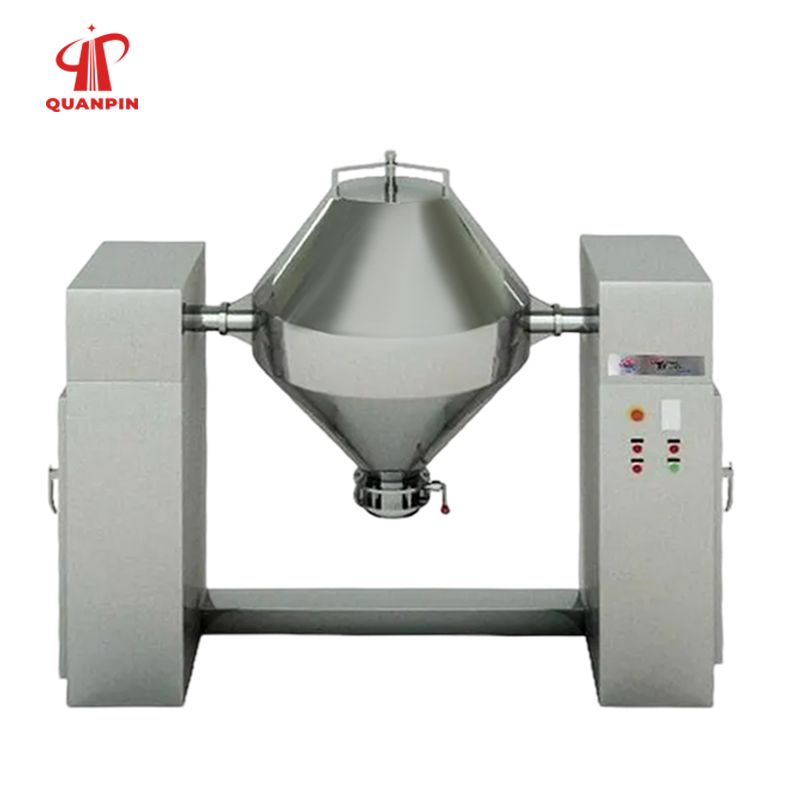
For a double cone tumble blender enquiry, describe the carrier, fine component and the bulk-composition objective. Identify any additional particle-association question.
Keep surface treatment and final-product testing within their confirmed responsibilities. They may lie outside the supplied mixer scope.
Compare the Confirmed Scope
A double cone blender price comparison should retain the actual equipment duty. Specialized coating and analytical work cannot be assumed included.
The useful conclusion identifies which scale was measured and what it demonstrates. It avoids treating bulk uniformity as a complete description of particle structure.
Frequently Asked Questions
Can an interactive mixture be bulk uniform?
No. Bulk composition can be consistent while fines are associated with carrier surfaces. These are different descriptions.
Does flowability establish mixing?
No. Fine-particle cohesion and carrier adhesion can compete, so a flow measurement alone cannot resolve the mixed state.
Does SZH duplicate specialized coating?
No. Centrifugal or rotor-based surface treatment is not the same operation as double-cone tumbling.
Is adhesion independent of the test?
No. Detachment depends on the particular force, airflow and apparatus used for evaluation.
Do these results establish clinical performance?
No. The cited studies report defined formulation and in-vitro responses, not clinical outcomes or supplied-machine guarantees.
What should the enquiry define?
Describe the bulk composition requirement and any separate carrier-association objective. Confirm the actual equipment and analytical scope.
Discuss Your SZH Mixing Application
Discuss the material, processing objective and required trials with QUANPIN. Review the equipment information and the relevant industry applications, or send an enquiry through our contact page.
Email sales@qpdryer.com or stacie@qpdryer.com. Call +86 19850785582 or contact WhatsApp +86 15921493205 to discuss the proposed scope.
For process evaluation, consider the double-cone blender for gravity-driven blending in a rotating double cone. Confirm suitability with representative material, the required product properties and the proposed process conditions.