Centrifugal Spray Dryer for Food Powders: Separate Hollow and Wrinkled Particles from Bulk Density
By QUANPIN
A centrifugal spray dryer can produce particles with similar external dimensions but different internal voids. Those differences matter when specifying food powder density.
For food processing, separate particle shape, internal cavities and packing between particles before interpreting a heavier or lighter powder container.
What Makes a Particle Hollow or Wrinkled?
Hollow particles contain cavities. Wrinkled particles have deformed surfaces. These descriptions can overlap rather than defining exclusive powder grades.
Surface images alone cannot establish cavity volume. Combine representative microscopy with a density method whose treatment of pores is understood.
Which Density Does the Specification Mean?
Bulk density divides powder mass by occupied bed volume, including spaces between particles. Tapping changes that arrangement and therefore the result.
Apparent particle density concerns individual particles. In the cited nitrogen-pycnometry protocol, closed pores remain included in particle volume; this is not pore-free true solid density.
Which Five Measurements Belong Together?
Loose Bulk Density
Loose bulk density needs a defined filling procedure. Pouring height and vessel geometry can change packing without changing the particle material.
Tapped Density
Tapped density requires a documented tapping method. Results from different tap counts should not be treated as interchangeable acceptance values.
Apparent Particle Density
Apparent particle density needs the gas, pressure and preparation protocol. Accessible pores and sealed cavities affect the measurement differently.
Particle Size Distribution
Particle size distributions reveal fines and larger fractions hidden by an average. Their mixture influences how particles fill available spaces.
Representative Microscopy
Microscopy should cover multiple fields and suitable fractions. A striking hollow particle is an observation, not a quantitative batch specification.
How Does the Drying Skin Affect Shape?
During evaporation, a concentrated outer region develops mechanical resistance. Continued volume loss can deform that region or leave a cavity.
Its response depends on formulation and drying history. A smooth exterior therefore does not demonstrate a dense interior or superior handling.
Single-droplet maltodextrin experiments found low-DE materials formed smooth particles with large cavities; higher-DE materials developed wrinkles, folds or creases.
Those droplets dried under controlled laboratory conditions. Their temperatures explain that experiment and cannot become industrial operating setpoints.
Which Trial Inputs Need Recording?
Carrier Identity
Record carrier identity and dextrose equivalent, rather than treating every maltodextrin as the same ingredient. Material behavior can differ substantially.
Feed Solids
Measure feed solids alongside the preparation method. Changing solids changes the starting droplet and its concentration history during drying.
Feed Viscosity
Describe viscosity at the actual feed temperature. A room-temperature result may misrepresent the liquid reaching the atomizer.
Atomization Conditions
Record atomization settings and resulting size distributions together. Changes in droplet formation can accompany changes in drying conditions.
Drying Air Conditions
Keep inlet and outlet air conditions separate. Neither value alone describes the complete temperature history experienced by every particle.
Sample Conditioning
Document conditioning before measurement. Moisture exchange during sampling can change handling and obscure comparisons between otherwise similar runs.
What Do Original Experiments Show?
Pilot Maltodextrin Findings
Pilot-scale maltodextrin research compared DE6, DE21 and DE38 and measured morphology alongside loose, tapped and apparent particle density.
Its lowest loose bulk density was about 351 kg/m3; another condition reached about 449 kg/m3. These observations are not supplier guarantees.
Higher inlet temperature also involved higher atomization pressure. Assigning every particle-size change to temperature alone would miss that experimental coupling.
Composition and Scale Effects
Pilot trials with maltodextrin and whey-protein mixtures associated more wrinkled particles with higher bulk density and more hollow particles with lower density.
The mixtures did not follow one universal temperature rule. Composition and faster pilot drying altered outcomes relative to slower single-droplet observations.
Use these findings to choose measurements and hypotheses. They do not establish that wrinkles always increase density for every food formulation.
Separate Density Measurements
A factorial maltodextrin experiment measured particle, loose and tapped density separately while varying air and feed conditions.
That separation is useful: one density number cannot reveal whether a change came from particle interiors or the arrangement of the powder bed.
The study used laboratory equipment and specific materials. Its numerical results should remain attached to those conditions rather than become equipment specifications.
How Can Batches Be Compared?
Compare batches after applying the same conditioning and sampling procedure. Otherwise a difference may reflect preparation rather than drying.
A bulk-density change with little particle-density change suggests investigating packing. Examine size fractions, agglomerates and filling consistency before assigning a cause.
A particle-density change warrants examining internal structure and measurement accessibility. Surface smoothness cannot confirm or exclude sealed voids.
These are diagnostic inferences, not automatic proof. Confirm the proposed mechanism with additional observations appropriate to the particular formulation.
Does Carrier Choice Change the Interpretation?
Carrier selection can change the drying window. An original allulose/fructose study compared dextrins and measured density among its outcomes.
Its accessible official abstract reports formulation-dependent yield and handling trade-offs. It provides no basis here for assigning a numerical density advantage.
What Belongs in a Food Powder Trial Brief?
A high speed centrifugal spray dryer trial brief should define the food formulation, preparation and required attributes before discussing operating adjustments.
Specify loose and tapped density separately, including units, filling method and conditioning. Add apparent particle density with a clear measurement protocol.
Include size distributions and representative images when hollow or wrinkled structure is central to the development question.
Ask how closed pores affect the laboratory measurement. Avoid relabeling an apparent-density result as true material density.
Keep formulation changes distinguishable from operating changes wherever practical. When both vary, describe the trial as a combined comparison.
Retain measurement records with sample identities. Without that connection, an attractive micrograph cannot explain a particular density result.
How Does This Inform Equipment Discussions?
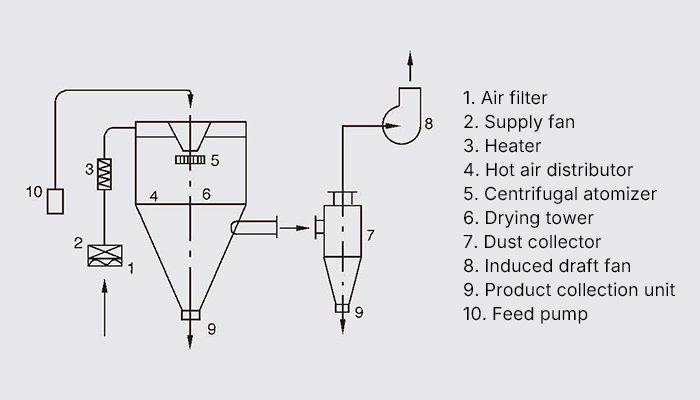
The centrifugal spray dryer working principle connects atomization, evaporation and particle formation. Formulation-specific structure still requires experimental confirmation.
For centrifugal spray dryer design discussions, provide measurement targets and feed information. Published apparatus capabilities are not QUANPIN equipment specifications.
What Should a Quotation Cover?
Compare centrifugal spray dryer price against a defined supply and trial scope. A quotation cannot guarantee a chosen hollow-particle fraction.
Send an application brief through the QUANPIN centrifugal spray dryer page and request confirmation of scope and testing arrangements.
Frequently Asked Questions
Are Hollow Particles Always Low Density?
Hollow particles contain cavities; bulk density additionally depends on packing. The relationship requires measurement rather than visual assumption.
Can Wrinkled Particles Contain Voids?
Wrinkles describe the exterior. A wrinkled particle can contain voids, so surface images do not settle its internal density.
Why Report the Tapping Method?
Tapped density reflects a defined procedure. Report tap count and method so another laboratory can interpret the value correctly.
Is Apparent Density True Solid Density?
No. Apparent particle density can include closed porosity and must not automatically be called pore-free true solid density.
Can One Temperature Guarantee Hollow Particles?
No universal inlet temperature guarantees hollow particles. Formulation, droplet formation and drying history interact, and published conditions remain experiment-specific.
Which Results Should I Send First?
Start with formulation, loose and tapped density, size distribution and conditioning. Add internal-structure analysis when cavities are the actual development target.
Discuss Your Food Powder Application
Discuss the material, processing objective and required trials with QUANPIN. Review the equipment information and the relevant industry applications, or send an enquiry through our contact page.
Email sales@qpdryer.com or stacie@qpdryer.com. Call +86 19850785582 or contact WhatsApp +86 15921493205 to discuss the proposed scope.
For process evaluation, consider the centrifugal spray dryer machine for centrifugal atomization of suitable liquid feeds. Confirm suitability with representative material, the required product properties and the proposed process conditions.