A pharmaceutical wet granulation batch begins as separate powders and ends as a cohesive population of wet agglomerates. The GHL route combines powder movement with liquid addition and mechanical breakup. Understanding those simultaneous actions helps a development team distinguish useful granule growth from localized overwetting. Lactose- or starch-containing trial blends can illustrate the work, but the actual formulation must establish suitability.
The potential advantage is bringing mixing and wet agglomeration into one vessel. That advantage depends on how the powder circulates, where binder arrives and when the batch leaves the bowl. A well-planned trial follows those events into drying and subsequent handling. It does not treat the appearance of a few satisfactory wet granules as proof that the full batch or finished dosage form will meet requirements.
- Describe each powder before charging. Note whether the blend includes fine cohesive ingredients, coarse excipient particles or components prone to lumps. Keep the supplier informed of the representative formulation and any handling restrictions. Physical differences influence circulation and wetting, even when the ingredient list remains unchanged between development batches. Discuss this step with the high shear granulator supplier. For applicable finished-drug operations, 211.87 requires the site to retest approved components as necessary after storage or exposure to adverse conditions.
- Confirm the charging sequence. Establish the order in which powders enter and how weighed portions are checked. A difficult minor ingredient may need a justified preparation step before it joins the main blend. Record that preparation so an apparently successful granulator trial does not conceal dependence on undocumented upstream handling.
- Observe dry circulation. The main mixing action should move powder through the vessel before binder addition begins. Review whether material collects around accessible boundaries or remains in persistent lumps. This observation gives a baseline for interpreting subsequent granule growth; changing dry distribution and changing binder conditions simultaneously makes diagnosis more difficult. For applicable finished-drug operations, 211.89 requires the site to identify and control rejected components to prevent their use.
- Prepare binder consistently. Record the liquid identity and preparation sequence, including any hold before use. A binder that has separated or changed during storage can produce a different wet mass. The granulator cannot compensate reliably for an undefined liquid input, so include the binder preparation vessel in the development discussion. Discuss this step with the high speed mixer granulator supplier.
- Follow liquid entry into the moving bed. Determine whether the proposed addition arrangement distributes binder across circulating powder or creates a local wet patch. Observe the result through suitable approved methods. The relevant question is how the liquid reaches fresh powder repeatedly, rather than simply whether the required total quantity entered the bowl. For applicable finished-drug operations, 211.100 requires the site to follow approved written production and process control procedures.
- Interpret the chopper contribution. Breakup action can limit persistent wet lumps while mixing continues. Compare the granule population with the intended action instead of assuming that more breakup always improves the result. Excess fines and oversized agglomerates should be assessed together because both can affect subsequent drying and sizing.
- Track the approach to the endpoint. Take development samples at defined stages using a suitable safe method. Relate appearance and handling to available process observations and laboratory results. A damp cohesive mass can continue changing with further working, so the endpoint needs a formulation-specific rationale rather than a visual habit alone. Discuss this step with the High-Speed Mixing Granulator supplier. For applicable finished-drug operations, 211.101 requires the site to control component weighing and addition under the specified procedures.
- Inspect discharge completeness. Observe material leaving the bowl and identify any residue that follows later or remains attached. Treat that retained portion as process information rather than ignoring it in the yield calculation. Uneven recovery can give the dryer a sequence of fractions with different histories and physical properties.
- Transfer wet granules deliberately. Avoid unnecessary accumulation while waiting for the dryer and record relevant holding conditions. Wet starch-containing or other aqueous blends may change during the wait. The trial should therefore connect the granulator endpoint to the actual transfer interval instead of testing only an immediately dried laboratory sample. For applicable finished-drug operations, 211.103 requires the site to calculate actual and theoretical yields at appropriate manufacturing phases.
- Assess the dried population. Compare fines, larger pieces and representative intermediate particles after the selected drying and sizing operations. Wet appearance alone cannot establish dried strength or downstream suitability. Use the intended subsequent process, such as blending for tablets, to define which material properties require investigation. Discuss this step with the rapid mixer granulator supplier.
- Demonstrate cleaning access. Examine the bowl, mixing components, chopper region and discharge assembly through the approved maintenance procedure. Ask how residues are found and removed before another campaign. A combined process vessel offers little practical benefit if product retention makes changeover difficult for the intended formulation range.
- Specify the demonstration around decisions. Ask QUANPIN for a trial that links charging, binder distribution, endpoint and discharge to recovered dried granules. Provide the real blend and planned downstream operation. Base selection on documented material behavior and practical operation, with agreed criteria instead of transferring a recipe from an unrelated product.
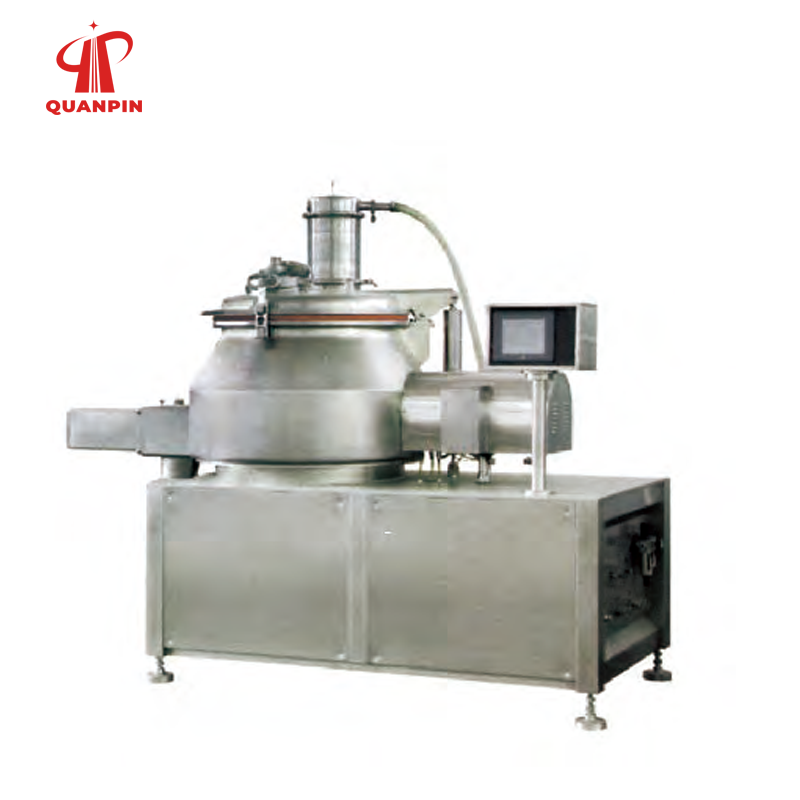
Discuss your material and production route with QUANPIN. Review the corresponding equipment information before arranging a material trial.
YANCHENG QUANPIN MACHINERY CO.. LTD
Sales Manager – Stacie Tang
MP: +86 19850785582
Tel: +86 0515-69038899
E-mail: stacie@qpdryer.com
WhatsAPP: 8615921493205
https://quanpindrying.en.alibaba.com/
Address: Jiangsu Province, China.