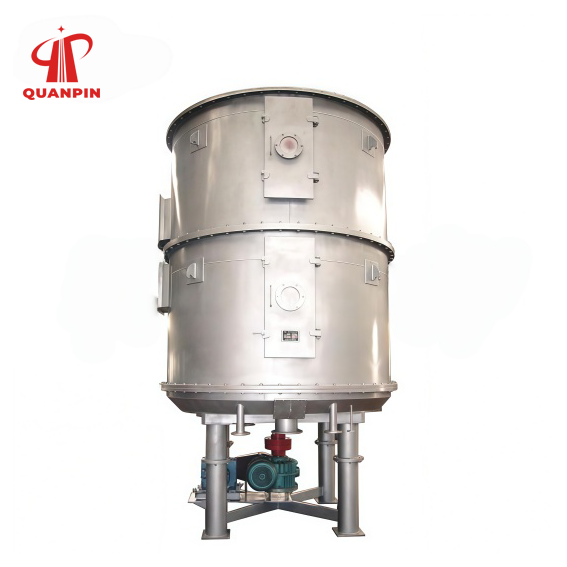
A filter cake can change character several times before it leaves a dryer. The stacked-plate PLG arrangement addresses that journey through heated surfaces and scraper-driven movement between levels. For a pharmaceutical intermediate, selection therefore starts with the relationship between cake preparation, surface contact and solids transfer. A representative trial should expose difficult feed conditions as well as the convenient, freely flowing fraction.
The practical attraction is continuous progression through an indirectly heated drying path. Its value depends on keeping the actual material moving while removing the evaporated liquid appropriately. QUANPIN distinguishes vertical drying from horizontal disc-and-shaft arrangements on its page; the discussion below concerns the stacked-plate route. None of these observations establishes a validated recipe or a guaranteed drying result.
- Define the filter-cake envelope. Collect examples from different filtration endpoints rather than submitting only the driest available sample. Record visible lumps, liquid identity and storage history. A cake that stands overnight may enter the dryer differently from a freshly discharged cake, so both conditions deserve attention when they occur in production. Discuss this step with the Continuous Disc Dryer supplier. For applicable finished-drug operations, 211.68 requires the site to include applicable instruments in a written calibration and inspection program.
- Connect cake breakup to feeding. Decide how large masses will reach a manageable form before admission. Compare the prepared feed with the original cake to identify whether breakup produces fines or smearing. This stage determines what the upper drying surface actually receives and should be included in the equipment demonstration.
- Observe the first working surface. Incoming wet material must spread sufficiently to exchange heat through the disc wall. A heavy localized pile can behave differently from a moving layer. Ask for observations of distribution and retained inventory as feed conditions change, keeping personnel outside operating machinery and using approved observation arrangements. For applicable finished-drug operations, 211.80 requires the site to identify and protect incoming component lots.
- Follow the alternating transfer route. Material moving from one disc to the next must cross the intended edges without sustained accumulation. Identify the points where a damp cake changes from cohesive pieces into smaller particles. The useful advantage is organized progression; a growing deposit at a transfer boundary undermines that progression. Discuss this step with the rotary disc dryers supplier.
- Challenge the adhesive interval. Some intermediate cakes become sticky before they become friable. Preserve samples associated with that behavior and relate them to the relevant operating period. A successful run with already granular feed does not establish suitability for the more difficult part of the expected production envelope. For applicable finished-drug operations, 211.82 requires the site to maintain applicable received-component quarantine until examination or testing and release.
- Relate heating to contact. Heat reaches the solids through the working surface rather than through direct contact with the heating utility. Review utility supply and return observations alongside material movement. Avoid using a utility setting as proof of uniform product exposure, particularly when parts of the cake remain attached to a surface.
- Plan the vapor destination. Identify the evaporated liquid and the proposed collection or treatment arrangement before interpreting a drying trial. A workable solids path still needs compatible vapor handling. Compare the proposed supplied configuration with the application instead of assuming that indirect heating automatically resolves solvent recovery or containment requirements. Discuss this step with the indirect contact dryer supplier. For applicable finished-drug operations, 211.84 requires the site to sample and test applicable component lots before production use.
- Keep the discharge sequence visible. Separate early discharge, established operation and the material recovered during emptying. Compare their physical condition and moisture using appropriate methods. Combining every fraction immediately can hide a troublesome transition and make a promising average look more consistent than the actual operating sequence.
- Investigate outlet handling. A dried intermediate may form bridges or release clusters even after evaporation has proceeded adequately. Use the intended receiver where practical and observe how solids leave it. Product usability includes transfer to the next operation, so include any planned milling or screening in the trial discussion. For applicable finished-drug operations, 211.86 requires the site to rotate the oldest approved component stock first unless an appropriate deviation applies.
- Assess recovery after interruption. Establish a controlled response for a feed pause or utility disturbance with the supplier and site team. Determine what material requires segregation after restart. The objective is to understand inventory and exposure during recovery, without inventing an operating response from observations made during an uninterrupted demonstration. Discuss this step with the conductive drying supplier.
- Review inspection access. Ask operators to identify the surfaces and scraper attachments they must examine between campaigns. A clean visible outlet does not establish cleanliness at internal transfer points. Include restoration and reassembly in the assessment because campaign readiness affects the practical value of a continuous processing arrangement.
- Turn observations into the purchase brief. Supply QUANPIN with representative wet intermediate, liquid information, feed preparation and the intended receiving step. Request evidence connecting feed variation to recovered solids. Select the layout and scope using that process chain, with acceptance criteria agreed for the actual material rather than borrowed from another cake.
Discuss your material and production route with QUANPIN. Review the corresponding equipment information before arranging a material trial.
YANCHENG QUANPIN MACHINERY CO.. LTD
Sales Manager – Stacie Tang
MP: +86 19850785582
Tel: +86 0515-69038899
E-mail: stacie@qpdryer.com
WhatsAPP: 8615921493205
https://quanpindrying.en.alibaba.com/
Address: Jiangsu Province, China.