A dry seasoning premix often combines a large carrier fraction with much smaller additions that determine flavor or appearance. The production challenge is to distribute those additions without allowing ingredient preparation or transfer to dominate the result. A three-dimensional motion mixer changes the orientation of its vessel through compound movement, providing a blending mechanism that deserves assessment with the actual dry formulation and intended receiving method.
For starch-based seasoning carriers, the useful starting point is a clear account of the feed. Record whether the powders flow freely, whether flavor ingredients arrive as agglomerates and whether fragile components must remain intact. Then follow the material through weighing, charging, vessel movement and discharge. This sequence reveals whether the proposed operation delivers a useful premix to the next stage rather than merely creating movement inside a vessel.
- Assess the 3D powder mixer as one operation in a prepared-powder route. Compound vessel movement changes how the bed moves and redistributes during a cycle. It does not remove the need to identify lumps, foreign material or moisture-related caking before loading. A repeatable starting condition makes comparisons between trial runs much easier to interpret and reduces unexplained differences between ingredient deliveries.
- Specify the carrier behavior when discussing a three dimensional mixer. Starch, salt and dry flavor carriers can occupy different volumes at the same mass. Their particle distributions may also differ substantially. Give the supplier representative physical information and samples rather than relying on a recipe name alone. Confirm the working load for the proposed vessel and the intended mixture.
- Use the three dimensional powder mixer to examine a defined charging sequence. Place small additions where they can enter the moving bed rather than remaining attached to a bag or loading tool. Weighing accuracy and complete ingredient transfer are separate from mixing action. Check the containers after charging so that an apparent blending problem is not actually a missing ingredient problem.
- Compare the multidirectional mixer using the final receiver as part of the trial. Movement within the vessel may redistribute the powder, while a subsequent fall can separate particles again. Collect samples over discharge and retain their sequence. That observation links the mixer assessment to the downstream packing or cooking process and exposes transfer effects that a single vessel sample could miss.
- Avoid treating additional movement as an automatic cure for poor preparation. A cohesive flavor lump may survive while the surrounding carrier continues to move. If agglomerates are found after discharge, investigate their incoming condition and any approved upstream preparation. Compare like-for-like feeds before deciding whether another cycle duration or a different blending mechanism is needed.
- Define preparation and weighing alongside mixing. The FAO feed-preparation chapter describes feed preparation and formulation operations. Its process context supports documenting ingredient preparation before interpreting a premix trial. For food seasonings, the particular formulation still needs its own assessment, including whether the carrier and minor fractions remain distributed through the intended final transfer.
- Check the powder identities before fixing the charging arrangement. CCOHS combustible-dust guidance explains combustible-dust conditions and includes examples of food powders. The practical implication is to supply the site assessment with the actual formulation and handling route. Compound vessel movement does not determine whether the surrounding charging, collection and housekeeping arrangements are suitable for those materials.
- Observe powder release during receiver changes. HSE food dust-explosion guidance discusses dust-explosion hazards in food processing and relevant precautions. A seasoning route includes surfaces and transfer points outside the mixing vessel. Review those locations with the site team, especially where ingredient fines escape during emptying, so the equipment layout reflects the complete operation rather than only the closed blending stage.
- Identify flour and enzyme additives explicitly in the recipe. HSE bakery-asthma guidance identifies these bakery materials as occupational-asthma concerns. Where a seasoning carrier contains either, bag opening and weighing deserve attention before the vessel starts moving. The chosen handling arrangement should address these tasks as part of the production sequence and be reviewed using the actual ingredient information.
- Use the charging method to limit unnecessary flour disturbance. The HSE flour-handling leaflet addresses dust control when working with flour. For a flour-containing premix, examine the height and manner of transfer into the vessel and the positioning of the receiving container. These are practical handling decisions; they do not establish a blend-uniformity result or a model-specific production capability.
- Measure the property that makes the premix useful. A colored ingredient can help observe gross distribution but may not represent a smaller, denser or more adhesive component. Agree on a suitable marker and sampling method with the production team. Keep the particle condition, transfer arrangement and sampling sequence consistent while comparing candidate operating settings.
- Send QUANPIN a process brief containing the formulation categories, occupied volume, minor-addition proportion, preparation steps and receiver arrangement. Include the required downstream consistency and any fragile-particle constraint. Ask for an assessment using representative material and a documented discharge sequence. That produces a clearer basis for selecting the mixer configuration than a cycle-time request without material context.
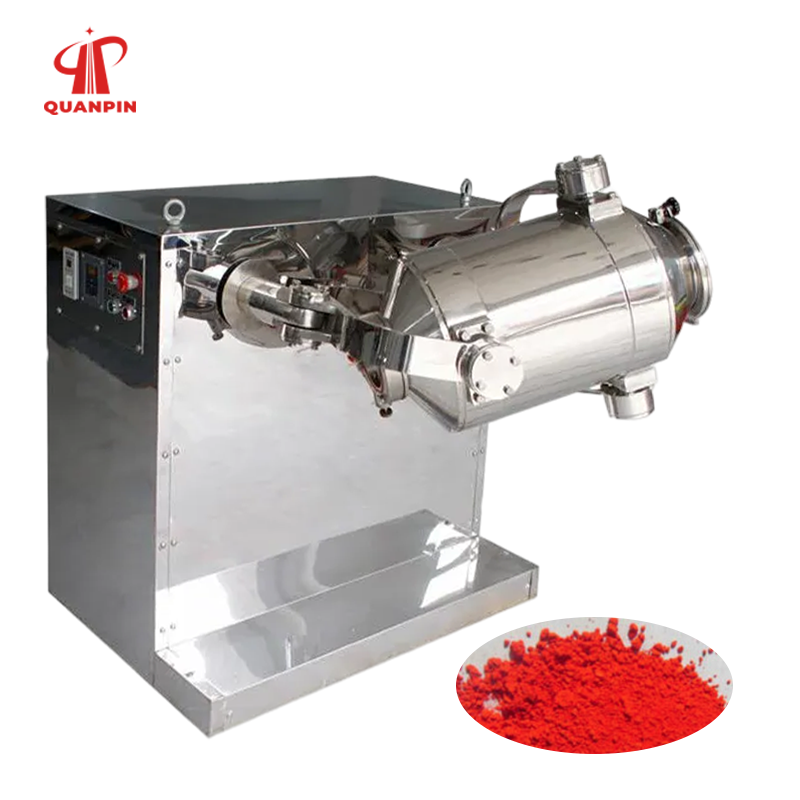
Discuss your material and production route with QUANPIN. Review the corresponding equipment information before arranging a material trial.
YANCHENG QUANPIN MACHINERY CO.. LTD
Sales Manager – Stacie Tang
MP: +86 19850785582
Tel: +86 0515-69038899
E-mail: stacie@qpdryer.com
WhatsAPP: 8615921493205
https://quanpindrying.en.alibaba.com/
Address: Jiangsu Province, China.