Sugar and starch carrier blends move through several distinct operations before they become useful bakery ingredients. The double-cone vessel addresses redistribution by tumbling a dry powder bed, while preparation and discharge determine what enters and leaves that bed. A successful production route therefore connects ingredient conditioning, measured charging, vessel movement and controlled collection. Each stage has a different job, and none should silently compensate for an unsuitable preceding stage.
For a bakery carrier application, begin with the composition and physical condition of the ingredients. Sugar crystals, starch particles and minor powdered additions may differ in density, size and tendency to cling. The assessment below follows a batch from incoming containers to the next mixer or packing station. Its purpose is to identify a workable process window using representative material, rather than to prescribe an unsupported universal mixing time.
- Choose the double cone blender around the movement required by the recipe. As the shell rotates, the powder bed changes orientation and portions move under gravity. That provides a route for redistributing freely moving ingredients without relying on an internal ribbon. Cohesive lumps still need a separate preparation decision; rotation alone should not be assumed to break them into their original particles.
- Prepare the carrier before charging the double cone mixer. Inspect bags for compacted material and document any screening step used to remove oversize pieces. A screen should suit the ingredient and its intended particle distribution. Discarding large particles indiscriminately could change the formulation, so investigate whether an oversize fraction represents agglomeration, foreign matter or an intentional ingredient feature.
- Use occupied volume to plan the double cone powder mixer load. A mass target does not describe the space taken by a fluffy starch compared with a dense sugar fraction. The bed needs room to change position during rotation. Ask the supplier to confirm a suitable working volume for the actual mixture, then keep both mass and volume information in the trial record.
- Introduce minor additions deliberately in the double cone tumble blender. One possible sequence is to distribute the small ingredient through a compatible portion of carrier before adding the rest. Whether that step helps depends on the ingredient and its adhesion behavior. Compare measured samples from the resulting batch rather than judging distribution from color or surface appearance alone.
- Separate mixing from downstream segregation. A blend can redistribute again when it falls into a tall receiver or flows through an uneven outlet arrangement. Observe the receiving operation and collect early, middle and late discharge samples. This connects the blending assessment to the material actually supplied to the following process, where consistency has practical value.
- Treat powder preparation as a formulation variable. The FAO feed-manufacturing chapter discusses grinding, mixing and other feed-manufacturing operations. Its discussion of ingredient characteristics provides background for examining particle-size differences in a carrier blend. For bakery materials, record the incoming ingredient condition and any preparation step before comparing different rotation periods or loading sequences.
- Plan flour-containing charging tasks with operators. HSE bakery guidance identifies flour and other bakery powders as exposure concerns. That matters when a carrier bag is opened or emptied before the closed mixing stage begins. Locate weighing, charging and receiver handling together in the operating review so that reducing dust at one task does not simply shift release to the next.
- Consider how the receiver is exchanged. HSENI flour-dust guidance discusses flour dust arising from activities including mixing. A practical trial should observe the point where the discharge ends, the container is disconnected and residual powder is handled. These observations help determine the needed transfer arrangement for flour-containing products without assigning identical handling assumptions to every starch or sugar grade.
- Make recipe sequence part of the production route. CFIA allergen-control guidance explains preventive controls for unintended allergen transfer. Shared scoops, residual powder and subsequent recipes belong in the same changeover review. The engineering implication is to identify accessible product-contact areas and the required cleaning approach before the blender becomes part of a multi-recipe bakery campaign.
- Allow room for operation as well as the vessel itself. HSE food-manufacturing guidance covers safety hazards in food manufacture. Use that background when reviewing the rotating envelope, charging position and access for cleaning. The proposed layout should also show where containers wait and how operators approach the discharge, since those movements can interrupt an otherwise convenient batch sequence.
- Evaluate fragile ingredients separately from blend uniformity. Compare the incoming and discharged particle condition when the recipe includes sugar granules that must retain their form. A uniform concentration result does not establish that the particle structure remains suitable for the next operation. Retain representative material from both stages and use a relevant inspection method agreed with the production team.
- Build the inquiry from the entire route: ingredient identities, preparation method, batch volume, minor-addition sequence, receiver geometry and the required outgoing condition. Ask QUANPIN to review these details against the proposed configuration. A documented trial can then identify whether double-cone movement is appropriate and which handling changes are necessary before planning routine production.
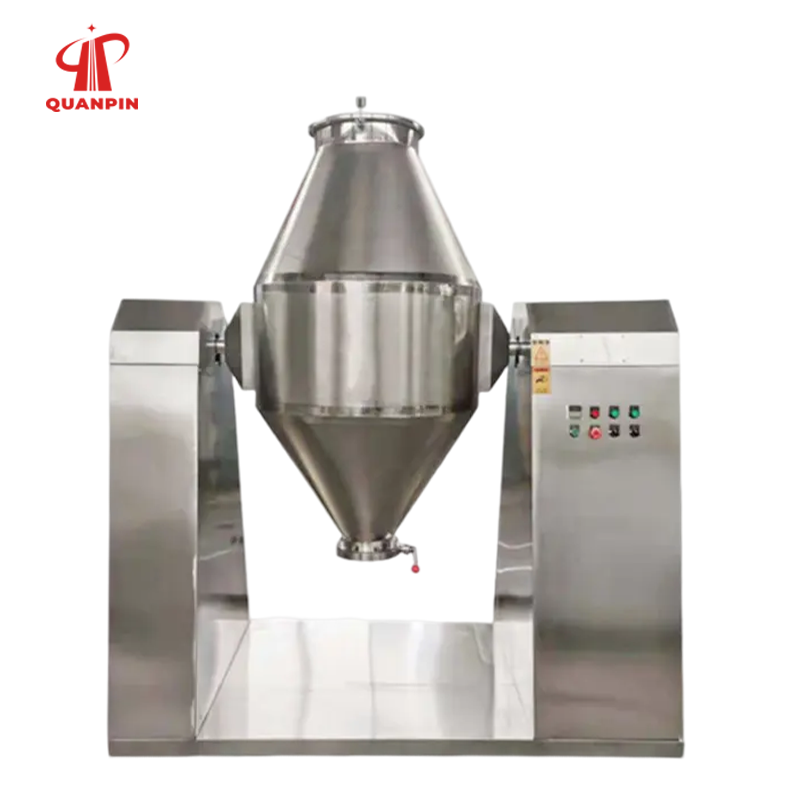
Discuss your material and production route with QUANPIN. Review the corresponding equipment information before arranging a material trial.
YANCHENG QUANPIN MACHINERY CO.. LTD
Sales Manager – Stacie Tang
MP: +86 19850785582
Tel: +86 0515-69038899
E-mail: stacie@qpdryer.com
WhatsAPP: 8615921493205
https://quanpindrying.en.alibaba.com/
Address: Jiangsu Province, China.