A production proposal for a dry falafel premix should start with the ingredient that will actually arrive at the factory and the product that must leave it. Receiving condition, preparation history and the next operation determine what useful processing means. A machine principle supplies the starting point for this discussion, while a representative trial supplies the application evidence.
This workflow follows a dry falafel premix through preparation, processing, collection and changeover. It treats the application as a development project rather than a guaranteed performance claim. The purchasing decision should connect observable material behaviour with an agreed acceptance procedure, including the material recovered at the end of the run and the work needed before another recipe can begin.
- Prepare the application brief for the ribbon blender by describing the incoming a dry falafel premix. Record supplier lot identity, physical form, storage condition and any prior treatment. Include normal variation instead of selecting only the easiest material for the demonstration. Ask the production team which changes have previously affected handling, and retain an incoming sample so differences between trial and later deliveries can be investigated.
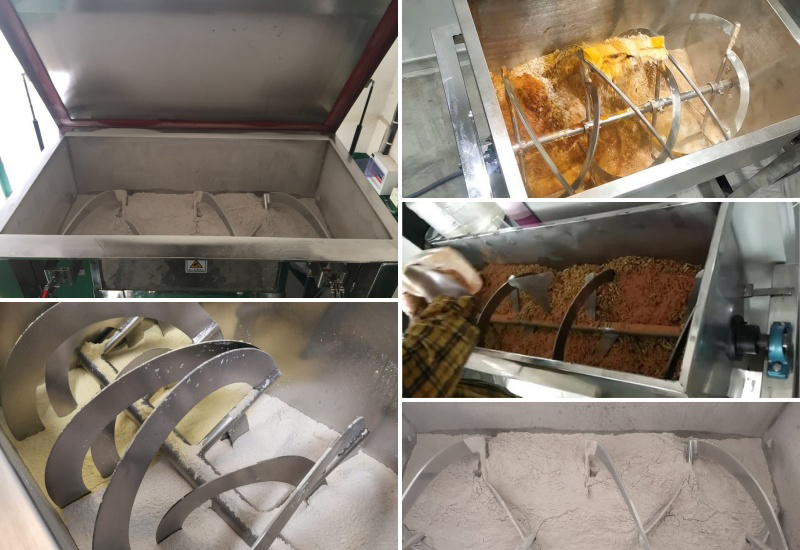
- Use the ribbon mixer discussion to follow the actual operating mechanism. Inner and outer ribbons move the batch along opposing axial paths while rotation exchanges material across the trough. This mechanical circulation brings different portions into contact. In a falafel premix, chickpea flour, salt, ground spices and herb pieces present different handling conditions. The principle explains the proposed blending action; only representative sampling can establish whether that action produces the distribution required by the recipe.
- Arrange the feed to the horizontal ribbon mixer as a controlled production task. Agree the preparation required before loading and the method for introducing successive quantities. Where a recipe has several ingredients, document their identity and addition order. Where reduction handles one ingredient, establish a consistent feed condition. Irregular charging can make observations difficult to interpret because the material and the operating duty change together.
- Assess the ribbon powder mixer through the properties the next operation needs. For a dry falafel premix, inspect representative collected material rather than relying on a single convenient scoop. Agree how samples will cover the run and where they will be taken. Record visible segregation, persistent lumps or unusual fragments as appropriate. A proposed operating adjustment should be evaluated against these observations and the agreed end-use requirement.
- Connect the outlet to a defined receiving arrangement. Name the destination container, explain how it is exchanged and decide when its contents are released for further use. Keep trial fractions separate until their disposition is agreed. This gives the proposed route a practical advantage: production staff can identify where material goes, reconcile recovered quantities and investigate retained product instead of treating collection as an unspecified final step.
- Compare the complete production cycle with the plant schedule. Loading, processing, emptying, inspection and changeover all occupy operator time and space. The preferred arrangement for a dry falafel premix should allow these tasks to proceed in a repeatable sequence. Discuss access and container handling before fixing the layout. Evaluate any suggested benefit against trial observations; do not convert a general equipment description into a capacity or quality guarantee.
- Arrange weighing, blending and packing as one identified route. For a dry falafel premix, use that guidance when assigning responsibilities at receiving and transfer. Identify the relevant operation in the plant procedure and verify how it will be performed during an ordinary batch. This reference supports the general process review; it does not verify this machine or prescribe a successful operating setting. Read the original institutional guidance.
- Where a marinade includes flour, examine the exposure created by bag opening and manual charging. Apply this context to the actual ingredient route, including containers used before and after the main operation. Check the proposed controls with the responsible plant team and retain the resulting instructions with the batch procedure. A useful application assessment considers the interfaces where operators handle material as carefully as the main processing chamber. Read the original institutional guidance.
- Identify the tasks that bring operators near the ribbon assembly, including additions, inspection and clearing retained material. Include the relevant tasks in the review for a dry falafel premix: charging, collecting, inspection and changeover. Decide who checks the condition and what happens when the check is unsuccessful. Documenting an intended practice is only the beginning; its suitability must be established for the installed arrangement and the materials that will pass through it. Read the original institutional guidance.
- Create the changeover plan from the complete ingredient declaration. Consider the implications while choosing access arrangements and writing the production method. Staff need a practical sequence for routine work and for interruptions, with the relevant responsibilities clearly assigned. Discuss the actual layout with the supplier and plant specialists. A public guidance document provides context, while installation-specific decisions still require a documented assessment. Read the original institutional guidance.
- Choose cleaning checks around the residue the formulation leaves behind. Use this evidence to define the questions asked during the acceptance review for a dry falafel premix. Include the receiving vessels and transfer tools where they affect the issue, and record the selected method and verification approach. Avoid assuming that a successful processing demonstration establishes every other aspect of production suitability. Read the original institutional guidance.
- For an application review, send QUANPIN a representative sample of a dry falafel premix, the intended finished ingredient specification and a description of the next production operation. Include the expected recipe sequence and the available collection arrangement. Agree trial observations before running the sample, then retain the accepted material and operating record. This produces a concrete basis for equipment selection and gives later production changes a reference for investigation.
Discuss your material and production route with QUANPIN. Review the corresponding equipment information before arranging a material trial.
YANCHENG QUANPIN MACHINERY CO.. LTD
Sales Manager – Stacie Tang
MP: +86 19850785582
Tel: +86 0515-69038899
E-mail: stacie@qpdryer.com
WhatsAPP: 8615921493205
https://quanpindrying.en.alibaba.com/
Address: Jiangsu Province, China.