The defining feature of this process is impeller mixing combined with chopping. Equipment selection becomes clearer when the team follows the material from preparation through the working zone and into the receiving operation. For pharmaceutical manufacturing, that route must be developed around the actual formulation. A supplier description explains the mechanism; a representative trial establishes whether the selected configuration can produce the condition required by the next stage.
This guide focuses on observable material behavior rather than unsupported output or quality promises. Establish the incoming condition, identify samples by their location or collection time, and compare physical handling with the chosen analytical endpoint. The discussion assumes an appropriately assessed pharmaceutical process. It does not establish suitability for every solvent, potent substance or regulated product, and the equipment itself does not confer regulatory approval.
- Begin with the dry powder blend. Record particle-size differences and any cohesive ingredients that resist distribution. The granulator cannot compensate automatically for an unsuitable charging sequence. Use representative pharmaceutical excipient blends and retain enough incoming material to investigate an unexpected wet-mass response after the trial. Discuss the high shear granulator when reviewing this part of the process.
- Observe circulation before adding binder. The mixing impeller should move the charge through the working zone rather than leave a persistent stationary pocket. Fill condition influences the observed pattern. Confirm the proposed working charge through testing instead of assuming every geometrically possible vessel loading behaves similarly. For finished-drug operations within its scope, 21 CFR 211.87 addresses component retesting; apply that requirement through the manufacturer’s quality system.
- Introduce binder in a controlled way. Liquid must distribute through moving powder before local wet regions grow excessively. Assess the addition location and consistency together with mixing behavior. A change in binder viscosity can alter distribution even where the total liquid quantity remains the same.
- Distinguish the impeller from the chopper. The impeller develops bulk movement, while the chopping action helps break and redistribute wet agglomerates within the working mass. Their combined effect depends on the formulation. More intense action can change granule structure, so faster operation is not automatically an improvement. Discuss the high speed mixer granulator when reviewing this part of the process.
- Watch nucleation and growth as separate developments. Small wetted clusters can enlarge as they encounter additional powder and liquid. Uneven wetting may produce large lumps while another portion remains powdery. Sampling should preserve that distribution long enough for development staff to understand the cause. For finished-drug operations within its scope, 21 CFR 211.89 addresses rejected components; apply that requirement through the manufacturer’s quality system.
- Develop a material-specific endpoint. Appearance, wet-mass consistency and a suitable operating signal may help describe the transition, but no single sign guarantees downstream success. Compare trial portions after drying and sizing. The chosen endpoint should connect the wet operation with acceptable finished granule behavior.
- Check the consequences of extended wet mixing. Continued mechanical work can alter density or create a mass that is harder to discharge and dry. Document the response during development rather than relying on an informal hand-feel judgment. Include the plausible delay between reaching the endpoint and starting discharge. Discuss the High-Speed Mixing Granulator when reviewing this part of the process.
- Observe discharge while the batch is still representative. Wet agglomerates may adhere to the vessel or outlet and leave a retained fraction. Weigh or otherwise assess recovery using an appropriate procedure. Uneven recovery can change the next batch boundary and complicate interpretation of the development results. For finished-drug operations within its scope, 21 CFR 211.100 addresses written production procedures; apply that requirement through the manufacturer’s quality system.
- Coordinate transfer to the dryer. Long drops or compressed holding can change wet granules before drying begins. Keep transfer conditions consistent between development runs so the team can interpret the granulator settings. The receiving dryer must accommodate the structure and moisture condition actually produced.
- Assess applications within a defined formulation space. High-shear wet granulation can be considered for pharmaceutical powder blends that need agglomeration before subsequent processing. Binder compatibility and the sensitivity of ingredients remain formulation decisions. Avoid converting the general mechanism into a promise of improved dissolution or tablet quality. For finished-drug operations within its scope, 21 CFR 211.101 addresses charge-in of components; apply that requirement through the manufacturer’s quality system.
- Inspect the mixing assembly after cleaning. Product may remain near seals, attachment points and the discharge boundary. Review how staff confirm correct restoration before the next charge. Mechanical access and repeatable assembly matter because changes in the working arrangement can alter the observed wetting and circulation pattern. Discuss the rapid mixer granulator when reviewing this part of the process.
- Bring the development evidence to QUANPIN. Supply powder characteristics, binder behavior, charge size and the desired dried granule properties. Request a representative trial that includes discharge and downstream drying. Select the equipment configuration using product observations and practical handling results rather than an isolated mixing demonstration. For finished-drug operations within its scope, 21 CFR 211.103 addresses calculation of yield; apply that requirement through the manufacturer’s quality system.
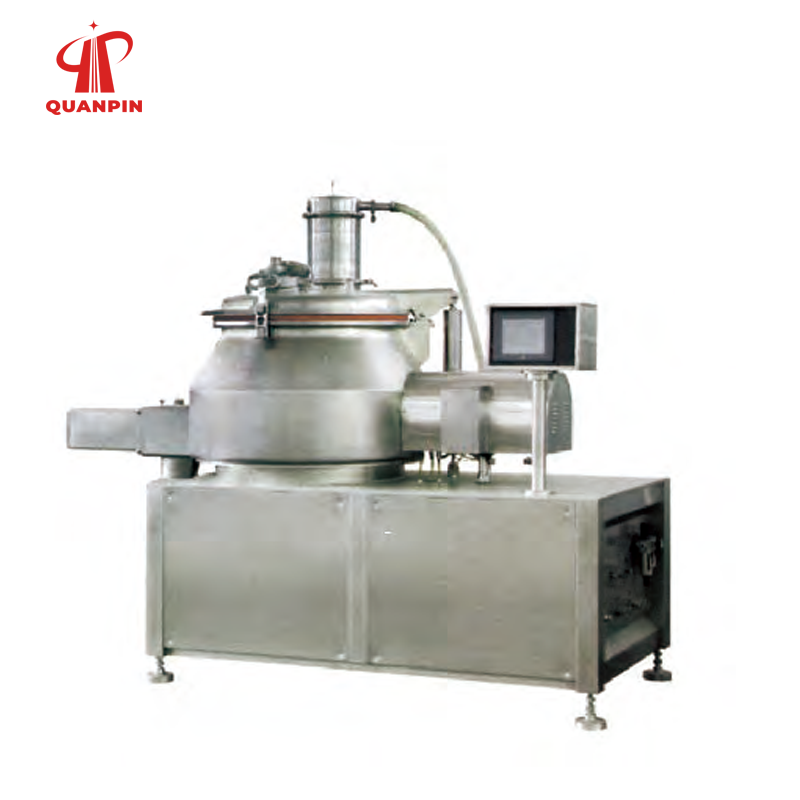
Discuss your material and production route with QUANPIN. Review the corresponding equipment information before arranging a material trial.
YANCHENG QUANPIN MACHINERY CO.. LTD
Sales Manager – Stacie Tang
MP: +86 19850785582
Tel: +86 0515-69038899
E-mail: stacie@qpdryer.com
WhatsAPP: 8615921493205
https://quanpindrying.en.alibaba.com/
Address: Jiangsu Province, China.