A dry soup premix can contain major carrier powders, strong seasoning components and small additions that must enter the batch deliberately. Ribbon blending uses opposing flows within a trough to redistribute compatible solids. A useful production workflow connects accurate ingredient preparation with charging, circulation and controlled discharge.
The following production sequence explains how the equipment fits between ingredient preparation and the next operation. Equipment-specific settings, contact materials and performance depend on the selected configuration and actual feed. Define the required product condition and the complete batch or hourly duty before finalizing the supply scope.
- Give the ribbon blender the complete formulation. Salt-rich powders, starch carriers, herbs and granular inclusions do not all have the same density or resistance to movement. Identify fragile components and ingredients that tend to form lumps. This lets the circulation duty be reviewed around the real soup base rather than a generic powder description.
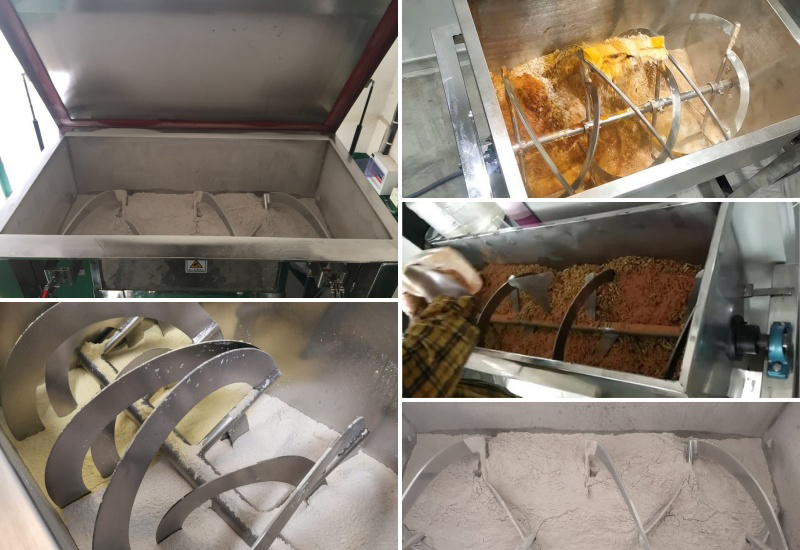
- A ribbon mixer circulates solids through inner and outer helical ribbons moving material in opposing axial directions. The circulation exchanges portions along the trough and across its working space. It is a blending action, not a substitute for every upstream preparation task. Large unwanted lumps may need separate treatment before the main batch is loaded.
- The horizontal ribbon mixer needs an agreed working fill. Batch mass alone does not describe the space occupied by a light carrier or dense seasoning mixture. Provide bulk density information with the target batch and discuss the usable volume for that configuration. Overlooking volume can create an unsuitable loading condition even when the nominal mass appears reasonable.
- Prepare small additions before they reach the ribbon powder mixer. Decide whether a low-dose seasoning needs a suitable premix or a different addition sequence. Introduce ingredients through a repeatable loading method that avoids leaving a concentrated pocket at one end of the trough. Accurate weighing and material identity remain essential even when the machine provides strong circulation.
- Consider the circulation advantage alongside ingredient sensitivity. A mechanically driven powder flow can be useful for compatible formulations that need exchange through a horizontal vessel. A delicate inclusion may respond differently from salt or starch. Confirm whether it enters with the major powders or through a separate agreed stage rather than assuming one sequence fits every recipe.
- Define discharge into the soup premix receiver. Review valve access, retained powder and the next transfer to packing or another process. If liquid flavouring is proposed, discuss its distribution and addition arrangement as a separate configuration requirement. The ability to blend a dry recipe does not establish suitability for a wetter or more cohesive formulation.
- FAO explains receiving, processing and packaging as a connected material route. A ribbon-mixing project similarly needs an identified route from ingredient weighing to finished seasoning collection. Define the minor-ingredient additions and the receiving container together so that the recipe remains identifiable throughout the complete batch cycle. Read the FAO material flow guidance for the supporting context.
- HSE discusses reducing flour exposure through ingredient choice and handling methods. Where a dry seasoning contains flour or powdered improvers, review charging and manual additions around the trough. A liquid or dust-suppressed replacement is a formulation decision that also requires checking compatibility with the selected mixer configuration. Read the HSE flour dust control guidance for the supporting context.
- WorkSafe Victoria explains how unguarded rotating mixer attachments can injure people and describes interlocked guards. Its examples concern food-preparation mixers rather than this WLDH model. The relevant design question is how loading, additions and access will prevent contact with the moving ribbon assembly in the proposed installation. Read the WorkSafe Victoria mixer guarding guidance for the supporting context.
- FDA describes shared equipment as a route for allergen cross-contact and discusses segregation, scheduling and cleaning. A seasoning recipe can contain several allergenic ingredients. Identify the complete recipe and the next product before deciding the changeover sequence; the dominant spice name alone does not describe the carryover risk. Read the FDA food allergen discussion for the supporting context.
- FDA research on retail food-contact surfaces found that cleaning effectiveness depended on the residue, surface and cleaning method. Those results do not prescribe a dry ribbon-mixer cleaning method. They support selecting and verifying a procedure for the actual seasoning residue instead of relying on a quick wipe as universal proof of allergen removal. Read the FDA allergen cleaning study for the supporting context.
- Specify a practical production cycle. Include loading, processing, discharge, inspection and changeover when discussing the required output. Give QUANPIN the complete formulation, feed condition, bulk density, target batch or hourly duty and downstream equipment arrangement. Request a configuration review with representative material before committing to the final scope. Acceptance should describe the usable product and operating conditions, rather than an unsupported promise of perfect powder or uniformity.
Discuss your material and production route with QUANPIN. Review the corresponding equipment information before arranging a material trial.
YANCHENG QUANPIN MACHINERY CO.. LTD
Sales Manager – Stacie Tang
MP: +86 19850785582
Tel: +86 0515-69038899
E-mail: stacie@qpdryer.com
WhatsAPP: 8615921493205
https://quanpindrying.en.alibaba.com/
Address: Jiangsu Province, China.