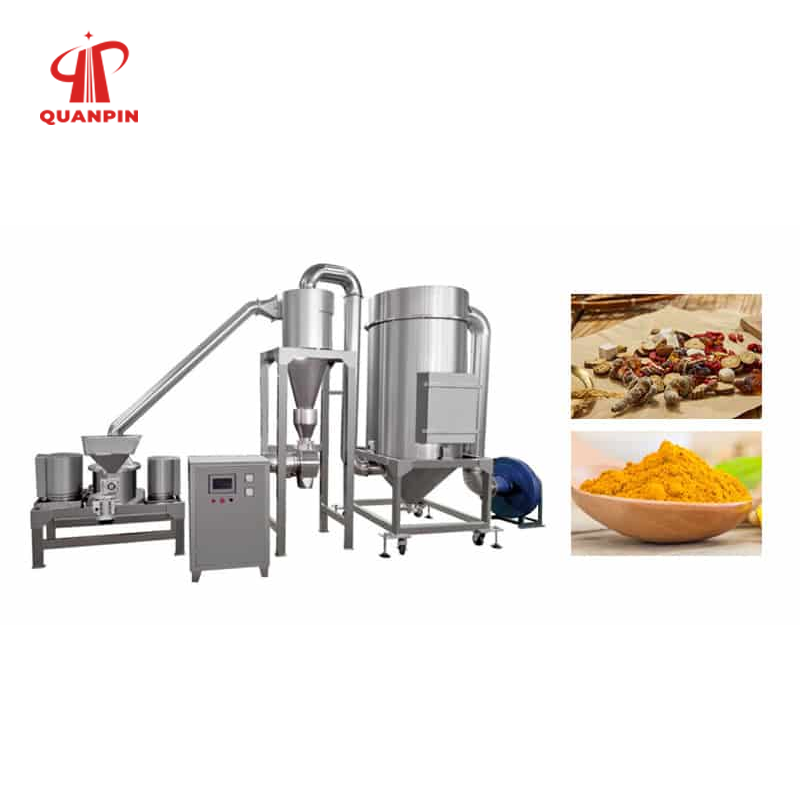
Fine milling is most useful when the accepted powder can move directly into the intended ingredient process. A WFJ line combines size reduction with a classifier that retains particles needing more treatment. Planning this route starts with a description of the incoming solids and ends with a defined receiver for the accepted fraction.
The following production sequence explains how the equipment fits between ingredient preparation and the next operation. Equipment-specific settings, contact materials and performance depend on the selected configuration and actual feed. Define the required product condition and the complete batch or hourly duty before finalizing the supply scope.
- Explain the product duty before choosing the grinding arrangement. An air classifier mill may be considered for sufficiently dry, brittle food ingredients where a finer fraction is required. Name the ingredient, its existing preparation and its next use. A powder intended for a dry blend can have different handling needs from material that will immediately enter another size-separation operation.
- Keep incoming pieces within the agreed inlet condition. A classifier does not replace upstream preparation of large fragments. If a preceding dryer discharges occasional lumps, identify whether they need separate reduction before the fine mill. Use a feeding arrangement that provides a controlled stream rather than allowing an entire container to empty suddenly into the chamber.
- The air classifying mill reduces particles mechanically in a high-speed grinding chamber. The classifier then separates the accepted finer fraction and returns oversize for additional treatment. These are connected operations: changing the amount or behaviour of solids entering the chamber changes what reaches the separation stage. The line should therefore be considered as a circuit rather than several unrelated machines.
- Follow the accepted stream into collection. An ACM mill needs a defined air-handling and product-recovery arrangement. Confirm where food powder is separated from air, how each receiver is emptied and what happens to material left in the system. This establishes a practical route to the next operation without assuming that all collected fractions are interchangeable.
- Use the fine powder grinder advantage where it fits the duty: grinding and classification take place within a connected process that gives oversize particles another opportunity for reduction. This avoids treating first-pass discharge as the final product by default. The arrangement still requires confirmation for the actual ingredient, especially when moisture, oil or temperature sensitivity changes its response.
- Close the production plan at the receiver. Decide whether the accepted fraction will enter a sieve, storage container or powder mixer and review that interface before selecting equipment. Record the maximum acceptable product condition and the intended changeover method. A finished-powder target should describe usable material in its receiving container, not merely material leaving the grinding chamber.
- Particle reduction, screening and mixing are related operations. FAO describes impact, attrition and cutting as distinct ways of reducing ingredients. This provides general process context for preparing a compatible feed; it does not establish the classification curve, output or temperature rise of a WFJ installation. Read the FAO feed milling chapter for the supporting context.
- CCOHS explains the purpose and contents of safety data sheets for hazardous products. Include available ingredient hazard information in the milling specification and communicate relevant handling precautions to operators. Do not describe the feed only as a generic food powder. An SDS is one input to the assessment, and material-specific information may still be needed. Read the CCOHS safety data sheet guidance for supporting context.
- HSE provides separate control guidance for bag opening, weighing, conveying and dust collection in flour work. Where the food recipe contains flour, assess the handling stages around the mill as well as the mill itself. A contained grinding chamber does not address every charging and emptying task. Read the HSE guidance for flour handling for the supporting context.
- Rotating machine parts and points of operation require appropriate guarding. Review access to the feeder, transmission and grinding assembly when defining the installation. A product receiver should allow routine emptying without requiring operators to reach into dangerous moving equipment. Read the CCOHS safeguarding guidance for the supporting context.
- The published 2025 edition of 21 CFR Part 117 addresses cleanable equipment and protection from contamination. For a food milling project, identify the product-contact surfaces, collection receivers and dismantling needs. Treat this as design context, not as a claim that the proposed machine is certified for a particular market. Read the US food manufacturing equipment provisions for the supporting context.
- Specify a practical production cycle. Include loading, processing, discharge, inspection and changeover when discussing the required output. Give QUANPIN the complete formulation, feed condition, bulk density, target batch or hourly duty and downstream equipment arrangement. Request a configuration review with representative material before committing to the final scope. Acceptance should describe the usable product and operating conditions, rather than an unsupported promise of perfect powder or uniformity.
Discuss your material and production route with QUANPIN. Review the corresponding equipment information before arranging a material trial.
YANCHENG QUANPIN MACHINERY CO.. LTD
Sales Manager – Stacie Tang
MP: +86 19850785582
Tel: +86 0515-69038899
E-mail: stacie@qpdryer.com
WhatsAPP: 8615921493205
https://quanpindrying.en.alibaba.com/
Address: Jiangsu Province, China.